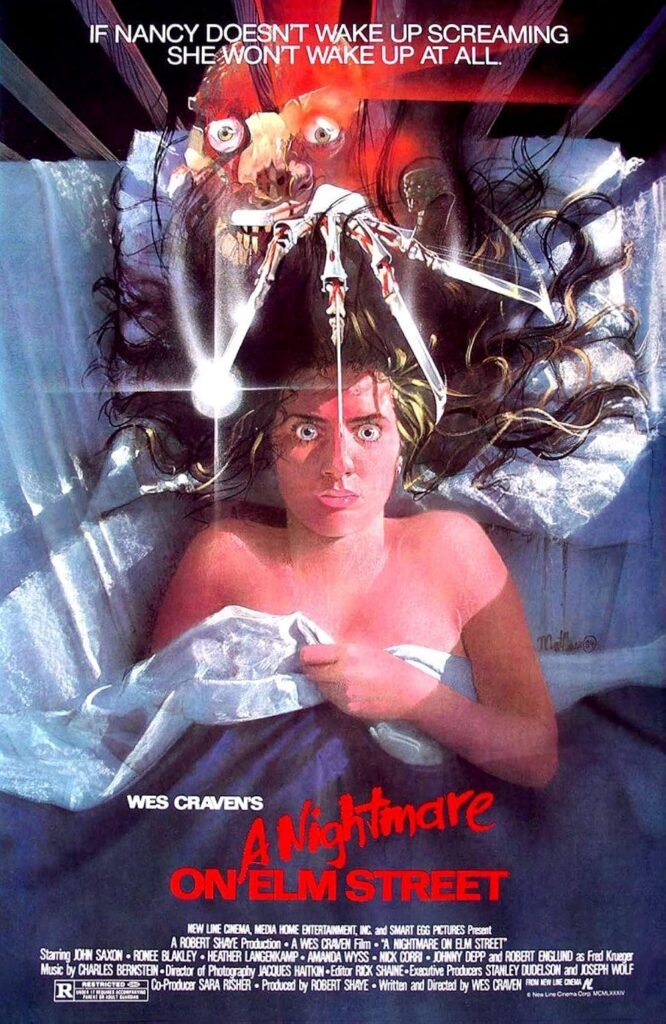
Quick Facts Panel
Director: Wes Craven
Writer: Wes Craven
Runtime: 91 minutes
Rating: R (MPAA) | 18 (UK) | R (Australia)
Budget: $1.1-1.8 million
Box Office: $57 million worldwide ($25.5 million domestic)
Subgenre(s): Supernatural Slasher, Psychological Horror, Dream Horror
CreepyCinema Scare Rating: 9/10 (Masterpiece-level terror)
The Essence
Wes Craven’s A Nightmare on Elm Street weaponized humanity’s most inescapable vulnerability—sleep itself—transforming a $1.1 million independent horror film into one of cinema’s most influential masterworks. By introducing Freddy Krueger, a razor-gloved dream demon who attacks teenagers in their nightmares, Craven created an icon rivaling Dracula and Frankenstein in cultural penetration while revolutionizing the slasher genre with psychological sophistication. This wasn’t just another masked killer stalking babysitters: it was a terrifying exploration of parental guilt, adolescent vulnerability, and the blurred boundaries between dreams and reality that saved New Line Cinema from bankruptcy and earned preservation in the Library of Congress National Film Registry as “culturally, historically, or aesthetically significant.”
Plot Synopsis
The Setup: When Dreams Become Deadly
In the fictional suburb of Springwood, Ohio, teenager Tina Gray awakens from a terrifying nightmare—a disfigured man with razor blades on his fingers chasing her through a dark boiler room. She wakes with four mysterious slashes across her nightgown. At Springwood High School, Tina shares her nightmare with best friend Nancy Thompson, Nancy’s boyfriend Glen Lantz, and Tina’s troubled boyfriend Rod Lane. Nancy reveals she’s had the same nightmare about the same burned man.
That night, seeking safety in numbers, Nancy and Glen stay at Tina’s house while her mother is away. Rod arrives uninvited, and he and Tina reconcile with passionate sex. But when Tina falls asleep, the nightmare returns with fatal consequences. Rod watches helplessly as an invisible force drags Tina up the bedroom wall and across the ceiling, slashing her brutally to death. He flees in terror and is immediately arrested for her murder.
The Descent: Reality Dissolves
Nancy experiences increasingly vivid nightmares of the burned man who identifies himself as Freddy. She falls asleep in English class and burns her arm on a pipe in the dream world—the burn manifests on her real arm when she wakes. In the film’s iconic bathtub scene, Freddy’s bladed glove emerges from the water between her legs, nearly dragging her under. Nancy visits Rod in jail, where he describes identical nightmares of the razor-fingered killer.
That night, despite Rod’s pleas for Nancy to believe him, she dreams of Freddy strangling Rod in his cell with bedsheets—staged to look like suicide. Nancy’s alcoholic mother Marge takes her increasingly sleep-deprived daughter to a sleep disorder clinic. During a monitored nightmare, Nancy enters extremely deep delta sleep where technicians observe her experiencing intense trauma. When she’s awakened, Nancy has somehow pulled Freddy’s trademark fedora into reality—physical proof that dreams are real. The hat bears a label: “Fred Krueger.”
The Climax: Facing the Dream Demon ⚠️ SPOILERS
Marge reveals the horrifying truth: Fred Krueger was a child murderer who killed at least 20 children in the Elm Street neighborhood, taking his victims to the boiler room where he worked as a maintenance man. After being caught, he was released on a legal technicality—an unsigned search warrant. Enraged parents, including Marge and Nancy’s police lieutenant father Donald, tracked Freddy to the boiler room and burned him alive in vigilante justice. Now returned as a supernatural dream demon, Freddy seeks revenge by killing the teenagers—children of those who murdered him. Marge shows Nancy Freddy’s bladed glove, hidden in the basement furnace as a trophy of their crime.
Nancy’s friends continue dying. Glen, despite promising to stay awake and help Nancy catch Freddy, falls asleep listening to music through headphones. He’s sucked into his bed, which erupts in a massive geyser of blood that covers the ceiling while his horrified parents watch. Now completely alone, Nancy researches dream manipulation and booby-traps her house using guerrilla tactics from The Anarchist’s Cookbook—gunpowder bombs in light bulbs, sledgehammer drop mechanisms, tripwire systems.
She sets her alarm for exactly 20 minutes of sleep, enters the dream world, and successfully lures Freddy back into reality where he’s vulnerable to her traps. The climactic battle moves through the house as Nancy’s preparations injure and burn Freddy. In the basement furnace room where her parents once murdered him, Nancy discovers the ultimate weapon: denying him her fear. “I take back every bit of energy I gave you,” she says, turning her back on him. “You’re nothing. You’re shit.” Freddy evaporates.
But in the controversial ending (forced by producer Robert Shaye against Craven’s wishes), Nancy’s victory may be another dream. She steps outside to find her supposedly dead friends and mother alive. She gets into Glen’s convertible, but the top suddenly comes down in Freddy’s red-and-green stripes, locking them inside. The car speeds away by itself while three little girls jump rope singing Freddy’s nursery rhyme. Freddy’s gloved arm smashes through the door’s window, grabbing Marge and dragging her into the house. The ambiguous conclusion creates lasting unease: perhaps Nancy never truly escaped the dream world at all.
The Horror Breakdown
What Makes It Scary
Primary Fear Exploited: Loss of control during sleep—humanity’s most vulnerable state. The film’s genius lies in weaponizing an inescapable biological necessity: you cannot avoid sleep forever, making doom inevitable. Freddy attacks in dreams where reality bends to his will, victims are powerless, and normal defenses fail completely.
Scare Techniques: The film employs atmospheric horror over jump scares at approximately a 90/10 ratio. With only about 11 jump scares total (mostly concentrated in the final 10 minutes), A Nightmare on Elm Street creates sustained dread through:
- Unsettling synthesizer score by Charles Bernstein creating constant unease
- Metal-scraping sounds from Freddy’s glove—immediately recognizable and spine-chilling
- Steam, shadows, and liminal spaces in boiler rooms and basements
- Red-green color scheme throughout (scientifically the most clashing colors to human vision)
- Dream logic and surrealism making audiences never certain what’s real
- Psychological torture before kills rather than immediate violence
Most Terrifying Scene: Tina’s death (approximately 12-15 minutes into the film) remains the most disturbing sequence. Shot in a specially constructed rotating room, Amanda Wyss is dragged up the bedroom wall and across the ceiling by an invisible force while being slashed to death. Rod watches helplessly, establishing that nowhere is safe and death can occur even with witnesses present. The scene required 12 frames of blood to be cut or the film would have been banned entirely. The visual rape metaphor—violent, helpless victimization—makes this more psychologically disturbing than merely graphic.
Scariest Moment (Spoiler-Free): The bathtub scene where Freddy’s gloved hand emerges from the water between Nancy’s legs represents every nightmare about something lurking beneath the surface. The phallic symbolism and violation imagery, combined with being attacked in the supposed safety of home while bathing, creates primal vulnerability that transcends typical slasher scares.
Gore & Intensity Levels
Violence Level: 7/10 — Significantly more restrained than typical 1980s slashers. The film features only four on-screen deaths (Tina, Rod, Glen, Marge) with stylized, dreamlike violence rather than exploitation gore. We rarely see blades actually penetrating flesh—the horror comes from suggestion and aftermath.
Gore Factor: 6/10 — Specific examples include:
- Tina’s wall-dragging death with slashing wounds (partially cut for R rating)
- Glen’s spectacular blood geyser erupting from his bed (500 gallons of fake blood)
- Freddy cutting his own fingers (unrealistic green blood)
- Freddy’s burned face makeup (modeled after pepperoni pizza texture)
- Various nightmare injuries that manifest in reality (burns, cuts)
The approach trusts imagination over explicit gore. Glen’s death shows the aftermath (blood covering the ceiling) without showing the victim mutilated. Required only 13 seconds of cuts total for an R rating, demonstrating restraint compared to Friday the 13th or The Texas Chainsaw Massacre.
Psychological Intensity: 10/10 — The film’s true power lies in existential dread and paranoia. The constant uncertainty about what’s real versus dreamed, the inevitability of sleep, the betrayal by parents who created the monster, and the weaponization of dreams themselves create pervasive psychological horror far more disturbing than any gore. Victims experience extreme sleep deprivation, hallucinations, and complete disorientation between waking and sleeping states.
Supernatural Elements: YES — Freddy Krueger exists as a supernatural dream demon with reality-bending powers within nightmares, ability to physically harm victims through dreams (injuries manifest on real bodies), near-omnipotence in the dream world, and apparent immortality. The film clearly establishes rules: Freddy can be brought into reality where he’s vulnerable, he requires victim’s fear as fuel, and he’s bound to Elm Street and the children of those who killed him.
Characters & Performances
Main Cast
Nancy Thompson – Heather Langenkamp
Nancy represents the quintessential “final girl”—intelligent, resourceful, and determined rather than merely lucky. Unlike typical slasher heroines who simply survive, Nancy actively investigates Freddy’s origin, discovers the truth her parents hide, and defeats him through understanding his nature rather than violence. She’s practical (booby-trapping her house with homemade weapons), resilient (enduring extreme sleep deprivation), and brave (willingly entering dreams to confront Freddy).
Character arc: Nancy transforms from normal teenager to warrior, forced to become the parent she never had when every adult fails her. She learns to trust her own perceptions over authority figures, discovers inner strength through trauma, and ultimately defeats evil through psychological warfare—denying Freddy her fear—rather than physical violence.
Heather Langenkamp’s performance won Best Actress at France’s Avoriaz Fantastic Film Festival and established the template for empowered horror heroines. Film scholar Carol J. Clover later cited Nancy as the definitive example of “final girl” theory in her influential work Men, Women, and Chainsaws. Langenkamp’s natural, non-Hollywood appearance made Nancy believable and relatable—exactly what Wes Craven wanted.
Freddy Krueger – Robert Englund
The burned child killer turned dream demon became horror’s most iconic villain through Robert Englund’s committed, nuanced performance. Freddy differs from masked slashers (Jason, Michael Myers) by having personality, humor, and the ability to speak—taunting victims psychologically before killing them. His burned face (inspired by pepperoni pizza texture), razor-fingered glove, red-and-green striped sweater, and battered fedora created an instantly recognizable silhouette.
Englund spent 2.5-3 hours in makeup per session, often waiting 6+ hours in full prosthetics. He brought surprising vulnerability to the character alongside sadistic glee, creating a villain who’s terrifying but weirdly charismatic. His performance emphasized Freddy’s “rat-like, weasel-like” qualities—appropriate for a child predator rather than imposing physical threat.
Character arc: In the 1984 original, Freddy is genuinely terrifying—minimal screen time keeps him mysterious, he’s largely silent and menacing with minimal humor, and he represents pure predatory evil. This contrasts sharply with later sequels where he became an increasingly comedic anti-hero. Englund would play Freddy in eight consecutive films plus a cameo in Jason Goes to Hell, making him inseparable from the character.
Glen Lantz – Johnny Depp
Johnny Depp’s film debut came almost accidentally when he accompanied friend Jackie Earle Haley to an audition and casting director Annette Benson noticed him. The decisive factor: Wes Craven showed headshots to his daughters, who picked Depp saying “He’s dreamy. Cast him!” Charlie Sheen was offered the part first but his agent demanded twice the $1,142 weekly wage New Line could afford.
Glen represents the typical teenage boyfriend—well-meaning but ultimately ineffective. He promises to help Nancy but falls asleep listening to music through headphones, leading to the film’s most spectacular death sequence. His character subverts typical slasher morality: despite being virginal and supportive, he still dies, proving virtue doesn’t guarantee survival against supernatural evil.
Tina Gray – Amanda Wyss
Tina serves as the sacrificial catalyst whose death drives the plot. In classic slasher tradition, she’s sexually active (having sex with Rod the night she dies) and becomes the first teenager killed. However, the film treats her sympathetically rather than punitively—her death is tragic, not karmic punishment.
Amanda Wyss’s performance during the rotating room death scene remains legendary—she experienced real vertigo that made her terror “75% real.” Her character’s vulnerability and fear feel authentic, making her death genuinely disturbing rather than exploitative.
Rod Lane – Jsu Garcia (credited as Nick Corri)
Rod represents the troubled outsider wrongly accused—the classic scapegoat. His working-class background, hot temper, and criminal record make him the perfect suspect when Tina is murdered, though viewers know he’s innocent. His desperate attempts to convince Nancy create genuine pathos.
In a 2014 interview, Garcia revealed he was high on heroin during the jail cell scene with Langenkamp—what she thought was brilliant acting was actually drug-induced incoherence. His death, staged as suicide by hanging, represents Freddy’s cruel manipulation of reality to avoid detection.
Marge Thompson – Ronee Blakley
Donald Thompson – John Saxon
Nancy’s parents represent the film’s central theme: parental failure and buried sins. Marge is an alcoholic in denial who initially dismisses Nancy’s fears, while police lieutenant Donald is divorced, distant, and ineffective. Their vigilante murder of Freddy—motivated by protecting children—created worse evil. They refuse to believe or protect their daughter until it’s too late, forcing Nancy to fend for herself against adult evil.
Standout Performances
Robert Englund’s transformation into Freddy Krueger remains the film’s performance anchor. Despite 2.5-3 hours of daily makeup application obscuring his features, Englund’s physicality, voice work, and commitment created a villain balancing genuine menace with dark personality. His approach emphasized predatory behavior—watching victims, stalking, psychological torture—rather than just murder.
Heather Langenkamp delivered authenticity rare in horror films. Her Nancy feels like a real teenager—scared but determined, exhausted but resilient. The scene where she falls asleep in class with a book balanced on her head captures genuine desperation. Her final confrontation with Freddy, where she denies him fear and power, resonates because Langenkamp makes Nancy’s emotional journey believable.
Amanda Wyss’s death scene required intense physical performance in the rotating room while experiencing real vertigo. Her genuine terror—screaming as she’s dragged up walls—makes Tina’s death the film’s most viscerally disturbing sequence.
Behind the Screams: Production
Development & Inspiration
Real Events That Inspired the Film
Wes Craven conceived A Nightmare on Elm Street while reading Los Angeles Times articles in the early 1980s about Hmong refugees mysteriously dying in their sleep. Between July 1977 and October 1981, at least 38 Southeast Asian men—healthy, young, averaging 33 years old—died during the night from what became known as Sudden Unexplained Nocturnal Death Syndrome (SUNDS), later medically identified as Brugada syndrome. The victims were Hmong, Laotian, and Cambodian refugees who had resettled in the United States after the Vietnam War.
One case particularly haunted Craven: a young Cambodian refugee who refused to sleep for days, terrified that the entity chasing him in nightmares would kill him if he fell asleep. When he finally collapsed from exhaustion, his parents heard screams from his room. By the time they reached him, he was dead. Medical examiners found no apparent cause of death—young, healthy men were literally dying of nightmares.
The Hmong communities attributed these deaths to Dab Tsog, the “Night Hag” from their folklore—a pressing spirit that appears during sleep paralysis and suffocates victims who can’t wake themselves. Craven saw the terrifying core of his story: “Here was a youngster having a vision of a horror that everyone older was denying.”
Personal Trauma: The Man in the Fedora
Craven synthesized the SUNDS deaths with his own childhood trauma. At age 10, looking out his apartment window, he saw a disheveled, drunk homeless man in a battered fedora and dirty coat stop on the sidewalk. The man looked directly at young Wes and stared at him with malevolent intensity for several minutes before shambling away. That image—the menacing stranger in the fedora—became Freddy Krueger’s visual foundation.
The villain’s name came from Fred Krueger, a childhood bully who tormented Craven. For the iconic red-and-green striped sweater, Craven consulted a 1982 Scientific American article identifying these as the two colors most clashing to the human retina—guaranteeing Freddy would be visually disturbing even in brief glimpses.
Writing and Development Hell
Craven began writing around 1981, working from a studio behind his Venice, California home while wearing a bathrobe and pith helmet, according to his then-wife Mimi Craven. He was in “desperate personal and financial straits” after Deadly Blessing and Swamp Thing underperformed at the box office. The original concept was significantly darker: Freddy was explicitly a child molester rather than murderer.
The screenplay floated around Hollywood for three years with rejection after rejection:
- Disney showed interest but wanted a family-friendly PG-13 version—Craven declined
- Paramount passed, citing similarity to their upcoming film Dreamscape
- Universal rejected it entirely; Craven later framed their December 14, 1982 rejection letter reading “Unfortunately, the script did not receive an enthusiastic enough response from us to go forward at this time”
- Even Friday the 13th director Sean Cunningham cautioned: “I don’t know if an audience is going to buy into this. Yeah, dreams are real. But at some point, you wake up.”
Craven made one crucial change during rewrites: he altered Freddy from child molester to child murderer. This decision came to avoid exploiting contemporary California child molestation cases making headlines during 1983-1984, which would have been tasteless and potentially derailed the film. The change maintained Freddy’s predatory nature while avoiding direct parallels to ongoing tragedies.
New Line Cinema: The House That Freddy Built
New Line Cinema, a struggling distribution company trying to transition into production, finally greenlit the project. Founder Robert Shaye—described by Craven as “a Fulbright scholar, an excellent chef, and very knowledgeable about the arts”—agreed to produce when no one else would. The original $700,000 budget increased to $1.1 million (some sources cite up to $1.8 million) as financing shifted chaotically.
The funding situation was precarious:
- Half the budget came from, as Shaye noted, “a Yugoslavian guy who had a girlfriend he wanted in movies”
- Four weeks before production began, an English investor contributing 40% backed out
- Media Home Entertainment stepped in with additional funding
- During the 32-day shoot (June 11 through end of July 1984), New Line’s distribution deal fell through
- Production shut down for two weeks without pay for cast and crew
- Composer Charles Bernstein completed the soundtrack but wouldn’t send it without his fee until producer Sara Risher—who had given birth just four hours earlier—convinced him from her hospital bed
Despite these near-catastrophic financial crises, filming completed. The gamble paid off spectacularly.
Filming Details
Shooting Locations
The film shot primarily in Los Angeles, California over 32 days:
- 1428 Elm Street house (Nancy’s home): 1428 North Genesee Avenue, Los Angeles—a private residence that has become a pilgrimage site for horror fans
- Tina’s house: Different Los Angeles location (not publicly identified)
- Boiler room sequences: Shot on constructed sets at a studio facility
- High school scenes: John Marshall High School in Los Feliz, Los Angeles
- Police station: Studio sets
- Sleep clinic: Studio sets with actual medical monitoring equipment
The production operated on an extremely tight schedule with minimal budget for location fees, requiring creative problem-solving and efficiency.
Production Challenges
Financial Collapse Mid-Production: The two-week shutdown without pay tested everyone’s commitment. Cast and crew continued because they believed in the project, not because they were compensated. This near-death experience for the production created a siege mentality that bonded the team.
Weather and Time Constraints: Shooting exterior scenes around Los Angeles summer heat while maintaining horror atmosphere required careful scheduling. The 32-day shoot left no room for extended delays.
Actor Availability: With such a low budget, scheduling around actors’ availability (particularly for supporting roles) required flexibility and creative shot planning.
MPAA Battles: During post-production, the MPAA initially threatened an X rating for violence. Craven had to trim approximately 13 seconds total—five seconds from Tina’s death and eight from Glen’s death—to secure an R rating. The battle to preserve the film’s horror while meeting rating requirements added stress to an already strained production.
Special Effects Techniques
The special effects team, led by Jim Doyle (mechanical effects) and David B. Miller (makeup effects), achieved remarkable results on approximately $60,000 budget—more than half devoted to the rotating room. Their ingenuity created cinema’s most memorable practical effects through creative problem-solving rather than expensive technology.
The Rotating Room ($35,000): Inspired by Fred Astaire’s ceiling dance in Royal Wedding, the room rotated 360 degrees on axles, manually operated by four stagehands. Wes Craven and cinematographer Jacques Haitkin were strapped into Datsun B-210 car seats mounted to the wall while filming. All furniture and props were nailed down. The room enabled Tina’s wall-dragging death and Glen’s blood geyser, later rented out for other productions including Breakin’ 2: Electric Boogaloo.
Freddy’s Glove: Three versions were created:
- “Hero Glove”: Full copper and stainless steel for close-ups requiring actual cutting ability ($200 to construct)
- Two “Stunt Gloves”: Plastic parts and wooden blades for safety during action sequences
The glove’s design came from Craven’s desire to make the weapon feel like “a horrible extension” of Freddy’s body—fingers with blades rather than a separate weapon.
Makeup Effects: David B. Miller designed Freddy’s burned face based on photographs of burn victims from UCLA Medical Center. The final inspiration was unexpected: pepperoni pizza. Miller noticed the textured appearance while eating dinner and realized it perfectly captured the scarification effect needed. The design showed deeper scarring with exposed muscle sinew rather than melting flesh. Application took 2.5-3 hours per session, with Robert Englund often waiting 6+ hours in full prosthetics between takes.
Blood Effects: The production used over 500 gallons of fake blood—actually red-dyed water rather than corn syrup for proper flow characteristics. Glen’s death alone used the entire 500 gallons in one take.
Budget Constraints and Advantages
The low budget forced creativity:
- Minimal retakes: Film stock was expensive; scenes needed to work in few takes
- Practical effects over optical: In-camera tricks were cheaper than post-production effects
- Limited shooting days: The 32-day schedule meant efficient planning
- Unknown cast: Hiring unknown actors (including Johnny Depp’s debut) kept costs down
However, constraints bred innovation. The team couldn’t afford expensive effects, forcing them to develop iconic practical solutions—spandex wall, rotating room, simple but effective makeup—that remain more memorable than CGI-heavy modern horror.
Director’s Vision
Wes Craven approached A Nightmare on Elm Street with specific goals that elevated it above typical slashers:
Dream Logic Over Conventional Narrative: Craven wanted to recreate how nightmares actually work—bizarre juxtapositions, physics-defying imagery, seamless transitions from normal to surreal, familiar spaces becoming alien. He studied Freudian and Jungian dream theory, eastern philosophy, and his own nightmares to achieve authentic dream mechanics rather than just using dreams as a gimmick.
Psychological Horror Over Gore: Coming from an academic background (Master’s in Philosophy and Writing, former humanities professor), Craven prioritized existential dread over exploitation violence. He wanted audiences terrified of sleep itself—making an inescapable biological necessity into a death sentence.
Social Commentary: The film critiques Reagan-era “family values” hypocrisy, showing nuclear families as dysfunctional, respectable communities hiding vigilante murder, and “Morning in America” optimism as nightmare. The class commentary positions working-class Freddy (boiler room) attacking privileged suburbanites.
Empowered Female Protagonist: Craven deliberately made Nancy intelligent and proactive rather than a passive victim. She investigates, discovers truth, and defeats Freddy through understanding his nature—not luck or male rescue. This feminist approach influenced horror for decades.
Talking Villain with Personality: Craven wanted to differentiate Freddy from masked, silent killers (Jason, Michael Myers): “A lot of the killers were wearing masks…I wanted my villain to have a mask, but be able to talk and taunt and threaten. So I thought of him being burned and scarred.”
The conflict with producer Robert Shaye over the ending revealed their different visions. Craven wanted Nancy to simply defeat Freddy and wake to an ambiguous morning suggesting “life is sort of dream-like too”—philosophical rather than sequel-baiting. Shaye demanded Freddy return for franchise potential. The compromise satisfied neither but enabled the sequels that built New Line Cinema.
Technical Mastery
Cinematography
Jacques Haitkin served as director of photography, achieving remarkable polish on the modest budget. The Washington Post praised the cinematography as “crisp and expressive” and “extraordinarily polished”—unusual acclaim for low-budget horror.
Visual Style: Shot on 35mm film with Arriflex cameras in 1.85:1 aspect ratio, Haitkin employed predominantly low-key lighting creating dark, shadowy atmospheres perfect for horror. He strategically used color temperature and lighting ratios to distinguish dream states from reality.ential example of “final girl” theory in her influential work Men, Women, and Chainsaws.
Robert Englund’s casting as Freddy Krueger came after David Warner dropped out due to scheduling conflicts. Craven initially wanted “a big, giant man” for the role and considered Kane Hodder (later Jason Voorhees). But Englund impressed by darkening his lower eyelids with cigarette ash on the way to his audition, slicking his hair back, and posing like Klaus Kinski’s Nosferatu. A friend had advised him to act “rat-like, weasel-like” because “when we read about abusers and molesters in the newspaper, they’re not big, hulking men, but weasels.” Craven recalled: “He wasn’t as tall I’d hoped, and he had baby fat on his face, but he impressed me with his willingness to go to the dark places in his mind. Robert understood Freddy.”
The makeup application took 2.5-3 hours per session, with Englund often waiting 6+ hours in full prosthetics. David B. Miller designed the burned face based on photographs of burn victims from UCLA Medical Center, but the final inspiration was unexpected: pepperoni pizza. Miller noticed the textured appearance while eating dinner and realized it perfectly captured the scarification effect he needed. The design showed deeper scarring with exposed muscle sinew rather than melting flesh, creating a grotesquely realistic appearance that remains disturbing four decades later.
Johnny Depp’s film debut happened almost accidentally. He accompanied friend Jackie Earle Haley (who would later play Freddy in the 2010 remake) to an audition when casting director Annette Benson noticed him. The decisive factor: Craven showed his daughters a set of headshots, and they picked Depp, saying “Dad, he’s dreamy. Cast him!” The role was originally written for a “big, blond, beach-jock, football-player guy” but changed after Depp was cast. Charlie Sheen was offered the part first but his agent demanded twice the weekly wage of $1,142, which New Line couldn’t afford. Sheen himself later admitted he turned it down because he “didn’t get it,” telling Craven: “I just don’t see this guy wearing a funny hat with a rotted face and a striped sweater and a bunch of clacky fingers. I just don’t see this catching on.” The scene where Glen kisses Nancy is considered Johnny Depp’s first on-screen kiss.
Amanda Wyss as Tina Gray created the film’s most iconic death sequence. During the rotating room filming, she experienced real vertigo—the terror was “75% real,” she later said. No separate auditions were held for Tina and Nancy; actresses read for Nancy first, then were paired for chemistry. Craven “decided immediately upon mixing Wyss and Langenkamp that this was the duo he wanted.” Jsu Garcia (credited as Nick Corri) played Tina’s boyfriend Rod Lane while dealing with personal struggles. In a 2014 interview, he revealed he was high on heroin during the jail cell scene with Langenkamp. She thought “his eyes were watery and they weren’t focused” meant he was giving “the best performance of his life,” not realizing the unintended authenticity. John Saxon as Nancy’s police lieutenant father and Ronee Blakley as her alcoholic mother completed the ensemble, representing the damaged, incompetent adults whose vigilante justice created the monster now targeting their children.
Technical mastery: How dreams were filmed
Jacques Haitkin’s cinematography achieved remarkable polish on the modest budget, earning praise from The Washington Post as “crisp and expressive” and “extraordinarily polished.” Shot on 35mm film with Arriflex cameras in 1.85:1 aspect ratio, Haitkin employed predominantly low-key lighting creating dark, shadowy atmospheres. He strategically used blue tones to distinguish dream states from reality: light blue shades appeared in early dream sequences denoting relaxation, while dark blues and blacks signaled deeper REM sleep and imminent nightmares. This color coding was particularly evident in Tina’s nightmare and Nancy’s sleep clinic sequence, where blue tones progressively darkened through each sleep cycle stage.
Charles Bernstein’s electronic score became iconic despite being composed with home recording equipment. Using synthesizers including Yamaha DX-7, Oberheim OB-SX, Roland Juno-106, and a tiny Casio keyboard, Bernstein created an “eerie, music-box quality” with a ten-note main melody. Boss guitar pedals processed his falsetto voice for ghostly, otherworldly vocal effects heard throughout. The score’s lo-fi aesthetic perfectly matched the film’s dreamlike atmosphere. Interestingly, the jump-rope melody wasn’t composed by Bernstein but by Alan Pasqua, Heather Langenkamp’s boyfriend at the time, later integrated into Bernstein’s score.
The special effects work—accomplished on approximately $60,000 budget—remains impressive four decades later. Jim Doyle served as mechanical special effects designer, with David B. Miller handling makeup effects. The production used over 500 gallons of fake blood (actually red-dyed water for proper flow characteristics). Their ingenuity created cinema’s most memorable practical effects through creative problem-solving rather than expensive technology.
The rotating room for Tina’s death scene cost $35,000 to construct—more than half the effects budget. Inspired by Fred Astaire’s ceiling dance in Royal Wedding, the room rotated 360 degrees on axles, manually operated by four stagehands. Wes Craven and Jacques Haitkin were strapped into Datsun B-210 car seats mounted to the wall while filming. All furniture and props were nailed down. As the room rotated, Amanda Wyss appeared to be dragged up walls and across the ceiling by invisible forces while being slashed. Wyss experienced intense vertigo, but the purely gravity-based practical effect created one of horror cinema’s most unforgettable images. The room was later rented out for other productions including Breakin’ 2: Electric Boogaloo.
Glen’s death scene—the blood fountain erupting from his bed—became the film’s most spectacular effect, partially due to a near-catastrophic accident. Using the same rotating room completely inverted with the bed positioned at the top, a sheet-lined chute was carved through the bed’s center. Crew positioned outside and “above” the inverted room began pouring 500 gallons of blood-water through the hole. What happened next created cinematic magic: the water hit the ceiling lights and became electrified. The crew member pouring was electrocuted, the electrified sloshing water threw off the room’s weight distribution, and operators lost control of the rotation. The room spun uncontrollably in darkness with cables ripping from rigging while blood poured everywhere. Craven and Haitkin remained strapped in their seats, spinning upside-down covered in blood and electrical sparks for approximately 20 minutes until all liquid poured out and they could be freed.
Miraculously, no one was seriously injured and they captured the footage. The malfunction created surreal, gravity-defying blood streams more nightmarish than anything they could have planned—what looked like impossible dream logic was actually chaos barely contained. Craven later called it “a Ferris wheel from hell.” The MPAA threatened an X rating for the scene’s length despite Craven arguing The Shining featured a similar elevator blood scene. The extended cut showed Glen’s bloodied body emerging from the bed after the geyser, but this was cut from the theatrical release.
Freddy pushing through Nancy’s bedroom wall like elastic used ingeniously simple materials: a wall built from spandex that stretched when pressed. Effects artist Jim Doyle himself (not Robert Englund) played Freddy in this scene, pressing against the material from behind to create the illusion of Freddy trying to break through. The stretched fabric showed facial features and hands in one of the film’s most unsettling images—achieved entirely in-camera without optical tricks or post-production.
The bathtub scene built a special bottomless tub over a swimming pool, with the tub positioned over a plywood water tank 36 inches deep. Heather Langenkamp sat on two-by-four planks or on Jim Doyle’s knees for scenes requiring movement. Doyle wore scuba equipment underwater and held his breath for up to 90 seconds for takes. Craven banged on the bathtub to signal Doyle when to thrust the glove up between Langenkamp’s legs. Multiple takes were needed as the glove emerged “too far right,” “too far left,” or “way too fast.” Filming lasted 8-9 hours with significant “pruning” of Langenkamp’s skin from extended water exposure.
Additional effects included elongated arms operated by fishing lines (prop arms strapped to Englund’s real arms, lifted by handlers on upper platforms), melting stairs created with pancake mix, and Freddy walking through prison bars achieved through precise camera triangulation and rotoscope matting. For Freddy’s burning scene, stuntman Anthony Cecere performed what Jim Doyle called “the best body burn I’ve ever worked on,” keeping the fire going longer than expected until the crew worried about ceiling damage. Freddy’s iconic glove came in three versions: the “Hero Glove” with full copper and stainless steel for close-ups requiring actual cutting, and two “Stunt Gloves” with plastic parts and wooden blades for safety during action sequences.
The nightmare unfolds: Plot and mythology
The film opens with Freddy Krueger crafting his iconic bladed glove in a boiler room before teenager Tina Gray has a nightmare of being chased by a disfigured man with razor fingers. She wakes with mysterious slashes on her nightgown. At Springwood High School, she shares her nightmare with best friend Nancy Thompson, Nancy’s boyfriend Glen Lantz, and Tina’s boyfriend Rod Lane. Nancy reveals she’s had the same nightmare. That night, Nancy and Glen stay at Tina’s house for support. Rod arrives uninvited, and he and Tina have sex. When Tina falls asleep, Freddy attacks her in the dream world while Rod watches helplessly as she’s dragged up the wall and across the ceiling by an invisible force, brutally slashed to death. Rod flees and is arrested for murder.
Nancy experiences increasingly vivid nightmares. She falls asleep in English class and burns her arm on a pipe in the dream—the burn appears on her real arm when she wakes. In the iconic bathtub scene, Freddy’s glove emerges from the water between her legs. Nancy visits Rod in jail, where he describes identical nightmares. That night, Nancy dreams of Freddy strangling Rod in his cell with bedsheets, staged to look like suicide. At Rod’s funeral, Nancy’s alcoholic mother Marge takes her to a sleep disorder clinic. During a nightmare there, Nancy grabs Freddy’s fedora labeled “Fred Krueger” and pulls it into reality—physical proof dreams are real.
Marge reveals the truth in the film’s crucial exposition: Krueger was a child murderer who killed at least 20 children in the Elm Street neighborhood, taking victims to the boiler room where he worked. After being caught, he was released on a legal technicality—an unsigned search warrant. Enraged parents tracked Freddy to the boiler room and burned him alive in vigilante justice. Now returned as a dream demon, he seeks revenge by killing their teenage children. Marge shows Nancy Freddy’s bladed glove, hidden in the basement furnace as a trophy of their crime.
Glen, despite promising to stay awake and help, falls asleep listening to music through headphones. He’s sucked into his bed, which erupts in a massive geyser of blood that covers the ceiling while his horrified parents watch. Nancy, now alone, learns about dream manipulation and booby-traps her house using techniques from The Anarchist’s Cookbook: gunpowder in light bulbs, sledgehammer drop mechanisms, tripwire systems. She successfully lures Freddy from dream into reality by refusing to give him her fear. “I take back every bit of energy I gave you,” she says, turning her back on him. “You’re nothing.” Freddy evaporates.
But the ending Robert Shaye forced (against Craven’s wishes) suggests this victory was another dream. Nancy steps outside to find her friends and mother alive. She gets into Glen’s convertible, but the top suddenly comes down in Freddy’s red-and-green stripes, locking them in. The car speeds away by itself while three girls jump rope singing Freddy’s nursery rhyme. Freddy’s glove grabs Marge through the window, pulling her into the house. The ambiguous conclusion—mandated for sequel potential—creates lasting unease: perhaps Nancy never truly escaped the dream world at all.
What makes it terrifying: Horror analysis and technique
A Nightmare on Elm Street weaponizes the most inescapable human vulnerability: sleep. You cannot avoid sleep forever—doom is inevitable. The film’s genius lies in making dreams, normally uncontrollable spaces where we’re already vulnerable, into hunting grounds where normal defenses fail. Freddy exploits primary fears: loss of control (in dreams, victims are powerless against reality-bending powers), vulnerability during humanity’s most defenseless state, and adolescent anxieties about sexual awakening, parental conflict, and transitioning to adulthood without protection. Parents and authority figures can’t help—they created the monster and now deny its existence.
The film employs atmospheric horror over jump scares at a 90/10 ratio. With only approximately 11 jump scares total (mostly in the final 10 minutes), the film instead creates sustained dread through Bernstein’s unsettling synthesizer score, metal scraping sounds from Freddy’s glove, steam and shadows creating liminal spaces, and the red-green color scheme throughout. The constant uncertainty breeds paranoia—audiences never know what’s real, mirroring the characters’ disorientation. Freddy’s psychological torture before kills, slow builds allowing dread to accumulate, and dreamlike surrealism create far more fear than cheap shocks.
Most terrifying is Tina’s death, which required 12 frames of blood cut or the film would have been banned entirely. Shot in the rotating room with Amanda Wyss experiencing 75% real terror from vertigo, the scene of her being dragged up walls and across the ceiling while Rod watches helplessly establishes that nowhere is safe and death can occur even with witnesses present. The visual rape metaphor—violent, helpless victimization—makes this more disturbing than merely graphic. The bathtub scene’s phallic symbolism suggesting sexual violation, Glen’s death where imagination fills in horror more terrifying than showing it, and the wall scene where reality itself becomes unreliable complete the film’s most iconic terror sequences.
Violence remains significantly more restrained than typical 1980s slashers. With only four deaths (Tina, Rod, Glen, Marge) and a 70% psychological, 30% physical horror balance, the film rarely shows blades actually slicing flesh. We see stylized, dreamlike violence rather than exploitation. Freddy cutting his own fingers shows unrealistic green blood. Glen’s spectacular blood geyser doesn’t show the victim mutilated. The approach trusts imagination over explicit gore—suggesting horror proves more disturbing than showing. Required only 13 seconds of cuts for an R rating, the film demonstrates restraint compared to Friday the 13th or Texas Chainsaw Massacre while remaining deeply unsettling through psychological sophistication rather than graphic mutilation.
The film masters dream logic by recreating actual nightmare mechanics: bizarre juxtapositions, physics-defying imagery, seamless normal-to-surreal transitions, familiar spaces becoming alien, inability to wake, trapped/pursued feelings, and loss of agency. This isn’t just using dreams as a gimmick—Craven understood how nightmares actually work. The melting staircase (created with pancake mix), Freddy’s arms stretching impossibly across entire alleys, solid walls becoming elastic membranes, and the constant uncertainty about what’s real versus dreamed create pervasive environmental horror. The monster is inside your head, making the threat atmospheric and constant rather than momentary shocks.
Buried sins: Themes and social commentary
The film’s central theme explores how sins of parents are visited upon children, literally manifesting parental guilt as supernatural vengeance. The Elm Street parents’ vigilante murder created a monster that now hunts their teenage offspring. Yet the parents remain alcoholic, divorced, absent, incompetent—they refuse to believe or protect their children, leaving teenagers to fend for themselves against adult evil. Nancy must become the parent she never had, using intelligence and resourcefulness to defeat the threat adults either created or deny exists. This represents a profound “youth power” statement: when every institution fails (legal system let Krueger go free, vigilante justice created worse evil, police can’t help, schools are oblivious, medical establishment is useless), young people must save themselves.
Released mid-Reagan presidency in 1984, the film viciously critiques conservative “family values” ideology. Nuclear families are dysfunctional jokes. Respectable suburban communities committed murder and covered it up. Moral decay festers beneath manicured lawns. “Morning in America” optimism is revealed as nightmare. The film exposes the myth of suburban safety created by post-WWII white flight: evil comes from within the community (Freddy is local), parents themselves are the danger, homes offer no protection, and the American Dream is built on violence and lies. Class commentary positions working-class Freddy (boiler room) attacking privileged middle-class suburbanites—labor versus clean suburban homes, the “dirty” working man versus “clean” bourgeoisie.
Sexual themes permeate the narrative through Freddy as “dirty old man, nasty father”—Craven’s words—representing pedophilic menace. Originally written as a child molester, Craven changed the character to child murderer to avoid exploiting contemporary California child molestation cases during 1983-1984 production. Sexual imagery abounds: the glove emerging between Nancy’s legs, Tina’s death as rape metaphor, phallic blades, Freudian hymen-breaking imagery (curtains torn, windows broken, walls penetrated). Yet the film subverts typical slasher morality where sexuality equals death: Tina dies after sex, but Glen dies despite virginity, and Nancy survives not purely through sexual innocence but through intelligence and courage.
Sleep itself becomes a metaphor for vulnerability, surrender, and mortality. Dreams represent the unconscious, repressed trauma, and hidden truths that surface when conscious defenses drop. Staying awake equals fighting death, but proves ultimately futile—everyone must eventually sleep. The film literalizes Freudian theory of dreams as the “royal road to the unconscious,” making repression physically deadly. Parents’ repressed crime (burning Freddy) returns through children’s unconscious minds. This psychoanalytic sophistication—unusual for slashers—came from Craven’s academic background (Master’s in Philosophy and Writing, former humanities professor) and deep understanding of Freud, Jung, and Eastern philosophy regarding dreams and reality.
Praise and vindication: Critical reception and legacy
Contemporary reviews ranged from enthusiastic to cautiously positive. Paul Attanasio in The Washington Post praised it as “extraordinarily polished…halfway between an exploitation flick and classic surrealism,” calling Freddy “the most chilling figure in the genre since ‘The Shape’ made his debut in Halloween.” Variety called it “a highly imaginative horror film that provides the requisite shocks.” Kim Newman in Monthly Film Bulletin deemed it “a superior example of an over-worked genre.” Notably, Roger Ebert did not review the original positively (he generally trashed slashers), only praising Wes Craven’s New Nightmare a decade later. Leonard Maltin originally gave it 1.5 out of 4 stars, later upgrading to 2.5 stars.
The film performed moderately well commercially with minimal advertising, relying heavily on word-of-mouth. Opening in just 165 theaters, it expanded to a widest release of 380 theaters and ran for 418 days. It earned back its $1.1 million budget during the first week and ultimately grossed $25.5 million domestically and $57 million worldwide—approximately a 50x return on investment. The film’s cult following grew almost immediately after release, with strong sales and rentals on home video (released by Media Home Entertainment in early 1985) cementing cult classic status quickly.
Critical reassessment has been dramatic. Now considered one of the greatest horror films ever made, it holds 94% approval on Rotten Tomatoes. The New York Times selected it as one of The Best 1000 Movies Ever Made. In 2021, the Library of Congress selected it for the National Film Registry as “culturally, historically, or aesthetically significant.” Additional honors include #40 on AFI’s 100 Years…100 Heroes and Villains (Freddy Krueger), #17 on Bravo’s 100 Scariest Movie Moments, and #162 on Empire’s 500 Greatest Movies of All Time.
The film distinguished itself from Halloween and Friday the 13th through crucial innovations. Unlike masked, silent killers (Michael Myers, Jason Voorhees, Leatherface), Freddy could talk, taunt, and threaten—giving personality to the slasher. The dream world setting removed “safe space” concepts: victims couldn’t escape by staying away from certain locations. Higher production values and psychological depth added surrealism to the slasher formula, proving horror could be intelligent and creative. Craven deliberately wanted Freddy different: “A lot of the killers were wearing masks…I wanted my villain to have a mask, but be able to talk and taunt and threaten. So I thought of him being burned and scarred.”
Icon status: Freddy’s cultural penetration
Freddy Krueger stands alongside Jason Voorhees, Michael Myers, and Leatherface as the “Big Four” slasher icons of the 1980s. His unique characteristics set him apart: he’s the only major slasher who extensively talks, has dream-based powers allowing environmental manipulation, wears no mask (his burned face IS the mask), wields an iconic weapon (razor-fingered glove), and possesses a distinct personality—darkly humorous, taunting, sadistic. While Jason and Michael rely on brute force as “real world” physical threats, Freddy uses fear and psychological manipulation as a dream-based supernatural threat.
Robert Englund played Freddy in eight consecutive films (nine counting a brief Jason Goes to Hell cameo), becoming forever associated with the role. The character achieved remarkable cultural penetration. As Englund stated in Wes Craven’s New Nightmare: “Every kid knows who Freddy is. He’s like Santa Claus, or King Kong.” The jump rope rhyme became embedded in pop culture, appearing in children’s playgrounds and referenced endlessly:
“One, two, Freddy’s coming for you / Three, four, better lock your door / Five, six, grab your crucifix / Seven, eight, gonna stay up late / Nine, ten, never sleep again.”
The character inspired international film derivatives including Bollywood’s Mahakaal (1993), appeared in video games (Call of Duty: Black Ops, Dead By Daylight, Mortal Kombat 9), earned musical tributes (Will Smith’s “A Nightmare On My Street”), and became a cultural reference point in The Simpsons, Rick and Morty, and countless other media. The character evolved significantly across the franchise, however, transforming from genuinely terrifying in the original to increasingly comedic in sequels.
In the 1984 original, Freddy was “just plain genuinely terrifying”—minimal screen time kept him shadowy and mysterious, largely silent and menacing, with no humor. By Parts 4-6, he’d become a “cartoonish caricature” cracking one-liners and jokes, an anti-hero figure. The 2010 remake producers explicitly stated they were “abandoning the things that made the character less scary—Freddy would not be ‘cracking jokes'” to focus on “crafting a horrifying movie.” Many fans consider Dream Warriors (Part 3) the best sequel for balancing horror and personality, while Parts 5-6 lost the fear factor entirely by making Freddy too familiar and comedic.
Franchise explosion: Sequels and beyond
The franchise spawned eight sequels plus a remake, generating $472 million worldwide across all films. Freddy’s Revenge (1985) earned $29.9 million but received negative reviews initially (later gaining cult status for homosexual subtext). Wes Craven refused to work on it, never having intended a franchise. Dream Warriors (1987) brought Craven back as co-writer, introducing the “Dream Warriors” concept and earning $44.2 million with mixed-to-positive reviews that many believe saved the series. The Dream Master (1988) became the highest-grossing horror film of 1988 at $49.9 million. The Dream Child (1989) took a darker, Gothic tone but box office declined to $22.2 million.
Freddy’s Dead: The Final Nightmare (1991) became New Line’s first 3D film, earning $34.5 million despite very negative reviews. It featured Johnny Depp’s cameo parodying “This is your brain on drugs” PSAs. Wes Craven’s New Nightmare (1994) offered meta-horror where cast played themselves and Freddy escaped into the “real world,” earning mixed-to-positive reviews but poor box office ($18.3 million). This influenced Craven’s later Scream (1996), which revived the horror genre through self-aware commentary. Freddy vs. Jason (2003) arrived 11 years later as a fan-pleasing crossover. The 2010 remake with Jackie Earle Haley as Freddy earned $63.5 million but received very negative reviews, with many fans considering it the worst franchise entry. No sequel materialized.
Television expanded the universe through Freddy’s Nightmares (1988-1990), an anthology series hosted by Freddy in Twilight Zone style format. The show ran 44 episodes over two seasons in syndication. The extended universe includes 12 novels, multiple comic book series, video games, and extensive merchandise including toys, dolls, and costumes. As of 2019, film rights reverted to Wes Craven’s estate, which began working on project pitches for both feature films and potential HBO Max series. As of 2023, development is described as “in limbo” as New Line prioritizes The Conjuring Universe.
Behind the screams: Production trivia and secrets
The film’s genesis involved three years of studio rejections before New Line picked it up. Disney wanted a PG-13 version for children. Paramount passed. Universal rejected it—Craven framed their December 14, 1982 rejection letter reading “Unfortunately, the script did not receive an enthusiastic enough response from us to go forward at this time.” Even Friday the 13th director Sean Cunningham warned Craven audiences wouldn’t buy the concept. At one point during filming, cast and crew worked for no money because Robert Shaye ran out of funding. Composer Charles Bernstein completed the soundtrack but wouldn’t send it without his fee until producer Sara Risher (who had given birth just four hours earlier) convinced him.
The controversy over the ending created lasting tension between Craven and Shaye. Craven wanted Nancy to simply defeat Freddy and wake up to a philosophical, ambiguous morning suggesting “life is sort of dream-like too.” Shaye demanded Freddy in the driver’s seat with kids screaming—”very negative,” Craven said. The compromise featured the convertible top slamming down in Freddy’s red-and-green stripes and Marge pulled through the door window by Freddy’s hand. This dummy-pull effect was admittedly ridiculous-looking—”everybody on set was laughing”—but “amused us all so much, we couldn’t not use it.” This forced ending enabled the franchise but caused lasting friction. Craven, who “never wanted the film to be an ongoing franchise,” didn’t work on the sequel.
Cross-franchise references include The Evil Dead appearing on a TV in the film (Sam Raimi had featured a Hills Have Eyes poster in Evil Dead). Raimi later put a Freddy glove in Evil Dead II and Ash vs Evil Dead. The name “Elm Street” was chosen both because Craven taught on Elm Street in Potsdam, New York before becoming a screenwriter, and because President Kennedy was assassinated on Elm Street in Dallas, Texas—representing “where the innocent world ended.” Lin Shaye (Robert Shaye’s sister) played the teacher in the classroom scene. Mimi Craven (Wes Craven’s then-wife) played a nurse at the sleep clinic.
The MPAA required two cuts totaling 13 seconds for an R rating rather than X. Five seconds were cut from Tina’s death scene and eight from Glen’s death. The uncut version was only available outside the United States for decades. Glen’s death was gradually restored (six seconds for initial home video, remaining two for subsequent DVDs), but Tina’s death remains censored to this day in U.S. releases. The film was released uncut in the United Kingdom both theatrically and on home video. The 1996 Elite Entertainment Laserdisc became the first U.S. release of the uncut version. All DVD and Blu-ray releases through 2023 used the R-rated theatrical version. The October 2024 4K Ultra HD release finally included both theatrical and uncut versions for the first time on digital format.
Enduring influence: Why it still matters
The film works on every level horror can operate. It frightens through primal fears everyone shares (sleep, dreams, vulnerability). It disturbs through psychological depth and Freudian subtext. It entertains through creative kills and memorable villain. It provokes through social commentary on Reagan-era America. It innovates through dream logic and practical effects. And it endures through intelligent craft transcending its era. The genius lies in understanding horror isn’t just about monsters—it’s about what monsters represent. Freddy Krueger embodies parental failure, sexual predation, class resentment, childhood trauma, and the inevitability of facing darkness within ourselves, attacking through dreams where we’re most vulnerable and normal rules don’t apply.
The film influenced subsequent horror profoundly. It proved the genre could be intelligent and creative after slashers had become formulaic. The dream-based horror concept inspired films including Jacob’s Ladder (1990), Inception (2010), It Follows (2014), and the Insidious franchise. The talking villain with personality influenced Chucky (Child’s Play), Pinhead (Hellraiser), and Candyman. The meta-horror approach pioneered by New Nightmare directly led to Scream’s genre-reviving self-awareness. The practical effects work (particularly the rotating room) influenced Interview with the Vampire (1994) and Inception (2010).
Nancy Thompson as feminist hero created a template for empowered female horror protagonists. She doesn’t wait to be rescued—she investigates, discovers truth, takes proactive measures, and defeats the villain through understanding his nature rather than luck. Heather Langenkamp brought authenticity to a role that inspired generations of “final girls” who use intelligence over just survival instincts. Film scholar Carol J. Clover coined the term “final girl” in her 1987 essay “Her Body, Himself: Gender in the Slasher Film,” citing Nancy alongside Laurie Strode (Halloween) as definitive examples of the archetype evolved beyond passive victim to active hero.
Forty years later, A Nightmare on Elm Street remains terrifying not because of jump scares or gore, but because it taps into something universal and inescapable: we all must sleep, we all dream, and we all fear what lurks in the darkness of our own unconscious minds. That’s why Freddy Krueger has become more than a villain—he’s a cultural icon representing our deepest fears made manifest. The film’s selection for the National Film Registry confirms its significance extends beyond horror into cinema history. It’s not just a scary movie—it’s an intelligent, crafted, meaningful work of art that happens to scare the hell out of audiences. And that’s why it endures.
Where to watch: Current availability
As of October 2025, the film streams on AMC+ (via Amazon Channel), AMC directly, HBO Max/Max (available October 1, 2025), and Philo (available October 3, 2025). Rental and purchase options include Amazon Video, Apple TV, Fandango At Home, and Spectrum On Demand. Notably, Netflix only has the 2010 remake, not the original 1984 film, and Shudder does not currently carry it.
The 40th Anniversary marked significant physical media releases. The standard 4K Ultra HD edition (October 15, 2024) from Warner Home Video features native 4K resolution, HDR10 support, Dolby Atmos audio, and—for the first time on digital format—both theatrical and uncut versions for $20-23. A limited edition Steelbook ($30-35) offers the same technical specs in collectible packaging. The 7-Film Collection 4K Steelbook Library (September 30, 2025) is an Amazon exclusive limited to 4,000 numbered copies, featuring seven individual steelbooks in a large metal display case with certificate of authenticity for $175 (quickly sold out). A standard 7-Film Collection 4K for $105 includes the same films without special packaging.
The 4K restoration represents the definitive version with proper 1.85:1 aspect ratio (correcting previous 1.78:1 and 1.83:1), refined grain rendering, significantly clearer image, and superior color grading making previously illegible details visible. Previous important releases include the 1996 Elite Entertainment Laserdisc (first U.S. uncut release), the 2006 Infinifilm Special Edition DVD (comprehensive two-disc set with deleted scenes, alternate endings, commentaries, and documentaries), and the 2010 Warner Blu-ray (first HD release with all Infinifilm features).
For those seeking similar experiences, dream-based horror recommendations include Dreamscape (1984), Jacob’s Ladder (1990), Paprika (2006), and Inception (2010). Classic 1980s slasher alternatives include Halloween (1978), Friday the 13th (1980), The Burning (1981), and Sleepaway Camp (1983). Other Wes Craven films worth exploring include Wes Craven’s New Nightmare (1994) for meta-horror brilliance and Scream (1996) for genre-reviving self-awareness. Similar supernatural slashers include Phantasm (1979), Hellraiser (1987), Candyman (1992), and The Ring (2002).
Conclusion
A Nightmare on Elm Street transformed horror cinema by making the inescapable need for sleep into a death sentence, creating one of cinema’s most enduring icons in Freddy Krueger, and proving low-budget independent horror could achieve both commercial success and artistic significance. Wes Craven’s synthesis of real-world tragedy (Sudden Unexplained Nocturnal Death Syndrome), folklore (the Night Hag), personal trauma (the menacing man from his childhood), and sophisticated understanding of psychoanalytic theory created a film operating on multiple levels simultaneously—primal fear, psychological horror, social commentary, technical innovation, and narrative craft.
The film’s journey from rejected script floating around Hollywood for three years to $57 million worldwide success to Library of Congress preservation demonstrates how vision and persistence can overcome industry skepticism. Its influence on horror remains immeasurable: weaponizing sleep and dreams, giving slasher villains personality and voice, empowering final girls with agency and intelligence, mastering practical effects through creative ingenuity, and proving genre films can contain thematic sophistication worthy of academic study. Robert Englund receiving a Hollywood Walk of Fame star in 2025 cements Freddy Krueger’s permanent place in cinema history alongside Universal’s classic monsters.
Four decades later, those little girls’ jump rope rhyme still echoes in playgrounds and nightmares: “One, two, Freddy’s coming for you…Nine, ten, never sleep again.” That cultural penetration—children who weren’t born when the film released knowing Freddy Krueger—represents the ultimate measure of a horror icon’s success. The film didn’t just scare audiences; it fundamentally changed how we think about dreams, sleep, and the monsters hiding in our unconscious minds. In making sleep itself the danger, Wes Craven created truly inescapable horror that grows more effective the more exhausted you become. Sweet dreams.