The Anatomy of Fear
The slasher film didn’t just change horror cinema—it fundamentally rewired how audiences experience fear. From the moment Janet Leigh stepped into that fateful shower in 1960 to the moment Ghostface first asked “What’s your favorite scary movie?” in 1996, the slasher genre has evolved from psychological thriller to cultural phenomenon, from taboo-breaking art to self-aware commentary on the very nature of cinematic terror.
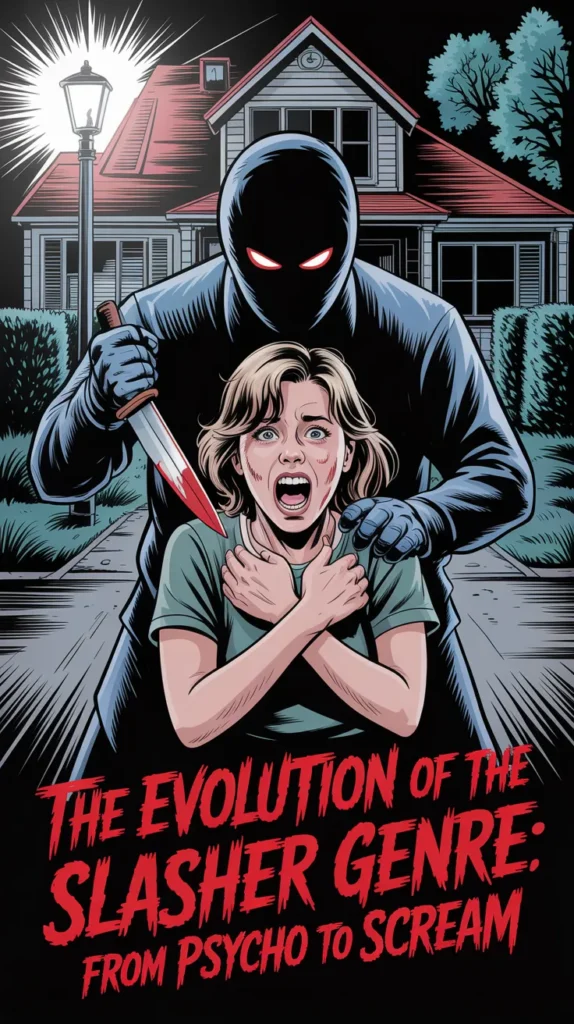
At its core, the slasher formula seems deceptively simple: a masked or mysterious killer, a group of unsuspecting victims, a signature weapon, and the emergence of the “Final Girl”—the lone survivor who faces down evil and lives to tell the tale. But this blueprint has proven remarkably adaptable, reflecting the anxieties, values, and rebellions of each generation that embraced it.
This article traces the bloodline of the slasher genre across four decades of innovation and reinvention. Alfred Hitchcock’s Psycho created the template that would haunt cinema for generations. John Carpenter’s Halloween perfected the formula and launched an empire. The 1980s transformed slashers into a cultural juggernaut through franchises like Friday the 13th and A Nightmare on Elm Street. Then, just when the genre seemed exhausted and headed for the graveyard, Wes Craven’s Scream dissected, deconstructed, and ultimately revitalized the slasher for a postmodern age.
What follows is a journey through cinematic carnage and creative evolution—a deep dive into how the slasher genre carved its place into horror history and continues to sharpen its blade today.
Quick Timeline of the Slasher Genre
1960 – Psycho introduces the human monster and psychological killer, breaking cinematic taboos with shocking violence and the death of a major star mid-film.
1974 – The Texas Chain Saw Massacre births raw, documentary-style realism and establishes rural horror as a terrifying subgenre.
1978 – Halloween codifies the modern slasher formula with the masked killer, Final Girl archetype, and suburban setting that defined the genre.
1980–1989 – The Golden Age sees Friday the 13th, A Nightmare on Elm Street, and countless imitators dominate the box office and video stores, establishing the franchise model.
1996 – Scream reinvents the genre for a meta-aware generation, deconstructing slasher tropes while delivering genuine scares.
2000s–Present – Revival and Evolution brings remakes, legacy sequels, and elevated horror that continues to reimagine the slasher for new audiences.
The Spark of Madness: Psycho (1960) and the Birth of the Modern Killer
When Alfred Hitchcock’s Psycho premiered in 1960, it shattered every rule Hollywood held sacred. The film’s infamous shower scene—a 45-second montage of 70 camera setups and 52 cuts—didn’t just shock audiences with its violence. It announced that cinema’s most beloved star could be brutally murdered 40 minutes into a film, that sex and violence could intertwine in ways that felt uncomfortably real, and that the greatest threat might come not from a supernatural entity but from the seemingly ordinary man next door.
Norman Bates represented something cinema had rarely explored with such unflinching psychological depth: the human monster. Unlike the Gothic creatures and Universal monsters that dominated horror’s golden age, Norman was disturbingly relatable—awkward, lonely, trapped by maternal domination and fractured identity. He was the proto-slasher, combining voyeurism, sexual repression, and explosive violence into a character who would influence every killer that followed.
Psycho‘s impact extended far beyond its narrative innovations. The film forced the Motion Picture Production Code to loosen its stranglehold on depictions of violence and sexuality. Hitchcock’s marketing campaign—which forbade latecomers from entering theaters after the film began—revolutionized how audiences experienced horror. The master of suspense had created something more immediate and visceral than suspense alone: he had weaponized shock.
The film’s structure influenced an entire generation of psychological thrillers throughout the 1960s, from Whatever Happened to Baby Jane? to Repulsion. But more importantly, Psycho established the slasher’s fundamental DNA: the isolated location, the vulnerable victims, the killer’s twisted psychology, and the understanding that horror’s most potent weapon isn’t the supernatural—it’s the capacity for human evil.
From Art-House to Grindhouse: The Texas Chain Saw Massacre (1974)
If Psycho brought psychological horror into the mainstream, Tobe Hooper’s The Texas Chain Saw Massacre dragged it into the sun-bleached nightmare of rural America. Made for less than $140,000, Hooper’s masterpiece felt less like a movie and more like a documentary of atrocity—a quality that stemmed from its guerrilla filmmaking style, the sweltering Texas heat that physically exhausted the cast and crew, and Hooper’s decision to root his horror in the textures of rot, rust, and rural decay.
The film’s genius marketing claimed it was “based on true events,” a half-truth that referenced the real-life crimes of Ed Gein (who also inspired Psycho) while amplifying the film’s documentary aesthetic. This approach to horror—positioning fictional terror as historical fact—would become a cornerstone of the genre, influencing everything from The Blair Witch Project to the Paranormal Activity franchise.
Leatherface and his cannibalistic family represented something deeper than simple movie monsters. Released in the aftermath of Vietnam, Watergate, and the shattering of American innocence, The Texas Chain Saw Massacre served as a grotesque mirror to post-1960s disillusionment. The Sawyer family’s perversion of American values—turning the family dinner into a torture chamber, transforming human remains into furniture and fashion—reflected a nation’s growing distrust of traditional institutions and the American Dream itself.
Hooper’s film spawned a wave of gritty, low-budget horror that prioritized raw atmosphere over polished production values. Films like The Hills Have Eyes (1977) and I Spit on Your Grave (1978) followed its lead, establishing rural horror and “wrong turn” narratives as enduring subgenres. More significantly, The Texas Chain Saw Massacre proved that horror didn’t need Hollywood budgets or conventional storytelling—it just needed to tap into primal fear and social anxiety with unflinching conviction.
The Shape of Evil: Halloween (1978) and the Slasher Formula Perfected
John Carpenter’s Halloween is the film that transformed the slasher from scattered antecedents into a codified genre with rules, rhythms, and recognizable iconography. Shot in 21 days for $300,000, Carpenter’s masterpiece would gross over $70 million and become the highest-grossing independent film of its time—but more importantly, it established the template every slasher film would follow, subvert, or challenge for decades to come.
Halloween refined Psycho‘s psychological menace and The Texas Chain Saw Massacre‘s relentless pursuit into something more elegant and archetypal. Michael Myers—”The Shape”—became the embodiment of pure, motiveless evil. Unlike Norman Bates’s fractured psychology or Leatherface’s family dysfunction, Michael offered no explanation, no backstory beyond a childhood murder and a psychiatric evaluation declaring him simply “evil.” This unknowability made him terrifying in a new way: he was both human and inhuman, capable of being stopped but seemingly impossible to kill.
Carpenter introduced innovations that would become slasher hallmarks. His pioneering use of Steadicam created Michael’s iconic POV shots, turning the audience into complicit voyeurs stalking suburban streets on Halloween night. His minimalist synthesizer score—which Carpenter composed himself—transformed simplicity into dread, with that unforgettable 5/4 piano melody becoming as synonymous with horror as the Jaws theme. The film’s suburban setting shattered the assumption that horror belonged to isolated rural areas or Gothic mansions—Michael proved that evil could walk down any tree-lined street in America.
Most significantly, Halloween gave birth to the “Final Girl” through Laurie Strode, brilliantly portrayed by Jamie Lee Curtis. Film theorist Carol J. Clover would later identify this archetype in her seminal work Men, Women, and Chain Saws: the resourceful, often virginal young woman who survives through intelligence, resilience, and determination rather than masculine aggression. Laurie wasn’t just a victim who got lucky—she was an active protagonist who fought back, transforming from babysitter to warrior through necessity.
Halloween‘s massive success created a blueprint that dozens of films would immediately copy: the holiday or significant date setting, the masked killer with a signature weapon, the teenage victims engaged in “transgressive” behavior (sex, drugs, pranks), the Final Girl who abstains from these activities, and the twist that the killer can never truly die. The slasher formula had been perfected, and Hollywood was ready to mass-produce it.
Blood in the ’80s: Friday the 13th, A Nightmare on Elm Street, and the Golden Era
Friday the 13th (1980)
Sean S. Cunningham’s Friday the 13th arrived two years after Halloween and immediately distinguished itself through sheer audacity. While Carpenter’s film built tension through suggestion and shadow, Friday the 13th delivered what audiences increasingly craved: spectacular, innovative death sequences that pushed the boundaries of special effects makeup.
The film’s twist—that the killer isn’t hockey-masked Jason Voorhees but his vengeful mother—played with audience expectations established by Halloween. Yet it was Jason himself, initially appearing only in the film’s nightmare ending, who would become the franchise’s centerpiece. Through eleven sequels (and counting), Jason evolved from deformed child to undead killing machine, his character arc reflecting the genre’s shift from mystery to spectacle.
Friday the 13th popularized the summer camp setting, creating a self-contained slaughter zone isolated from help and packed with attractive young counselors making poor decisions. The series also elevated the “body count” to central importance, with each sequel attempting to outdo the previous installment’s creative kills. Tom Savini’s groundbreaking makeup effects—particularly Kevin Bacon’s arrow-through-the-throat death—transformed gore from exploitation to art, influencing an entire generation of effects artists.
The franchise’s success established the slasher series as a viable business model. Each Friday the 13th sequel cost relatively little to produce and virtually guaranteed a profitable return, regardless of critical reception. This franchise mentality would define horror throughout the 1980s.
A Nightmare on Elm Street (1984)
Just as the slasher formula threatened to calcify into predictability, Wes Craven injected surrealism and psychological depth with A Nightmare on Elm Street. Craven’s masterstroke was making the victims’ dreams the killing ground, transforming sleep—humanity’s most vulnerable state—into a death sentence.
Freddy Krueger represented a radical departure from silent, masked killers. Portrayed by Robert Englund with theatrical menace and dark humor, Freddy talked, joked, and terrorized victims with personalized nightmares tailored to their fears. His burned face, striped sweater, and razor-fingered glove created an instantly iconic look, but his personality made him a star. As the series progressed, Freddy became increasingly comedic—a shift that reflected audiences’ growing familiarity with and affection for horror villains.
A Nightmare on Elm Street elevated the slasher’s creative potential by abandoning physical reality. Dreams allowed Craven to craft surreal, impossible deaths—bodies pulled through beds, victims transformed into grotesque puppets, teenagers absorbed into televisions. This oneiric freedom influenced countless horror films and demonstrated that slashers could be more than stalk-and-slash exercises.
The film also featured a star-making performance from Johnny Depp (in his film debut) and created one of horror’s most compelling Final Girls in Nancy Thompson. Unlike Laurie Strode’s reactive survival, Nancy actively researched Freddy’s history, prepared traps, and faced her fears directly—literally pulling Freddy out of the dream world to defeat him on her terms.
The 1980s Slasher Boom
The early-to-mid-1980s represented the slasher genre’s golden age and its greatest excess. The rise of home video transformed how audiences consumed horror, allowing teenagers to rent increasingly graphic titles from their local video stores without parental supervision. VHS cover art became an art form unto itself, with lurid imagery promising visceral thrills that the films didn’t always deliver.
This era spawned countless franchises (Halloween, Friday the 13th, A Nightmare on Elm Street, Child’s Play, Hellraiser) and equally numerous one-off slashers attempting to find their own gimmick: My Bloody Valentine (Valentine’s Day), April Fool’s Day (twist ending), Prom Night (high school revenge), Sleepaway Camp (gender-bending twist), and dozens more. Each holiday, location, or high school milestone became potential slasher fodder.
The slasher’s rules became codified through repetition: have sex and die, drink or do drugs and die, say “I’ll be right back” and definitely die. Only the Final Girl—typically intelligent, resourceful, and abstaining from teenage “sin”—would survive to face the killer. These moralistic underpinnings earned slashers criticism from both conservative groups (too much violence and sexuality) and progressive critics (puritanical punishment of sexual agency and reinforcement of gender stereotypes).
By the late 1980s, the slasher boom had become a bust. Audiences grew weary of formulaic plots and increasingly self-parodic sequels. Friday the 13th Part VIII: Jason Takes Manhattan (1989) and A Nightmare on Elm Street 5: The Dream Child (1989) showed franchises running on creative fumes. The genre needed reinvention—or a mercy killing.
Meta Murder: Scream (1996) and the Postmodern Revival
When Scream premiered in December 1996, the slasher genre had been mostly dormant for nearly a decade. What Wes Craven and screenwriter Kevin Williamson delivered wasn’t just a return to form—it was a genre-defining work that simultaneously deconstructed and celebrated everything that came before.
Scream‘s genius lay in its self-awareness. The characters knew horror movie rules because they’d grown up watching Halloween and Friday the 13th. Randy Meeks (Jamie Kennedy) literally lectures his friends on survival: virgins live, anyone who drinks or does drugs is doomed, never say “I’ll be right back,” and “the killer always comes back for one last scare.” This meta-commentary acknowledged what audiences already knew while weaponizing that knowledge—characters who knew the rules could still die, because knowing and surviving are different things.
The film’s opening sequence remains one of horror’s most effective. Drew Barrymore—top-billed star and the film’s biggest name—is brutally killed within the first 12 minutes, a direct homage to Psycho‘s Janet Leigh. The scene establishes Ghostface’s methodology (the phone calls, the sadistic game-playing, the horror movie trivia) while demonstrating that Scream would honor slasher tradition even as it interrogated it.
Sidney Prescott represented the Final Girl evolved for the 1990s. Unlike her predecessors, Sidney wasn’t sexually naive—she had agency, complexity, and trauma predating the film’s events. Neve Campbell’s performance gave Sidney genuine emotional depth, making her survival feel earned rather than formulaic. The film interrogated the “promiscuity equals death” equation of earlier slashers, with Sidney’s decision to have sex with her boyfriend neither punished nor rewarded, simply existing as a choice.
The Ghostface killer(s)—and the film’s twist that two killers worked together, inspired by the Leopold and Loeb case—reflected 1990s anxieties about media violence, celebrity culture, and teenage nihilism. The killers’ motivation combined psychosexual obsession, revenge, and the desire for infamy in a media-saturated age. Their plan to frame Sidney’s father and script themselves as survivors added layers of manipulation that earlier slashers never attempted.
Craven’s direction balanced genuine scares with knowing humor without tipping into full parody. The film worked both as effective slasher and commentary on slashers—a difficult balance that many imitators (I Know What You Did Last Summer, Urban Legend) attempted but never quite matched. The success of Scream and its sequels proved the slasher could evolve by acknowledging its own history rather than ignoring it.
Beyond Scream: The Legacy of the Slasher in the 21st Century
The early 2000s saw Hollywood mining slasher nostalgia through high-budget remakes. Michael Bay’s Platinum Dunes production company reimagined The Texas Chainsaw Massacre (2003), Friday the 13th (2009), and A Nightmare on Elm Street (2010), while Rob Zombie brought his brutal aesthetic to Halloween (2007) and its sequel. These remakes achieved financial success but often stripped away the originals’ gritty, low-budget charm in favor of polished production values and torture-horror influences from the Saw and Hostel franchises.
The 2010s witnessed a renaissance of “elevated” or “prestige” horror that brought fresh perspectives to slasher conventions. Adam Wingard’s You’re Next (2011) and The Guest (2014) played with audience expectations through genre-blending and protagonist subversion. David Robert Mitchell’s It Follows (2014) reimagined the slasher’s sexual politics through a supernatural predator passed through intimate contact, transforming the “sex equals death” equation into a meditation on trauma and inevitability.
The late 2010s and early 2020s saw legacy sequels that brought original characters back decades later. Halloween (2018), Halloween Kills (2021), and Halloween Ends (2022) followed an aging Laurie Strode still traumatized by Michael Myers, examining how surviving horror shapes entire lives. Scream (2022) and Scream VI (2023) continued Ghostface’s meta-commentary while introducing new generations of characters and exploring toxic fandom and franchise culture itself.
The streaming era has democratized horror production while fragmenting audience attention. Television series like Scream, Slasher, and Chucky have extended slasher narratives across episodic formats, allowing for character development and complex plotting impossible in 90-minute features. Meanwhile, independent filmmakers have used the slasher’s familiar structure to explore social commentary on class (Ready or Not), race (The Blackening), and generational trauma (X and Pearl).
Interestingly, the slasher has influenced prestige horror-adjacent series like American Horror Story, whose anthology seasons frequently incorporate slasher elements, and streaming hits like You and The Watcher, which adopt the genre’s voyeuristic menace for psychological thriller frameworks.
The Rules of Survival: Why Slashers Still Matter
The slasher genre’s endurance stems from its unique psychological appeal. Unlike supernatural horror’s cosmic dread or ghost stories’ atmospheric unease, slashers offer audiences a specific transaction: watch transgression be punished, witness the vulnerable fight back, survive vicariously through the Final Girl’s triumph. It’s a controlled exposure to danger, a safe space to confront mortality and test survival instincts against an implacable threat.
Each generation redefines the killer and survivor to reflect contemporary anxieties. 1960s slashers explored psychosexual repression and the collapse of social order. 1970s entries confronted post-Vietnam disillusionment and the failure of countercultural idealism. The 1980s boom coincided with Reagan-era moral panics and the rise of consumer culture. 1990s slashers embraced irony and media self-awareness. Today’s iterations grapple with trauma survival, toxic masculinity, and the violence embedded in American culture itself.
The Final Girl archetype has evolved from moralistic survivor to complex protagonist. Early Final Girls survived partly through sexual purity and moral virtue—a troubling implication that sexual activity deserved punishment. Modern iterations like Sidney Prescott, Erin from You’re Next, and Scream (2022)’s Sam Carpenter possess agency, complicated backstories, and survival skills that owe nothing to chastity. This evolution reflects broader cultural conversations about agency, victimhood, and resilience.
The slasher functions as cultural mirror because it explores the boundaries of acceptable behavior and the consequences of transgression. The genre’s “rules”—both within the films and governing the films themselves—create a moral universe where actions have consequences, even if those consequences feel arbitrary or unjust. This appeals to our desire for order in a chaotic world, even when that order is enforced by a masked killer.
The Blade Never Dulls
From Janet Leigh’s fatal shower to Drew Barrymore’s shocking opening death to the latest Ghostface killings, the slasher genre has proven remarkably resilient and adaptable. What began with Alfred Hitchcock’s psychological thriller evolved into John Carpenter’s suburban nightmare, exploded into 1980s excess, and reemerged through Wes Craven’s postmodern lens—each iteration reflecting its era’s anxieties while maintaining the genre’s essential DNA.
The slasher’s fundamental appeal lies in its simplicity: a killer stalks victims, and one survivor must find the strength to fight back. Within this basic structure, filmmakers have explored psychosexual terror, social commentary, meta-textual playfulness, and profound questions about trauma and survival. The machete changes hands, the mask takes different forms, but the core mythology endures.
As we look toward horror’s future, the slasher genre shows no signs of dulling its blade. Artificial intelligence killers could combine Psycho‘s psychological horror with technological paranoia. Virtual reality might transform the stalking experience into immersive terror. Streaming platforms continue experimenting with episodic slasher narratives that blend horror conventions with prestige television’s character development.
What remains certain is that as long as audiences crave catharsis through controlled danger, as long as we need to confront mortality in safe spaces, and as long as filmmakers seek to explore the darkness within human nature, the slasher will survive. The formula may evolve, the rules may change, but the archetypal battle between killer and Final Girl—between death and survival—will continue to define horror cinema for generations to come.
After all, in the slasher genre, the killer always comes back for one more sequel.