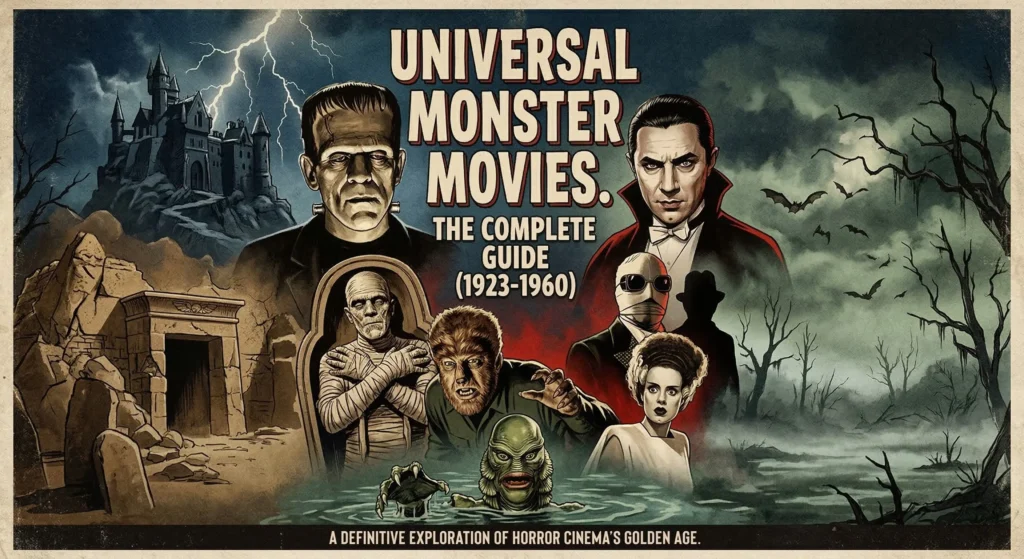
They did not know what they were building. That is the first thing to understand. Nobody at Universal Pictures in 1931 sat down with a long-term plan and a whiteboard and mapped out thirty years of monsters. They made Dracula because a stage play had made money on Broadway and Carl Laemmle Jr. had a hunch. They made Frankenstein because Dracula worked. What followed was thirty years of filmmaking that accidentally invented the grammar of fear, and we have been living inside that grammar ever since.
Dracula, Frankenstein’s Monster, the Mummy, the Wolf Man, the Invisible Man, the Bride, the Gill-Man. These are not just horror characters. They are the foundational architecture of an entire way of being frightened at the cinema. Every sympathetic monster in the history of film traces its lineage back to what Boris Karloff did under Jack Pierce’s makeup in 1931. Every creature that earns your pity at the same moment it earns your terror is working in the tradition James Whale established when he pointed a camera at a man with a flat-topped skull and asked the audience to understand him before they feared him.
This is the complete guide to Universal Monster Movies, from the silent grotesques of 1923 through the final Gill-Man entry in 1956 and everything that followed. Every film. Every key person. The history of how it happened and why it still matters.
How Universal Horror Began: The Chaney Era (1915-1930)
Universal Pictures was founded by Carl Laemmle in 1912, a German immigrant who had fought the Edison Trust’s film monopoly and won on nerve alone. By the early silent era the studio was a functioning movie town sprawling across the San Fernando Valley, producing films at an industrial pace across every genre. Horror was not yet in the vocabulary. Then Lon Chaney arrived and changed what the vocabulary contained.
Chaney was called the Man of a Thousand Faces, which undersells what he actually did. His transformations were not tricks. They were arguments. When he played Quasimodo in The Hunchback of Notre Dame (1923), he wore a contraption that weighed somewhere between fifty and seventy pounds and distorted his body into something that should not have been able to move, let alone perform. He performed. The film cost over a million dollars to produce and returned several times that, which told Universal something important: audiences would pay generously to see a human being push the limits of what a human being could be.
The Phantom of the Opera followed in 1925. The unmasking scene, the moment where Christine pulls away the Phantom’s mask and reveals the skull beneath the face, was one of cinema’s first great shock moments. People fainted at screenings. Some of that is myth and some of it is not, and the distinction matters less than the fact that Chaney had discovered something: the face beneath the face, the human horror underneath the monster, was the thing that truly reached inside people and would not let go.
That combination, the thing that horrifies you is also the thing you recognize in yourself, became the template. It is the emotional engine that runs through every Universal Monster that came after. Chaney established it without anyone asking him to, without a franchise plan or a studio mandate. He just understood something true about fear and put it on film.
When sound arrived in 1929, Universal lost its irreplaceable man. Chaney died of throat cancer in 1930 before he could make the transition. The studio had to find a new way to make the world afraid.
The Golden Age: 1931-1936
Carl Laemmle had handed the studio’s creative reins to his son, Carl Laemmle Jr., in 1928. Junior was twenty-one years old and widely mocked in Hollywood for being handed such power through nepotism. He answered his critics by doing something nobody expected: he bet the studio on horror. He saw the Broadway production of Dracula, the stage play starring Bela Lugosi, and bought the film rights immediately. What followed was five years of filmmaking that changed cinema permanently.
Dracula (1931)
Dracula opened on Valentine’s Day, 1931, directed by Tod Browning, starring Lugosi in a performance he had already perfected on stage for years. The film cost $442,000, well above the studio average, and grossed over $700,000 in its domestic run. The numbers were extraordinary. The performance was something else entirely.
The film is imperfect. It is stagey. Its second half loses momentum in ways that modern viewers feel acutely. It is still thinking in theatrical terms rather than cinematic ones, and the camera knows it. None of that matters when Lugosi enters the frame. His Dracula is not a monster performing humanity. He is something anterior to that: a figure of absolute aristocratic menace whose stillness communicates an intelligence utterly indifferent to human suffering. He does not need to run. He does not need to roar. He looks at you with those eyes, and that is the whole argument.
There is also the Spanish-language version, filmed simultaneously on the same sets at night with a different cast and director (George Melford). It is widely considered technically superior: better camera movement, more expressive staging, a film that understood cinema in ways Browning’s version did not. Serious students of the form seek it out. But Lugosi is Dracula. His version is the one that defined the character for the next hundred years, and it is not a close competition.
Frankenstein (1931)
Frankenstein arrived nine months later, on November 21, 1931. James Whale directed. Boris Karloff played the Monster. The film cost $291,000, took 34 days to shoot, and grossed approximately $12 million worldwide, one of the most profitable films of the entire decade relative to its era. The numbers tell you what audiences felt. They do not tell you why.
What Whale understood, and what Jack Pierce helped him realize, was that the Monster should not be frightening the way a predator is frightening. It should be frightening the way a wronged child is frightening: abandoned by its creator, given life without consent, trying to understand a world that wants it dead. Pierce spent three months researching anatomy, surgery, and electrodynamics to build that look. The flat-topped skull, the neck bolts, the raised wrists, the skin the color of old wax. He built it from cotton, collodion, rubber, spirit gum, and greasepaint, with no foam latex, no digital assistance, nothing that existed yet. Every Frankenstein Monster that came after has been in negotiation with what Pierce built in 1931, and none of them has won the argument.
Karloff, under five and a half hours of daily makeup application, found the grief inside the Monster. There is a moment when he reaches toward sunlight through a dungeon window, not menace, not violence, just longing, and it is one of the most quietly devastating images in the history of horror. Quietly. That is the word. Whale made it quiet, and quiet is what cuts through.
The Mummy (1932)
Karl Freund had been Dracula’s cinematographer. Universal trusted him enough to give him the director’s chair for The Mummy, released in December 1932. It was the right call. Freund brought a visual intelligence to horror that the previous films had not quite located: the use of light and shadow not as atmosphere but as emotional instruments, the sense that the darkness in the frame is doing specific psychological work.
Karloff again, this time as Imhotep, buried in nine yards of rotting linen for Pierce’s application process. The film is slower and more hypnotic than its predecessors. It is concerned with atmosphere first and shock not at all. The resurrection scene, where the Mummy’s hand simply moves into frame and the archaeologist who witnesses it is later found laughing uncontrollably and never recovers his sanity, is horror working at its most economical. You see almost nothing. You feel everything.
The Invisible Man (1933)
Whale returned to direct The Invisible Man in 1933, adapting H.G. Wells’s novel with a casting decision that looks like a gamble and turned out to be a masterstroke. Claude Rains was almost entirely unseen throughout the film. He was present only as a voice, and what a voice: classically trained, capable of shifting from charm to contempt to full-blown megalomania within a single sentence.
The Invisible Man is an unusual creature in the Universal stable. He is not a victim. He is not tragic in the Wolf Man sense. He is brilliant, vain, and genuinely dangerous, a man whose power has outrun his sanity and who enjoys what he has become far more than he should. Rains turned what could have been a technical gimmick into a character study in grandiosity and disintegration. The special effects, achieved through painstaking optical techniques, held up for decades because they were built on craft rather than technology. The craft does not age.
Bride of Frankenstein (1935)
If there is one film in the Universal Monsters canon that deserves the word essential more than any other, it is Bride of Frankenstein. Released in 1935, directed again by Whale, it is richer and stranger and funnier and more moving than its predecessor in every measurable way, and in several ways that are not measurable at all.
Whale was given more creative control for the sequel, and he used it to make a film that is simultaneously a horror picture, a black comedy, a meditation on loneliness, and a piece of baroque excess that should not cohere and coheres perfectly. Dr. Pretorius, played by Ernest Thesiger, is one of cinema’s great supporting presences: grinning, amoral, keeping miniature homunculi in glass jars and offering gin to corpses. He is exactly as strange as he sounds and stranger still in the watching.
Elsa Lanchester plays both Mary Shelley in the prologue and the Bride herself, created in minutes of screen time, rejected by the Monster in a single look that contains an entire tragic universe, destroyed in the film’s final explosion. Her hissing, her electrified hair, the coiling snakelike movement of her neck: it is a great performance assembled from almost no screen time, which is its own kind of genius.
The Monster wants companionship. That is the whole film. He has been alive and alone and he wants someone to exist alongside him, and the world keeps refusing, and Whale makes you laugh and grieve at the same moment over the same image. That is a very specific and very difficult thing to do. Whale did it without apparent effort, which is the mark of someone who understood their material all the way down.
Bride of Frankenstein was, in retrospect, the last moment of genuine artistic ambition in Universal’s golden age. The Production Code had been rigidly enforced from 1934 onward. Whale was operating right at the edge of what was permissible, and the subtext ran deep in ways the censors either missed or chose to let pass. After 1935, the formula began to calcify. The next great film from this studio would take four years to arrive.
Dracula’s Daughter (1936) and the End of an Era
Dracula’s Daughter arrived in 1936, directed by Lambert Hillyer, and it gets more interesting with each passing decade. Gloria Holden’s Countess Zaleska is a figure of reluctant monstrosity: a vampire who hates what she is and cannot stop being it. The film’s subtext around sexuality and compulsion was radical for 1936 and remains striking now. It was also the last serious, prestige horror production under the Laemmle regime.
In 1936, Universal’s accumulated financial troubles ended the Laemmle family’s control of the studio. Carl Laemmle Jr.’s era was over. The five years that had produced the monster cycle were done. New management took the studio in a different direction. Horror would continue at Universal, but never again with the same investment of creative ambition and artistic seriousness.
The Silver Age: 1939-1945
Horror returned to Universal with Son of Frankenstein in 1939, directed by Rowland V. Lee and starring Karloff in his final appearance as the Monster. Karloff felt the role was being diminished by sequels, and he was not wrong, but Son of Frankenstein is better than its reputation. It introduced Bela Lugosi in his best post-Dracula performance, as the broken-necked Ygor, a character so vivid and so specific that it transcended the film it inhabited. The movie performed well. The floodgates opened.
What followed was five years of extraordinary productivity and declining artistic ambition in roughly equal measure. Universal built an assembly line. The monsters became more interchangeable, the productions cheaper, the directorial talent more workmanlike. But the best of the Silver Age did something that pure B-movie logic cannot account for, and it is worth understanding why.
The Wolf Man (1941)
The Wolf Man was released in December 1941, weeks after Pearl Harbor, into a country that was freshly at war and needed its nightmares given shape. Directed by George Waggner, it introduced Larry Talbot, played by Lon Chaney Jr. with an earnestness that bordered on physical anguish. Chaney was not his father. He lacked the elder Chaney’s technical brilliance and physical plasticity. What he had instead was a quality of inescapable sadness, a man who seemed genuinely burdened by being alive, that made Larry Talbot’s curse feel real in a way that technically superior werewolf films have rarely matched.
Screenwriter Curt Siodmak invented most of what audiences now believe is ancient werewolf mythology. The pentagram. The silver bullet. The full moon as trigger. The transferability of the curse through a bite. None of it came from established folklore. Siodmak made it up in a Hollywood office, and it became the folklore. Universal’s version replaced the actual historical record so completely that most people encountering werewolf mythology for the first time are encountering Siodmak’s version. That is a remarkable achievement for a B-movie script.
Jack Pierce’s Wolf Man transformation required yak hair applied strand by strand, rubber appliances, and hours of daily application that Chaney reportedly despised with genuine passion. The despair was real. The camera caught it. Chaney played the Wolf Man five times across five films, and each time the sadness deepened. By Abbott and Costello Meet Frankenstein he had been carrying Larry Talbot for seven years, and you can see every one of those years in his face.
The Crossover Era and the Shared Universe
Frankenstein Meets the Wolf Man (1943) was Universal’s first explicit monster crossover, directed by Roy William Neill. It is a flawed and fascinating film in which the ambitions of the premise outrun the budget and the script, but the premise itself was genuinely new. What it established was that Universal’s monsters inhabited the same world: a gothic Central European space where Transylvanian counts and Bavarian mad scientists and cursed Welsh noblemen coexisted without requiring narrative explanation.
Modern audiences take the shared universe concept for granted because Marvel spent fifteen years and billions of dollars making it the dominant form of franchise entertainment. Universal got there first, in 1943, with a fraction of the budget and none of the planning. They did not build toward it. They stumbled into it. The logic was shaky from the start: the Frankenstein films are set in some vague nineteenth-century Central Europe, and The Wolf Man is explicitly set in the early 1940s, and nobody ever explained how those two worlds were supposed to coexist. Universal’s answer was to simply not address it. Audiences did not care, which says something real about what people actually want from their monster movies.
House of Frankenstein (1944) and House of Dracula (1945) pushed the concept to its logical limit, packing Dracula and the Wolf Man and Frankenstein’s Monster and a hunchback and a mad scientist into films that moved too fast to fully develop any of them. They are monster revues, not monster films. They delivered what audiences paid to see, and audiences paid.
Abbott and Costello and the Graceful Ending
Abbott and Costello Meet Frankenstein (1948) is listed among the comedy team’s best films, and that assessment is correct. Directed by Charles Barton, it brought Bela Lugosi back as Dracula for the first time since 1931, seventeen years after the original. Karloff declined to participate, believing the comedy would diminish the characters, which was a reasonable position and also a wrong one. Lugosi is genuinely sinister between the gags. The horror and comedy coexist with more grace than they have any right to. Chaney is back as the Wolf Man, still carrying that weight.
But it was an ending. Once the monsters were punchlines, they could not fully return to being terrors. The franchise had acknowledged what it had become: beloved entertainment rather than genuine horror cinema. It made that acknowledgment into a film, and the film is wonderful, and something was finished when it ended.
The Decline and the Last Great Monster: 1945-1960
The post-war horror landscape was shifting beneath Universal’s feet in ways the studio could feel but not fully name. Audiences were changing. Television was arriving. Atomic anxiety and Cold War paranoia were replacing the gothic European dread that had powered the classic monsters. The Mummy series had already burned itself out across four Kharis films in four years, each cheaper than the last, each generating less dread than the one before. The franchise was running on fumes and reputation.
Then Jack Arnold made Creature from the Black Lagoon and reminded everyone what this studio was capable of when it cared.
Creature from the Black Lagoon (1954)
Released in 1954, originally in 3D, Creature from the Black Lagoon is the last Universal Monster film that belongs in the same conversation as the Golden Age productions. Jack Arnold directed. James C. Havens shot the underwater sequences. Ricou Browning wore the Gill-Man suit beneath the water in sequences of startling grace and genuine menace, moving through the lagoon with a fluid physicality that made the creature beautiful before it made it threatening.
The Gill-Man is a different order of monster from his predecessors. He is older and more elemental, not human-adjacent in the way Dracula or the Wolf Man are human-adjacent. He is genuinely alien, something that predates human civilization by millions of years, looking up from below at a world that does not belong to him and will not share. In the famous lagoon sequence, he glides beneath Julie Adams with a combination of menace and something that looks disturbingly like longing. The film understands its creature at that level. That understanding is the difference between a monster movie and a Universal Monster movie.
Two sequels followed: Revenge of the Creature (1955), which is a significant step down and contains Clint Eastwood’s uncredited film debut as a lab technician, and The Creature Walks Among Us (1956), which surgically alters the Gill-Man to breathe air. Surgically alters him. To breathe air. That creative decision speaks for itself, and what it says is that the studio had run out of ideas and needed to fill a release slot. The Gill-Man ends the series trapped between two worlds, belonging to neither, which is either an unintentional metaphor for what Universal had done to its monsters or exactly the right way to end things. Either way, it ends there.
The Television Resurrection: Shock! (1957)
Universal officially ended its classic horror cycle, but the monsters refused to disappear. In October 1957, Screen Gems syndicated a package of 52 pre-1948 Universal horror films to television stations across America under the name Shock! The ratings impact was immediate and staggering. Some markets saw viewership increases of over 1,000 percent. A generation of children who had never seen these films encountered them through the blue glow of television sets in darkened living rooms, and they were marked by them in ways that did not wash out.
Famous Monsters of Filmland magazine launched in February 1958, directly inspired by the Shock! phenomenon. Founded by James Warren and Forrest J Ackerman, it required a second printing after its first issue to meet demand. The magazine ran for decades, doing for horror film what Rolling Stone did for rock music: creating a community of obsessives who took the genre seriously, who argued about it and collected it and dreamed about making it.
Stephen King has cited it as formative. Guillermo del Toro has spoken about it the same way. The Universal Monsters became the religion of a generation of horror filmmakers, and Famous Monsters of Filmland was their scripture. Without it, the horror renaissance of the 1970s and 1980s looks different. Without it, some of the filmmakers who built that renaissance might not have found their way in at all.
The Complete Universal Monsters Film List (1923-1956)
Every film in the core Universal Monsters cycle, in release order. Films marked with an asterisk (*) are part of Universal’s own official 30-Film Collection. Dates are original US release dates.
| Year | Title | Director | Monster |
|---|---|---|---|
| 1923 | The Hunchback of Notre Dame | Wallace Worsley | Quasimodo |
| 1925 | The Phantom of the Opera | Rupert Julian | The Phantom |
| 1931 | Dracula * | Tod Browning | Dracula |
| 1931 | Frankenstein * | James Whale | Frankenstein’s Monster |
| 1932 | The Mummy * | Karl Freund | The Mummy |
| 1933 | The Invisible Man * | James Whale | The Invisible Man |
| 1933 | The Black Cat | Edgar G. Ulmer | Poelzig / Werdegast |
| 1935 | Bride of Frankenstein * | James Whale | Bride / Monster |
| 1935 | Werewolf of London | Stuart Walker | Werewolf |
| 1936 | Dracula’s Daughter * | Lambert Hillyer | Dracula’s Daughter |
| 1939 | Son of Frankenstein * | Rowland V. Lee | Frankenstein’s Monster |
| 1940 | The Invisible Man Returns * | Joe May | The Invisible Man |
| 1940 | The Mummy’s Hand * | Christy Cabanne | Kharis the Mummy |
| 1940 | The Invisible Woman | A. Edward Sutherland | Invisible Woman |
| 1941 | Man Made Monster | George Waggner | Dynamo Dan |
| 1941 | The Wolf Man * | George Waggner | The Wolf Man |
| 1942 | The Ghost of Frankenstein * | Erle C. Kenton | Frankenstein’s Monster |
| 1942 | The Mummy’s Tomb * | Harold Young | Kharis the Mummy |
| 1942 | Invisible Agent | Edwin L. Marin | Invisible Agent |
| 1943 | Frankenstein Meets the Wolf Man * | Roy William Neill | Both |
| 1943 | Son of Dracula * | Robert Siodmak | Dracula |
| 1943 | Phantom of the Opera | Arthur Lubin | The Phantom |
| 1944 | The Invisible Man’s Revenge | Ford Beebe | Invisible Man |
| 1944 | House of Frankenstein * | Erle C. Kenton | Multiple |
| 1944 | The Mummy’s Ghost * | Reginald Le Borg | Kharis the Mummy |
| 1944 | The Mummy’s Curse * | Leslie Goodwins | Kharis the Mummy |
| 1945 | House of Dracula * | Erle C. Kenton | Multiple |
| 1948 | Abbott and Costello Meet Frankenstein * | Charles Barton | Multiple |
| 1951 | Abbott and Costello Meet the Invisible Man | Charles Lamont | Invisible Man |
| 1954 | Creature from the Black Lagoon * | Jack Arnold | The Gill-Man |
| 1955 | Revenge of the Creature * | Jack Arnold | The Gill-Man |
| 1955 | Abbott and Costello Meet the Mummy | Charles Lamont | The Mummy |
| 1956 | The Creature Walks Among Us * | John Sherwood | The Gill-Man |
* Included in Universal Classic Monsters: Complete 30-Film Collection.
The Key People Behind Universal Horror
Carl Laemmle Jr. (1908-1979): The Man Who Bet on Monsters
Carl Laemmle Jr. became head of production at Universal in 1928, at twenty years old. Hollywood laughed at him. His father had installed him through nepotism, and everyone said so out loud. He answered by greenlighting Dracula and Frankenstein in the same year.
He was responsible for every major creative decision of the golden age: Dracula, Frankenstein, The Mummy, The Invisible Man, Bride of Frankenstein. Five years of work that permanently altered what horror cinema could be and mean. In 1936, Universal’s accumulated debts forced the Laemmle family out of the studio they had founded. Carl Jr. spent the rest of his life without another major credit. Horror owes him a debt it has never fully acknowledged, and his name barely registers in most histories of the form. That is worth sitting with for a moment.
James Whale (1889-1957): The Director Who Made Monsters Weep
Whale was an openly gay British director who had come to Hollywood after directing the stage production of Journey’s End. Universal gave him Frankenstein, and he transformed it from a genre exercise into something approaching personal cinema. He directed four horror films for the studio: Frankenstein (1931), The Old Dark House (1932), The Invisible Man (1933), and Bride of Frankenstein (1935). Each one is distinct from the others in tone, approach, and sensibility. None of them looks or feels like the work of a director who was simply doing his job.
Whale found in these monster films a vehicle for something more personal: the outsider’s experience, the cost of being different in a world that wants conformity, the loneliness of the creature who cannot fit. Whether he intended the subtext or simply could not help it, the subtext is there in every frame. His work has never dated. Watch Bride of Frankenstein today and you will find a film that is still ahead of most of what gets made in its genre.
Jack Pierce (1889-1968): The Architect of the Universal Face
Jack Pierce created the look of Universal’s monsters, which means he created the visual vocabulary that the entire genre has been working with ever since. His Frankenstein Monster required three months of research in anatomy, surgery, and electrodynamics before a single application. The flat head, the neck bolts, the deep brow ridge, the skin the color of old wax: he built it from cotton, collodion, rubber, spirit gum, and greasepaint, in an era before foam latex prosthetics existed.
His Wolf Man transformation used yak hair applied strand by strand. Five hours to apply. Two hours to remove. Every single day of filming. Chaney despised the process. The camera caught the despair that process produced and turned it into performance.
Pierce was fired by Universal in 1946, after twenty years of service, for resisting the new foam latex techniques that were replacing his methods. He was unceremoniously let go by the studio whose most enduring images he had built. His creations outlasted his employment by decades and show no signs of losing their hold.
Boris Karloff (1887-1969): The Monster With a Soul
Karloff was a character actor in his forties, working steadily in small roles, when James Whale chose him for Frankenstein. The performance under Pierce’s makeup transformed his career permanently and typecast him in ways he accepted with more grace than most actors could have managed. He played the Monster three times in the main franchise and declined the fourth time, unwilling to participate in what he saw as the character’s diminishment. His Imhotep in The Mummy is a different kind of achievement: more restrained, more menacing, more purely physical. A completely different instrument, played by the same man.
Karloff brought genuine intelligence to every role he accepted. You can see the intelligence operating even under Pierce’s makeup, even in the films that did not deserve it. That intelligence is what separates him from the actors who wore similar makeup in similar films and left no impression at all.
Bela Lugosi (1882-1956): Dracula and the Weight of a Single Role
Lugosi had played Dracula on Broadway before Universal came calling. His performance in the 1931 film made him a star overnight and typecast him forever, which is one of the crueler ironies in Hollywood history. He never fully escaped Dracula’s shadow. Studios offered him monster roles, not dramatic roles, because that was what the market would support, and he took them because he needed the work. His later career descended through poverty and morphine addiction and the films of Ed Wood Jr., which are their own particular kind of tragedy wrapped in a different kind of love.
He appeared as Dracula only once more in a major production: Abbott and Costello Meet Frankenstein in 1948, seventeen years after the original. He was still commanding. He was still, in his way, frightening. He died in 1956 and was reportedly buried in his Dracula cape. The circumstances are disputed. The image endures because it is the right ending for a man who had given so much of himself to a single character that the character and the man had become inseparable.
Cultural Legacy: What Universal Built and Why It Still Stands
Every major strand of modern horror traces at least one root back to Universal’s monster cycle. The sympathetic monster, the creature whose tragedy you feel even as you fear it, is Whale’s contribution. The atmospheric slow-burn Gothic is the template that Dracula and The Mummy established. The shared universe was Universal’s commercial accident in the 1940s, two decades before Marvel made it a genre.
Hammer Film Productions picked up the Universal templates in the late 1950s and 1960s, remaking Dracula and Frankenstein in vivid Technicolor with Peter Cushing and Christopher Lee as their icons. The debt was explicit and acknowledged: Hammer kept the characters’ names and story outlines while recasting everything visually. Without Universal, there is no Hammer. Without Hammer, British horror takes a different shape, which means dozens of subsequent filmmakers develop differently or not at all.
The Shock! television syndication and Famous Monsters of Filmland created a pipeline from the original films to the generation who would reinvent American horror in the 1970s and 1980s. Steven Spielberg, John Landis, Joe Dante, Rick Baker, Stephen King: all have named these films as formative. Del Toro’s entire filmography is in explicit dialogue with the Universal tradition, from Cronos through Pan’s Labyrinth to The Shape of Water, which is a reimagining of Creature from the Black Lagoon directed by someone who loved the Gill-Man too much to let him die, and it won the Academy Award for Best Picture.
By the early 1960s, Aurora Plastics had turned the monsters into model kits that children assembled at kitchen tables and painted themselves. The Frankenstein Monster, Dracula, the Wolf Man, the Mummy: millions of people built them with their own hands. That is not diminishment. That is transmutation. The monsters passed from cinema into childhood imagination, into the private mythologies of people who had made them themselves. That kind of ownership does not fade. The people who built those models grew up and became the filmmakers and writers and artists who kept the monsters alive for the next generation. And so on.
Where to Watch Universal Monster Movies Today
Streaming availability changes constantly. Verify current status at JustWatch.com before you settle in. These reflect known availability as of early 2026.
Peacock (Best Single Platform)
Peacock is Universal’s own streaming platform and carries the most comprehensive single-platform collection of Universal Classic Monsters films available anywhere. The major franchise entries are here: Frankenstein, Bride of Frankenstein, The Invisible Man, The Wolf Man, Son of Frankenstein, The Ghost of Frankenstein, Frankenstein Meets the Wolf Man, House of Frankenstein, House of Dracula, Abbott and Costello Meet Frankenstein, and the Mummy series. Dracula (1931) and Creature from the Black Lagoon availability varies due to separate licensing arrangements, so check current status before you go looking for them.
Tubi and YouTube (Free)
Tubi has historically carried Creature from the Black Lagoon and rotating selections of classic Universal horror on its free, ad-supported platform. The 1925 Phantom of the Opera and the 1923 Hunchback of Notre Dame have entered the public domain and are freely available on YouTube from multiple sources in varying restoration quality. Universal’s Fear: The Home of Horror YouTube channel has also made select classic Monster films available at various points. The Internet Archive at archive.org is a reliable free source for public domain titles.
Physical Media
The Universal Classic Monsters: Complete 30-Film Collection on Blu-ray is the definitive home collection and remains the right answer for the serious fan. Individual films have received standalone 4K Ultra HD releases: Dracula, Frankenstein, Bride of Frankenstein, The Invisible Man, and Creature from the Black Lagoon have all received or been announced for 4K treatment. These films earned the best version available. Get them in it.
Frequently Asked Questions
What are the Universal Monster Movies?
The Universal Monster Movies are a series of horror and suspense films produced by Universal Pictures from 1923 to 1960. They include the foundational monster films of American cinema: Dracula, Frankenstein’s Monster, the Mummy, the Wolf Man, the Invisible Man, the Bride of Frankenstein, and the Creature from the Black Lagoon. They established the visual and narrative language of horror that all subsequent generations of filmmakers have worked with or against.
How many Universal Monster Movies are there?
The core Universal Classic Monsters series spans 30 films, as defined by Universal’s own Complete 30-Film Collection. If you include all horror and horror-adjacent films Universal produced during the 1923 to 1960 period, including the silent era, the comedy crossovers, and the peripheral entries, the full list exceeds 50 titles. The 30-film collection is the standard reference.
Who are the main Universal Monsters?
The eight core Universal Monsters: Dracula (Bela Lugosi), Frankenstein’s Monster (Boris Karloff), the Mummy (Karloff as Imhotep; Lon Chaney Jr. as Kharis in the later films), the Wolf Man (Lon Chaney Jr.), the Invisible Man (Claude Rains), the Bride of Frankenstein (Elsa Lanchester), the Phantom of the Opera (Lon Chaney in 1925; Claude Rains in 1943), and the Creature from the Black Lagoon (Ben Chapman on land, Ricou Browning underwater).
What was the first Universal Monster Movie?
The first Universal horror film is generally considered The Hunchback of Notre Dame (1923), starring Lon Chaney as Quasimodo. The first film of the sound-era monster cycle is Dracula (1931), directed by Tod Browning and starring Bela Lugosi, which launched the golden age.
Why did the Universal Monster Movies end?
Several things converged. The Hays Production Code from 1934 restricted what horror could depict. The departure of Carl Laemmle Jr. in 1936 removed the key creative advocate who had championed the monster films. Through the 1940s the productions got cheaper and less artistically ambitious, and the Abbott and Costello crossovers transformed the monsters into comedic figures that could not easily return to genuine terror. Post-war audiences were responding to different fears: atomic anxiety and Cold War paranoia had replaced gothic European dread as the dominant horror mode, and the classic monsters belonged to a world that felt very far away.
Are Universal Monster Movies still relevant today?
They are not merely relevant. They are foundational. The entire grammar of horror film, the sympathetic monster, the gothic atmosphere, the shared monster universe, was established by Universal in the 1930s and 1940s. Guillermo del Toro’s The Shape of Water is a reimagining of Creature from the Black Lagoon, and it won the Academy Award for Best Picture in 2018. The legacy is not nostalgia. It is living architecture, and the people building with it right now know exactly what they are working with.
Where is the best place to start with Universal Monster Movies?
Dracula (1931) and Frankenstein (1931), in that order, on the same evening. They are each under 80 minutes, they establish the visual and tonal language of the entire cycle, and they introduce Lugosi and Karloff at the heights of their respective performances in these roles. After those two, Bride of Frankenstein (1935) is the next essential step. By many measures it is the finest film in the series. Start there and see what happens to you.