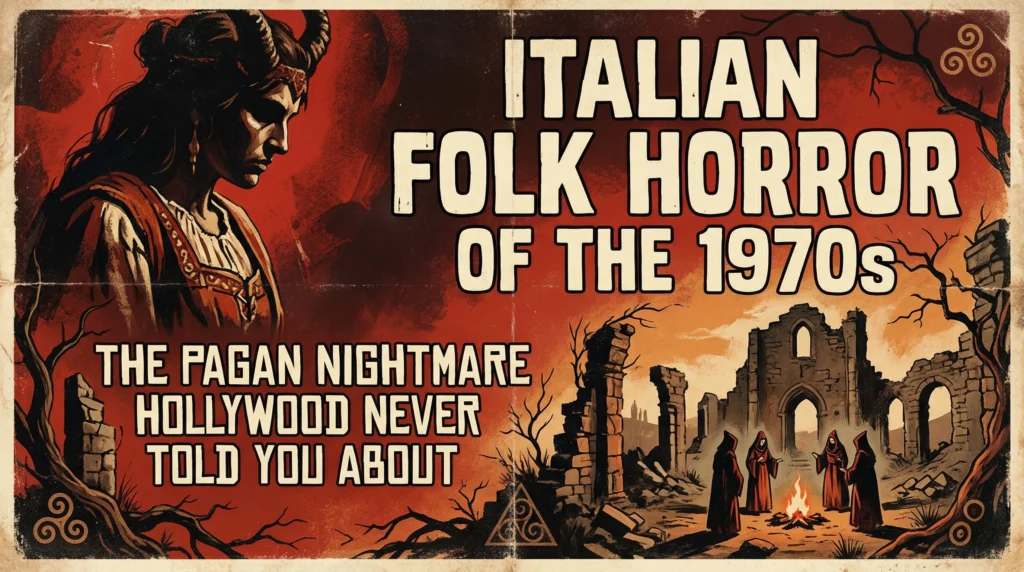
It is 1973. The olive groves outside Florence are dark by seven o’clock and the old women in the village don’t talk about what happens up in the hills after dark. They just cross themselves and look at the floor. That is the atmosphere of Italian folk horror 1970s cinema. That terrifying, soil-deep dread is what a handful of directors were bottling on celluloid while Spielberg was still figuring out how to scare suburbanites with a mechanical shark.
American horror in the 1970s gets all the textbooks. The Exorcist. The Texas Chain Saw Massacre. Halloween. The critics write about them like they were handed down from Sinai on stone tablets. Fine. Okay. But while all that was happening, over in the boot-shaped peninsula poking into the Mediterranean, a wilder, stranger, more genuinely pagan strain of horror was crawling out of the Italian earth. Almost nobody in the English-speaking world was paying attention.
That is a crime. A cultural crime. And we are here to prosecute it.
Italian Folk Horror 1970s: What Is It, Exactly?
Before we go further, understand what we are not talking about. We are not talking about giallo. Those jewel-bright, black-gloved murder mysteries that Argento and Bava made famous: Giallo is a different beast, elegant and urban, obsessed with style and the psychology of the killer. It is jazz. What we are talking about is something older. Something that smells like woodsmoke and animal blood. For more on the broader genre, see our guide to folk horror movies.
Italian folk horror 1970s films (sometimes called horror rurale in the critical literature, though nobody much uses the term outside of academic journals that eleven people read) draw their power from the same deep aquifer as British folk horror: the idea that the land itself is cursed, that the old religion never really died, that the peasants in the valley or the village in the mountains are keeping secrets that the modern world isn’t equipped to survive. Think The Wicker Man (1973), but with more blood on the church steps and a completely different relationship to guilt.
In Italy, this subgenre emerged from a specific cultural fault line. The country was violently, uncomfortably modern by the early 1970s: industrialized north, agricultural south, fascist memory rotting just below the surface everywhere. The Italian folk horror film is, at its most honest, a document of that split. The city person who wanders into the rural dark isn’t just a horror protagonist. They are the Italian economic miracle walking straight into the thing it tried to bury.
The Films You Need to Track Down: Part One
Let’s get specific. Because the films are the whole point.
The Devil’s Wedding Night (1973), also released as Il plenilunio delle vergini, is technically a vampire film, but the way it uses Transylvanian folklore and ancient ritual puts it squarely in this tradition. Not a sophisticated film by any measure, it nonetheless carries a genuinely disturbing relationship with female sexuality and pagan sacrifice that sticks in the brain like a burr.
The House with the Laughing Windows (Pupi Avati, 1976) is the crown jewel of the entire Italian folk horror 1970s canon and it is criminal that it doesn’t get mentioned in the same breath as Don’t Look Now or The Wicker Man. Avati, a Bolognese director whose work is almost entirely unavailable on mainstream streaming, made something extraordinary here: a slow, suffocating mystery about a restorer hired to clean a fresco in a remote village church, who begins to discover that the painter was a murderer, possibly a sadist, and that the village has been protecting a secret for decades. Quiet for long stretches, almost unbearably so, the film then suddenly lunges. The ending is one of the great gut-punch conclusions in all of horror cinema. Full stop.
Footprints on the Moon (Luigi Bazzoni, 1975) barely qualifies as horror in the traditional sense, but it operates as a kind of folk dread film: a woman piecing together a lost week of her memory, drawn to a coastal village where something terrible happened. Formally extraordinary, shot like a fever dream, and completely forgotten outside of Italian cult circles.
The Films You Need to Track Down: Part Two
The Perfume of the Lady in Black (Francesco Barilli, 1974) is the most psychologically complex film in this tradition: a Repulsion-style descent into madness, but saturated with imagery of ritual, childhood folk belief, and the violence lurking inside domestic space. Barilli only made two features. This is one of the great what-ifs of Italian genre cinema.
Zeder (Pupi Avati, 1983). Yes, Avati again, because the man was possessed. It is arguably the finest Italian horror film of the 1980s that nobody has seen. It involves a writer who discovers a manuscript detailing something called “K-zones”: patches of earth where the dead refuse to stay dead. None of the gore of its contemporaries weighs it down. Cold and intelligent, it is absolutely terrifying in the way that good science fiction is terrifying: the horror of an idea, not a body count. You can read our full breakdown of psychological horror films to see where this tradition fits in the wider landscape.
Why Has Nobody Written About This?
The honest answer is: the anglophone critical establishment spent forty years treating Italian genre cinema as junk food. Something to watch at two in the morning and giggle at the dubbing. The giallo got its rehabilitation first. Thank Tarantino, thank home video, thank the Blu-ray boutique labels that started releasing gorgeous restorations in the 2010s. Then the zombie films got their reassessment. Then the Argento canon got the full Criterion treatment it deserved.
But this quieter, earthier tradition of Italian folk horror 1970s filmmaking? It’s still waiting. Search volume for “Italian folk horror” is microscopic compared to “giallo films” or “Italian zombie movies.” Almost no English-language books exist on the subject. The academic essays are few and mostly in Italian. For a horror site, this represents an opportunity. More than that, it is a genuine injustice that deserves correcting.
There is also something specific about the quality of the fear these films produce that is hard to find elsewhere. The best of them, Avati’s work above all, generate a dread that feels almost pre-verbal. Not the dread of the monster, not the dread of the serial killer, but the dread of the village that has kept its secret for two hundred years and is not about to stop now. The dread of roots. The dread of soil that has absorbed too much.
The British Connection (And Why It Matters)
British folk horror: The Wicker Man, Witchfinder General, Blood on Satan’s Claw. That tradition has received enormous critical attention in the last decade, particularly after Adam Scovell’s essential 2017 book Folk Horror: Hours Dreadful and Things Strange. This attention has been deserved and has created real hunger for the form. Audiences who discovered the British tradition through that book and through the documentaries and essays it spawned are now, consciously or not, looking for the next thing.
Italian folk horror 1970s cinema is that next thing. The two traditions share a skeletal structure: the intrusion of the modern into the sacred, the violence of the land. But the Italian films come from a different soil, a different history, a different relationship with the Catholic Church (as source of both protection and of original horror). Cousins who grew up speaking different languages and dreaming different nightmares, these two cinemas are not the same thing. That difference is precisely what makes the Italian tradition worth seeking out.
Where to Start
If you want to enter this particular darkness, start with The House with the Laughing Windows. It is the best of the lot, the most purely frightening, and the most accessible to a viewer not already steeped in Italian genre cinema. After that, move to Zeder. After that, The Perfume of the Lady in Black. For further reading on horror that operates through atmosphere and dread rather than spectacle, see our psychological horror and gothic horror archives.
Then sit with them for a while. Let the dread settle. Think about what it means that these films exist, that somebody in Bologna in 1976 looked at the hills outside his city and saw not beauty or history but teeth.
That is what horror is for. Not the jump scare, not the monster in the corridor. The creeping certainty that the world is older than you, stranger than you, and has no particular interest in your survival.
The Italians knew this. They put it on film. Now it is time the rest of us caught up.
Key films discussed: The House with the Laughing Windows (1976), Zeder (1983), The Perfume of the Lady in Black (1974), Footprints on the Moon (1975), The Devil’s Wedding Night (1973). Director spotlight: Pupi Avati, Francesco Barilli, Luigi Bazzoni.