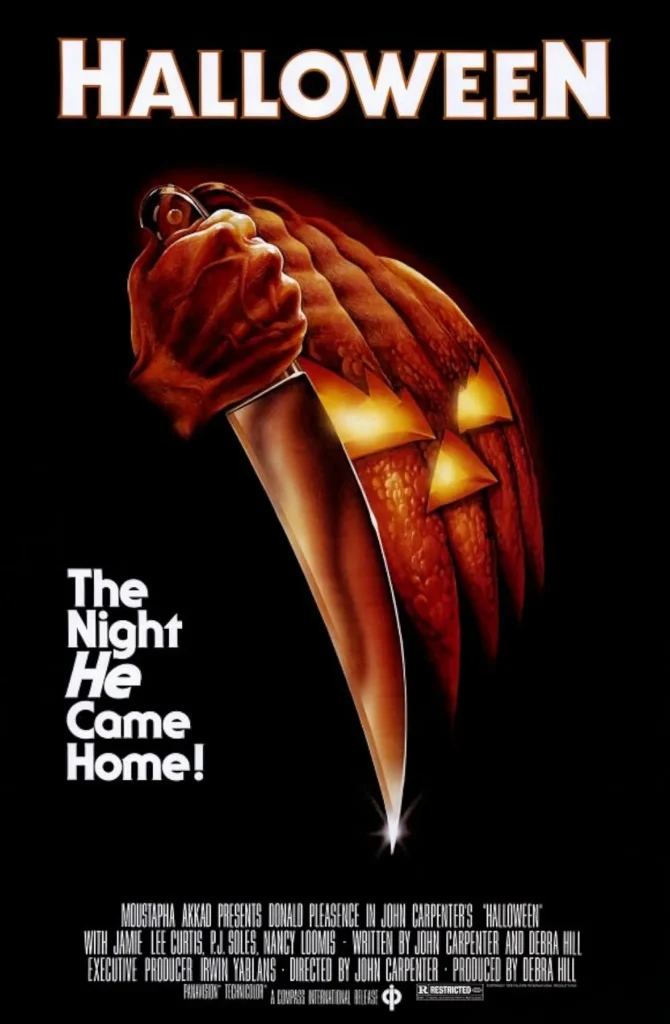
With a $300,000 budget, a $1.98 Captain Kirk mask, and just 20 days of filming, John Carpenter’s Halloween (1978) became the most influential horror movie of all time. It redefined independent cinema, created the modern slasher template, and proved that genuine terror comes not from gore, but from atmosphere, suspense, and the slow approach of evil itself.
This definitive guide explores every aspect of Halloween—from production challenges to revolutionary cinematography, from box office dominance to cultural legacy. Whether you’re a horror enthusiast studying genre evolution, a film student analyzing Carpenter’s techniques, or a franchise fan seeking deeper understanding, this comprehensive analysis reveals why Halloween remains cinema’s quintessential horror film.
Key Points:
- Production origins and financing challenges
- Cast and performances that defined archetypes
- Complete plot synopsis with spoiler warnings
- Horror techniques and cinematography innovations
- The iconic musical score
- Critical reception and box office phenomenon
- Cultural impact and franchise evolution
- Behind-the-scenes trivia and Easter eggs
- Legacy and influence on modern horror
The Birth of a Horror Legend: Halloween’s Unlikely Origins
From Babysitter Concept to Box Office Phenomenon
The story behind Halloween’s creation is nearly as remarkable as the film itself. The concept originated not with director John Carpenter, but with executive producer Irwin Yablans, a former Warner Brothers employee disillusioned with Hollywood’s business practices. The breakthrough came at midnight when Yablans conceived a deceptively elegant premise: Why not make a movie about babysitters being terrorized in a single night? Why not set it on Halloween, the scariest night of the year?
This simple concept would revolutionize horror cinema, but first it needed the right director. Yablans and financier Moustapha Akkad had seen Carpenter’s Assault on Precinct 13 (1976) at the Milan Film Festival and recognized his talent for creating tension on minimal budgets. They approached Carpenter with their babysitter-stalker concept, and Carpenter agreed—but only under strict conditions.
Carpenter demanded full creative control, his name in the title, and the ability to collaborate with Debra Hill as co-writer and producer. His payment? A mere $10,000 total for writing, directing, and composing the score—though he wisely negotiated 10% of profits, a decision that eventually made him wealthy beyond his expectations.
The Three-Week Script That Changed Everything
The screenplay took approximately three weeks to write in early 1978, with a strategic division of labor. Hill, drawing from her teenage babysitting experiences, wrote most of the female characters’ dialogue, creating authentic teenage conversations that elevated the script above typical horror fare. Carpenter focused on Dr. Loomis’s philosophical speeches about Michael Myers’ soullessness and the mechanics of terror.
The inspiration for Michael Myers came from a haunting experience during Carpenter’s college years. While visiting a Kentucky psychiatric institution, he encountered a young patient with what he described as a “schizophrenic stare”—blank, emotionless, and profoundly disturbing. That image of a child’s face devoid of humanity became the psychological foundation for Michael Myers.
Character names paid homage to Carpenter’s influences and personal history:
- Haddonfield, Illinois – Named after Hill’s hometown of Haddonfield, New Jersey
- Dr. Sam Loomis – A reference to John Gavin’s character in Psycho, boyfriend of Marion Crane (played by Janet Leigh, Jamie Lee Curtis’s mother)
- Tommy Doyle – Honoring Lt. Det. Thomas J. Doyle from Hitchcock’s Rear Window
- Michael Myers – Named after an English producer who had entered Assault on Precinct 13 in European festivals
The suburban setting and choice of Halloween night created natural resonance with audiences. Though the original film doesn’t explicitly reference Celtic Samhain traditions (that connection appeared primarily in Halloween II and later sequels), the choice of Halloween night and imagery of thin boundaries between safety and danger reflect the same spirit as ancient festivals when it was believed the veil between worlds grew thin and spirits walked among the living.
Financing Miracles and Budget Constraints
Securing financing nearly derailed the project before it began. Akkad was initially uninterested, occupied shooting a lavish historical epic in Morocco where a single day’s filming cost $300,000—Carpenter’s entire proposed budget. Yablans employed cunning psychology, suggesting to Akkad that he wasn’t interested because he lacked sufficient funds. Outraged by the implication he couldn’t afford such a “small” project, Akkad immediately agreed to finance the film.
The final budget landed between $300,000-$325,000, with approximately $70,000 (nearly 25% of the total) allocated to professional Panavision camera equipment. This wasn’t extravagance—Carpenter believed high-quality equipment would trick audiences into perceiving higher production values. The gamble paid off spectacularly.
Every dollar was stretched to its absolute limit. Most crew members were students or amateur filmmakers who heard about the production through word-of-mouth, working 12-14 hour days for minimal or no pay. Even star Jamie Lee Curtis helped move camera equipment between setups. Actors wore their own clothes, with Curtis’s entire wardrobe purchased at J.C. Penney for approximately $100. The production became legendary as essentially “a bunch of film students making a movie.”
Production Challenges: Making Magic in 20 Days
Shooting October in May: The Seasonal Problem
Principal photography occurred over 20-21 days throughout May 1978 in South Pasadena and surrounding Southern California locations. The production immediately faced a fundamental problem: shooting an October-set film during California spring meant no autumn foliage. The ingenious solution? The crew purchased bags of artificial leaves from a crafts store, spray-painted them orange, red, and brown, then strategically scattered them throughout scenes.
Between takes, cast members literally chased windblown leaves through the streets, collecting them in garbage bags to reuse in subsequent scenes. Despite these efforts, careful viewers can spot numerous continuity issues: palm trees visible in backgrounds, lush green vegetation, warm sunny weather far from Illinois autumn, and California license plates on all vehicles. These imperfections became charming elements of the film’s cult appeal.
Iconic Filming Locations
Halloween transformed South Pasadena into the fictional Haddonfield, Illinois, with several locations becoming pilgrimage sites for horror fans:
- 1103 Fairview Avenue at Oxley Street – Laurie Strode’s house, instantly recognizable with its distinctive porch
- 707/709 Meridian Avenue – The original Myers house location (now relocated to 1000 Mission Street, preserved as “Century House”)
- 1019 Montrose Avenue – The famous hedge where Laurie first glimpses Michael stalking her, now marked on Google Maps as “Halloween Hedge” and deliberately maintained to appear exactly as it did in 1978
- 1530 and 1537 Orange Grove Avenue, Hollywood – The Doyle and Wallace houses where the babysitting terror unfolds
- Pioneer Cemetery, 553 East Sierra Madre Boulevard – Haddonfield Cemetery in the film
- South Pasadena High School – Haddonfield High School
- Garfield Elementary, Alhambra – Laurie’s classroom
These locations remain popular with Halloween enthusiasts who recreate scenes and pay homage to the film’s legacy.
The Legendary Opening Shot: 16 Hours of Hell
The iconic four-minute single-take POV opening sequence stands as one of cinema’s technical marvels—and one of its most grueling productions. Filmed on the final night of principal photography (May 19, 1978), this ambitious shot required 16 continuous hours and 20 separate takes to achieve.
Halloween was only the second production ever to utilize Steadicam/Panaglide technology, and the revolutionary equipment proved physically punishing. The heavy camera rig exhausted operators so thoroughly that three different cinematographers had to rotate—no single person could remain strapped into the equipment for longer than a minute without collapsing from fatigue.
The crew performed what Assistant Director Rick Wallace called “high-stakes indoor parkour,” jumping through windows to reposition lights, dangling from balconies, and hurling furniture to clear the shot’s complex path. They worked through the night, only stopping when sunrise made continued filming impossible. Wallace recalled: “I’m convinced that if it were still night, we’d still be shooting that damn opening.”
The result? A masterpiece of technical filmmaking that drops viewers directly into a killer’s perspective, creating immediate visceral discomfort that sets the tone for everything that follows.
The $1.98 Mask That Became a Horror Icon
Perhaps the most famous budget-saving decision in cinema history created one of its most recognizable images. Production designer Tommy Lee Wallace received a simple assignment: “Go find a mask.” With virtually no budget, he visited a magic shop on Hollywood Boulevard where options included clown masks, a werewolf, and Richard Nixon.
Wallace selected a 1975 Captain Kirk mask manufactured by Don Post Studios for the princely sum of $1.98-$2.00. Back at the production office, he made specific modifications:
- Widened the eye holes with scissors for better visibility
- Shaved off the sideburns and eyebrows
- Spray-painted the face a ghastly bluish-white
- Spray-painted the hair darker brown
When Wallace brought the modified mask to set, the reaction was immediate and visceral. Carpenter recalled: “As soon as the mask came out of the dressing room, it created a shiver through the room, and we knew we had something special.” Producer Debra Hill explained the effect: “The idea was to make him almost humorless, faceless—this sort of pale visage that could resemble a human or not.”
The mask’s unsettling quality came from its origin: it was made from a mold of William Shatner’s face, originally created for Star Trek makeup effects. The neutral human features, once painted and distorted, created an uncanny valley effect—simultaneously familiar and alien, human and inhuman.
Shatner didn’t learn his likeness terrorized audiences until years after the film’s release. He later stated he felt “honored” by the association, though he receives no royalties from the franchise’s continued use of his facial structure.
After filming wrapped, the mask’s journey continued. Nick Castle kept it in his back pocket during shoots, causing significant wear and damage. Hill later stored it under her bed for years before Halloween II production—as a heavy smoker, her cigarettes yellowed the mask and coated it in dust. This deterioration explains why the mask appears noticeably different in the sequel, becoming an accidental continuity element that fueled fan theories about Michael’s changing appearance.
Casting the Archetypes: Performances That Defined Horror
Jamie Lee Curtis: The Birth of the Final Girl
Jamie Lee Curtis’s portrayal of Laurie Strode established the “final girl” archetype that defined horror cinema for decades. Remarkably, Halloween was her feature film debut—she was just 19 years old during filming. Curtis wasn’t Carpenter’s first choice; he originally wanted Anne Lockhart (daughter of June Lockhart from Lassie), but scheduling conflicts made her unavailable.
Producer Debra Hill recognized the publicity goldmine: “I knew casting Jamie Lee would be great publicity for the film because her mother was in Psycho.” The horror lineage proved irresistible—Curtis, daughter of Janet Leigh (Marion Crane) and Tony Curtis, brought Hollywood pedigree to the low-budget production.
Curtis earned $8,000 for her work—a respectable sum for an unknown actress, though modest compared to horror standards today. She initially had reservations about the role, feeling she identified more with outspoken characters than the “quiet, repressed young woman” Laurie represented. However, Curtis brought natural charm and authenticity that transcended the script.
Carpenter employed an innovative technique to help Curtis navigate shooting out of sequence: the “fear meter.” Because scenes were filmed non-chronologically, Carpenter assigned numerical terror ratings: “Here’s about a 7, here’s about a 6, and the scene we’re going to shoot tonight is about a 9½.” Curtis calibrated her facial expressions and scream volumes accordingly, creating consistent emotional progression despite fragmented filming.
Curtis’s performance combined vulnerability with unexpected resilience. While some scholars argue Laurie survives only through luck and male intervention (Dr. Loomis’s rescue), she severely wounds Michael multiple times—stabbing him with a knitting needle, a wire coat hanger through the eye, and a kitchen knife through the chest—before Loomis arrives. Her authentic depiction of fear and resourcefulness became the template for horror heroines, launching Curtis as the “scream queen” of American horror and leading directly to roles in The Fog, Prom Night, and Terror Train (all 1980).
Donald Pleasence: Gravitas and Obsession
Donald Pleasence brought Shakespearean gravitas to Dr. Samuel Loomis, Michael Myers’ psychiatrist turned hunter. Fascinatingly, Pleasence was Carpenter’s third choice for the role. Peter Cushing (fresh from Star Wars) rejected the offer due to low salary, and Christopher Lee also declined—Lee later told Carpenter it was “the biggest mistake he made during his career.”
Producer Irwin Yablans suggested Pleasence, a respected character actor who agreed to the project because his daughter Lucy (a guitarist) had enjoyed Assault on Precinct 13’s score. Pleasence commanded the highest salary in the production at $20,000 but filmed all his scenes in just 5 days. His total screen time? Approximately 18 minutes.
Despite limited screen time, Pleasence’s performance proved indelible. His piercing blue eyes and quiet, methodical delivery created a Van Helsing-like character driven by obsessive conviction that he faces pure evil. Pleasence brought particular power to Loomis’s most famous speech: “I met this six-year-old child with this blank, pale, emotionless face, and… the blackest eyes. The Devil’s eyes. I spent eight years trying to reach him, and then another seven trying to keep him locked up, because I realized that what was living behind that boy’s eyes was purely and simply… evil.”
Originally scripted to show surprise at Michael’s disappearance in the film’s final moments, Pleasence made a crucial suggestion: replace surprise with an “I knew this would happen” expression. This subtle change transformed the ending, suggesting Loomis always understood Michael couldn’t be stopped—only temporarily halted. The moment became one of horror cinema’s most chilling conclusions.
Nick Castle as “The Shape”: Directed to Not Act
Nick Castle, Carpenter’s USC film school friend, played Michael Myers in most scenes for just $25 per day—barely minimum wage even in 1978. Castle’s casting came through friendship rather than audition, and his approach proved perfect for Carpenter’s vision of Michael as something inhuman.
When Castle asked about Myers’ motivation, Carpenter gave brilliantly simple direction: walk from marker to marker and “not act.” The only specific instruction came during Bob’s murder scene, when Carpenter told Castle to tilt his head and examine the corpse “as if it were a butterfly collection.” This signature head tilt became one of horror’s most iconic gestures, copied in countless subsequent films.
Castle developed a “plodding style,” deliberately taking time with reactions rather than rushing through movements. He later explained: “That was a little creepier… it’s kind of strange, once you put that mask on you just do turn into something else.” The mask’s transformative power on Castle’s psychology created authentically unnerving movements—not quite human, but not supernatural either.
Multiple actors actually portrayed Michael Myers across the film:
- Nick Castle – Most scenes as “The Shape”
- Tony Moran – Face reveal in the unmasking (Carpenter wanted a more “angelic” face to contrast with Michael’s evil)
- Jim Winburn – Stunt work, particularly the balcony fall
- Tommy Lee Wallace (production designer/editor) – Scenes involving breakaway glass
Moran received $250 for his brief unmasked appearance—literally seconds of screen time that became one of the film’s most memorable images.
Halloween Plot Synopsis: Three Acts of Escalating Terror
Act I: The Night Evil Came Home (Halloween 1963)
WARNING: Complete plot spoilers follow
Halloween opens with the now-iconic jack-o’-lantern glowing against absolute darkness as John Carpenter’s unforgettable theme pulses ominously. The film then plunges viewers into one of cinema’s most disturbing sequences: a four-minute continuous POV shot experienced through an unknown figure’s eyes.
October 31, 1963, Haddonfield, Illinois. The camera watches through a window as 17-year-old Judith Myers kisses her boyfriend inside the house. They ascend the stairs together while the POV moves around the house to find an entrance. Inside, the figure retrieves a large chef’s knife from a kitchen drawer, then waits in shadows as Judith’s boyfriend descends and leaves.
The figure climbs the stairs. In the parents’ bedroom, the camera’s POV “picks up” a clown mask, putting it on—our vision now filtered through eyeholes. Entering Judith’s bedroom, we see her at her vanity wearing only panties, brushing her hair. She turns, recognizing her visitor: “Michael!” she says with annoyance, not fear.
The knife plunges repeatedly. Judith falls. The figure walks methodically down the stairs, exits through the front door, and stands on the lawn as Mr. and Mrs. Myers arrive home. Mr. Myers approaches, removes the clown mask, and the camera reveals the killer’s identity: a blank-faced six-year-old boy, Michael Myers, standing motionless, clutching the bloody knife.
This devastating opening established Halloween’s central horror: evil doesn’t require explanation, trauma, or supernatural origin. Sometimes it simply exists, wearing a child’s face.
Act II: The Shape Returns (Halloween 1978)
Fifteen years later, on October 30, 1978, Dr. Samuel Loomis and nurse Marion Chambers drive through a violent rainstorm toward Smith’s Grove Sanitarium. They’re scheduled to escort the now-21-year-old Michael Myers to a court hearing. During the journey, Loomis reveals his obsession: he spent eight years attempting to reach Michael psychologically, then another seven trying to keep him institutionalized after recognizing the “purely and simply evil” behind his eyes.
Approaching the sanitarium, they discover patients wandering freely in the storm—security has been breached. As Marion slows the car, Michael suddenly leaps onto the vehicle’s roof, reaching through the driver’s window to grab Marion’s hair. She fights free, scrambles into the passenger seat, and they watch helplessly as Michael speeds away in their stolen vehicle, disappearing into the night.
Loomis investigates, discovering a murdered tow truck driver and stolen mechanic’s coveralls. He instantly realizes Michael’s destination: Haddonfield. The Shape is going home.
The following morning—Halloween day—17-year-old Laurie Strode walks to Haddonfield High School, meeting eight-year-old Tommy Doyle, whom she’s babysitting that evening. Laurie drops a house key at the old Myers house (her father’s a real estate agent trying to sell the notorious property). Unknown to Laurie, Michael watches from inside the abandoned house, beginning his stalking.
Throughout the day, Laurie repeatedly spots Michael:
- Standing beside a station wagon across from her school
- Behind bushes near the sidewalk
- Between hanging laundry in her neighbor’s yard
- Driving slowly past in a station wagon
Each sighting unnerves Laurie, but her friends Annie Brackett (daughter of the sheriff) and Lynda Van Der Klok dismiss her concerns, teasing her about being the “responsible” virgin while they pursue sexual relationships. The film establishes character dynamics: Laurie is bookish, cautious, and somewhat repressed; Annie is irreverent and sexually confident; Lynda is boy-crazy and carefree.
Act III: The Babysitter Murders Begin
That evening, Laurie and Annie drive to their babysitting assignments—Laurie to the Doyle house with Tommy, Annie across the street to the Wallace house with young Lindsey Wallace. The two houses face each other, establishing the geographic space where terror will unfold.
Michael follows in the stolen station wagon, parking nearby to watch. While Annie prepares dinner, she accidentally spills butter on her clothes. Changing into an oversized shirt, she walks to the laundry room. Michael appears in the shadows, strangling the Wallace family dog, Lester, when it barks at his presence.
Annie’s boyfriend Paul calls, and she decides to drop Lindsey at the Doyle house so Laurie can watch both children while she picks up Paul. Crossing back to the Wallace house to retrieve her car keys, Annie enters the dark garage. She gets into her car, notices it’s unlocked though she’d locked it earlier, and reaches up to wipe fog from the windshield.
Michael rises from the back seat, his reflection suddenly visible in the rearview mirror. Before Annie can react, he wraps an arm around her throat, strangling her while slashing her throat with a kitchen knife. Annie dies violently, Michael’s first victim of the evening.
Later, Lynda Van Der Klok and boyfriend Bob Simms arrive at the supposedly empty Wallace house, planning to use it for sex. After their encounter, Bob heads downstairs for beers. In the kitchen, Michael lunges from the pantry, grabbing Bob and slamming him against the wall. With terrifying strength, Michael lifts Bob off the ground and pins him to the wall with a single knife thrust through the stomach.
Michael stands motionless, studying Bob’s corpse, performing his signature head tilt—examining the kill with inhuman curiosity, as if Bob were an insect specimen rather than a human being.
Upstairs, Lynda calls Laurie while Michael enters the bedroom covered with a white sheet, Bob’s glasses placed over the eyeholes in a mockery of a ghost costume. Thinking it’s Bob playing a prank, Lynda teases him: “See anything you like?” Michael approaches silently as Lynda continues her phone conversation with Laurie. He suddenly wraps the telephone cord around Lynda’s neck, strangling her as Laurie listens to gasping, strangled sounds, dismissing them as a prank.
The Final Confrontation: “It Was The Boogeyman”
Unable to reach anyone at the Wallace house by phone, Laurie becomes concerned. She tells Tommy and Lindsey to stay put while she investigates. Crossing the street, she enters the dark Wallace house, calling for Annie and Lynda.
Upstairs, Laurie discovers a scene from nightmares: Annie’s body carefully arranged on the bed with Judith Myers’ stolen headstone placed above her head like a grotesque memorial. As Laurie reels in horror, Bob’s body suddenly drops from the ceiling in the doorway, suspended by the knife still embedded in his chest. Laurie screams and stumbles backward, finding Lynda’s corpse stuffed in a closet.
Michael emerges from shadows behind her. He raises his knife and plunges it into Laurie’s shoulder. She falls over the balcony railing, tumbling down the stairs and badly spraining her ankle. Michael follows at his characteristic slow, methodical pace—he never runs, never hurries, yet somehow always catches up.
Laurie limps frantically from the house, running through the neighborhood, pounding on doors and screaming for help. But no one answers—the suburban community that seemed so safe in daylight has become a maze of locked doors and unresponsive neighbors. Halloween decorations that seemed playful earlier now leer menacingly.
Laurie desperately reaches the Doyle house. She breaks Tommy’s window with a potted plant to wake him. He lets her inside just as Michael approaches. She locks the door, but Michael easily breaks through. He lunges at Laurie on the couch, but his knife embeds in the cushions. Laurie seizes a knitting needle and stabs Michael in the neck.
Michael collapses. He appears dead.
Exhausted and terrified, Laurie drops the knife and limps upstairs to check on the children. But as she comforts them, Michael rises impossibly behind her, entering the room. Laurie screams, pushing the children toward a bedroom. She hides in a closet, frantically tying stockings around the inside handles as a makeshift lock.
Michael’s knife smashes through the wooden slats. His hands reach inside, trying to grab her. Laurie spots a wire coat hanger, straightens it, and stabs Michael directly in the left eye. Michael jerks backward, dropping his knife into the closet. Laurie grabs it and plunges it into Michael’s chest. He falls backward, apparently dead for the second time.
Laurie tells the children to run to a neighbor’s house and call police. She sits against the closet, weeping with relief and trauma. Behind her, Michael—thought dead again—slowly, impossibly rises and grabs her by the throat.
Suddenly, Dr. Loomis appears in the doorway. He raises his revolver and fires six shots in rapid succession. The barrage forces Michael backward through the balcony doors. He crashes through the railing and falls from the second story, landing heavily on the lawn below.
Laurie, gasping and shaking, says through tears: “It was the boogeyman.”
Dr. Loomis looks at her gravely: “As a matter of fact, it was.”
Dr. Loomis walks to the broken balcony and looks down at where Michael should be lying. His expression shifts from relief to horror: the body has vanished. Only an empty patch of grass remains.
The film concludes with a haunting montage, showing locations Michael appeared throughout—the Myers house, the sidewalk hedge, the Doyle house interior, the Wallace house—accompanied by the sound of heavy breathing echoing from behind Michael’s mask. The implication is inescapable: Michael Myers is still out there, still alive, impossible to kill.
The boogeyman is real, and he can never truly die.
Horror Mastery: How Halloween Creates Terror
Atmosphere Over Gore: The Hitchcock Influence
Halloween revolutionized horror through psychological sophistication rather than visceral violence. The film’s effectiveness stems from an approximately 90/10 ratio favoring atmosphere over jump scares, built entirely on suspense rather than graphic content.
Film scholars consistently note the “non-existence of blood and gore” and “surprisingly little graphic violence”—only 5 deaths total with just 4 on-screen kills. This restraint is unusual for slasher films and ironically makes Halloween scarier than its more explicit imitators.
Executive producer Irwin Yablans, who grew up with radio horror shows, wanted to create a “theatre of the mind” where audience members conjure mental images far more terrifying than anything visible on screen. Carpenter directly adapted Hitchcockian techniques, showing aftermath displays rather than graphic killings. Michael has “not a drop of blood on him” after attacks—a deliberate artistic choice (not MPAA-driven) to make him seem supernatural rather than human.
Time Manipulation and “Tick-Tockality”
Carpenter employs sophisticated tension-building through what film scholars call “tick-tockality” or time manipulation. He subverts traditional cross-cutting to stretch subjective time: the climax takes 20 minutes of screen time but represents only 5-10 minutes of story time.
When Michael walks toward Laurie pounding desperately on doors, each cut picks up precisely where the previous shot ended—the “other side freezes when not shown,” creating nightmare-like temporal distortion. This technique makes Michael seem to move impossibly fast while maintaining his slow, methodical pace.
The concentrated time frame from “magic hour to darkness” creates palpable mounting dread as daylight protection fades. Unlike later slashers that rush to creative deaths, Halloween draws out every mundane moment—babysitting, phone calls, watching television—in excruciating, naturalistic detail.
The Lurking Presence: Background Menace
The “lurking presence” technique became Halloween’s signature innovation. Myers appears unfocused in backgrounds while foreground characters remain oblivious. Carpenter and cinematographer Dean Cundey deliberately wanted to “drag eyes right and scare them on the left.”
Shot in widescreen (2.39:1 Panavision), the film exploits vast empty spaces to create fear of the unseen. Long shots of Michael standing motionless across streets are “truly terrifying” despite the distance because they establish his omnipresent surveillance. “Vanishing point POV” creates shots down tree-lined streets with deep shadows, suggesting evil’s approach without actual movement.
These techniques transform everyday suburban environments into hunting grounds. Michael appears:
- Standing beside station wagons outside schools
- Behind bushes along sidewalks
- Between hanging laundry in yards
- In shadows inside houses
Each appearance violates assumed safety, suggesting nowhere offers true protection.
Point-of-View Horror: Forced Complicity
Point-of-view shots create profound unease by forcing audience complicity. The opening murder shown entirely from young Michael’s perspective (through clown mask eyeholes) makes viewers participants rather than observers.
Film scholar Sheldon Hall notes: “We are often positioned along or beside Michael but denied the reverse angle cut which would show his reaction…the necessary pre-condition for empathy.” We never see Michael see, maintaining his mystery and inhuman quality.
When shown from Laurie’s POV, camera angles deliberately position low, looking upward—framing her as “small, timid, and helpless” while Michael towers above. This visual psychology operates subconsciously, creating vulnerability without viewers consciously recognizing the technique.
Scene Analysis: Moments That Terrify
The opening POV murder establishes voyeurism and delivers its killer reveal shockingly—the camera pulls back to reveal a six-year-old child, subverting expectations of an adult killer.
Michael appearing behind bushes and laundry throughout the day violates suburban safety in broad daylight, establishing that danger exists even when the sun shines.
The slow station wagon following creates “uncomfortable atmosphere that makes audiences feel as if they are being stalked,” mimicking real predatory behavior.
Annie’s death after comic struggles with the laundry room door uses misdirection masterfully—viewers are lulled by situational comedy when “we barely have time to process this before Michael has her in a death grip.”
The ghost sheet scene where Michael covers himself with a sheet and Bob’s glasses creates unbearable suspense because “we know it’s not Bob but Lynda doesn’t,” forcing viewers to watch helplessly as Lynda walks toward her death.
The closet confrontation showcases Jamie Lee Curtis delivering “one of the most authentic depictions of fear and panic ever seen on film,” with hyperventilating breath, trembling hands, and desperate improvised weapons.
These scenes demonstrate Carpenter’s mastery: terror comes not from what’s shown but what’s suggested, not from gore but from the slow, inevitable approach of something that cannot be stopped.
The Score That Saved The Film: Carpenter’s Musical Genius
From “Not Scary” to Iconic in Three Days
After a test screening, a young Fox executive delivered devastating feedback: the film “wasn’t scary.” Carpenter became “determined to save it with the music,” recognizing that the right score could transform audience perception.
Working against impossible deadlines, Carpenter composed and performed the entire score himself in just three days. The iconic Halloween Theme—now one of cinema’s most recognizable motifs—was written in approximately one hour, based on a simple piano exercise Carpenter’s father taught him on bongos in 1961.
Carpenter stated: “I can play just about any keyboard, but I can’t read or write a note.” This technical limitation paradoxically became an advantage, forcing Carpenter to rely on instinct and emotional impact rather than complex composition theory.
Recording occurred at Sound Arts Studios in Los Angeles in late June 1978, with Dan Wyman as creative consultant. Wyman programmed synthesizers and performed technically difficult lines alongside Carpenter. Remarkably, the score was created in “double-blind” mode—composed and performed without reference to picture, using only a click track and stopwatch, then matched with film during editing.
Musical Innovation: Why The Theme Works
The Halloween Theme’s power comes from multiple sophisticated elements:
Unconventional meter – The theme uses a complex 5/4 time signature (or “10/8” depending on analysis), creating an off-kilter, unsettling rhythm. The phrase structure follows an irregular 3+3+2+2 pattern, creating rushing acceleration with a “tick-tock clock-like nature suggesting Michael’s unrelenting drive to kill.”
Minimalist repetition – The piano melody serves as foundation, with early synthesizer pads and stabs layering on top. Low brass whole notes create “impending doom” while steady pulsing electronic percussive sound drives forward in unrelenting sixteenth notes.
Dissonance and unresolved tension – The music employs dissonant minor 2nds and wavering, vibrato-like pulsing. Crucially, “the music doesn’t resolve,” keeping audiences in perpetual anticipation with no release.
Strategic silence – During Michael’s most intense attack on Laurie, “the music dies out completely. The silence…leaves us unsettled, as if the rug has been pulled out.” Strategic silence heightens jump scares and draws out tension beyond what continuous scoring could achieve.
Critical Reception: From Mixed Reviews to Universal Acclaim
Initial Critical Response: Divided Opinions
Halloween’s initial critical reception was sharply polarized, illustrating the film industry’s struggle to recognize innovation in low-budget horror. The first champion emerged quickly: Tom Allen of The Village Voice wrote enthusiastically in November 1978, comparing Halloween favorably to Psycho and Night of the Living Dead. Allen praised its “Hitchcock-like technique” as “the most honest way to make a good schlock film.”
Andrew Sarris, the influential auteur theory advocate, wrote a follow-up piece stating Halloween “bids fair to become the cult discovery of 1978.” Most significantly, Roger Ebert delivered a rave review that legitimized the film for mainstream audiences: “Halloween is an absolutely merciless thriller, a movie so violent and scary that, yes, I would compare it to Psycho… It’s a visceral experience—we aren’t seeing the movie, we’re having it happen to us.” Ebert selected Halloween as one of his top 10 films of 1978, bringing serious critical attention to what many dismissed as exploitation cinema.
The Backlash: Notable Detractors
Not all critics embraced Halloween’s innovations. Pauline Kael of The New Yorker delivered a scathing review that influenced critical discourse for years: “Carpenter doesn’t seem to have had any life outside the movies,” she wrote, dismissing it as “dumb scariness” with “a pitiful, amateurish script.” Kael’s review reflected broader critical suspicion of genre films, particularly horror made outside the studio system.
Gary Arnold of The Washington Post complained that “Carpenter’s techniques are so transparent and laborious that the result is attenuation rather than tension.” The Los Angeles Times deemed it “well-made but empty and morbid,” representing a critical establishment uncomfortable with horror’s commercial success and cultural resonance.
However, once Tom Allen’s Psycho comparison gained traction, many critics began reassessing their initial dismissals. The film’s commercial success and growing cultural impact forced reconsideration of its artistic merits.
The Misogyny Debate: Scholarly Interpretation
Halloween sparked significant academic debate about gender representation in horror. Some feminist critics initially accused the film of misogyny, arguing it punished sexually active women while rewarding the virginal “good girl.” This reading focused on the pattern where sexually active characters (Judith, Lynda, Bob, Annie planning sex) die while virgin Laurie survives.
However, both Carpenter and Hill vehemently denied any intentional moral message. Carpenter stated: “It has been suggested that I was making some kind of moral statement. Believe me, I’m not. The one girl who is the most sexually uptight just keeps stabbing this guy with a long knife. She’s the most sexually frustrated. She’s the one that’s killed him.”
Debra Hill confirmed: “There was absolutely no intent for that to be the underlying reason. I was raised a Catholic schoolgirl and what leaked into the script is my Catholic sensibility. It was totally unintentional.”
Later feminist film scholars, particularly Carol J. Clover in her influential 1992 book “Men, Women, and Chainsaws,” reinterpreted Halloween more favorably. Clover argued the “Final Girl” represents female empowerment—a traditionally feminine character who masculinizes herself through violence, defeating the killer through resourcefulness and courage. Clover’s analysis transformed critical understanding of Halloween, shifting it from potentially misogynistic to potentially feminist.
The complexity of this debate stems partly from the film being co-written by Debra Hill, a feminist woman who created natural, authentic teenage female characters. Jamie Lee Curtis later attributed this authenticity to Hill: “Debra Hill—a feminist, feisty, sexy, smart, snarky girl from New Jersey—wrote, predominantly, these three women.”
Modern Critical Consensus: A Masterpiece Recognized
Today, Halloween enjoys near-universal critical acclaim:
- 97% on Rotten Tomatoes (86 reviews) with 8.6/10 average rating
- 90/100 on Metacritic indicating “universal acclaim”
- Selected for the National Film Registry in 2006 as “culturally, historically, or aesthetically significant”
The Rotten Tomatoes consensus captures modern appreciation: “Scary, suspenseful, and viscerally thrilling, Halloween set the standard for modern horror films.” Critics now recognize what early detractors missed: Carpenter’s technical mastery, the film’s influence on independent cinema, and its role in legitimizing horror as worthy of serious artistic consideration.
The critical journey from mixed reviews to canonical status demonstrates how genuinely innovative films often require time for audiences and critics to fully appreciate their contributions to cinema.
Box Office Phenomenon: The $300,000 Film That Earned $70 Million
Strategic Release: The Kansas City Gambit
Halloween’s distribution strategy proved as innovative as its filmmaking. After major studios showed zero interest in distribution—Warner Brothers and others were “uninterested in distributing horror films because they felt horrors never made any money”—producer Irwin Yablans decided on self-distribution through Compass International Pictures.
The film opened October 24, 1978, not in major markets but in Kansas City, Missouri, specifically at the AMC Empire theatre. This strategic soft launch in a market resembling the film’s Midwestern setting allowed word-of-mouth to build organically. The initial weekend brought disappointing numbers, but something remarkable happened: attendance doubled, then tripled, eventually reaching ten times the opening weekend through pure audience enthusiasm.
The Word-of-Mouth Miracle
From its Kansas City launch, Halloween earned $1,270,000 from 198 theatres in its opening week—impressive for a film with virtually no advertising budget. As word spread about the terrifying experience, the film expanded gradually, building momentum through genuine audience excitement rather than marketing campaigns.
The final numbers exceeded every expectation:
- $47 million domestic box office
- $23 million international
- $70 million worldwide total
- Approximately $150-180 million in inflation-adjusted modern ticket prices
The return on investment? An astounding 233x multiplier—one of the most profitable independent films in cinema history. That $300,000 budget generated $70 million, creating a financial model that proved low-budget horror could be extraordinarily lucrative.
Cultural Phenomenon: Beyond Box Office
Halloween’s success extended beyond theatrical release. The television rights sale to NBC brought $3 million—ten times the production budget for a single TV deal. The film’s profitability attracted the attention of every studio and independent producer, fundamentally altering how Hollywood viewed horror films.
The success demonstrated that:
- Independent films could compete with studio productions
- Genre films deserved theatrical distribution
- Word-of-mouth remained more powerful than expensive advertising
- Technical craft mattered more than big budgets
- Horror audiences were larger and more sophisticated than studios believed
Halloween’s financial success empowered a generation of independent filmmakers, proving creativity and skill could overcome budget limitations to create commercially viable, culturally significant cinema.
Halloween’s Enduring Legacy: How One Film Changed Horror Forever
The Slasher Blueprint: Defining a Genre
Film scholar Adam Rockoff definitively stated: “It is difficult to overestimate the importance of Halloween. It is the blueprint for all slashers and the model against which all subsequent films are judged.” This isn’t hyperbole—Halloween created templates that defined horror for decades.
Friday the 13th (1980) exists because of Halloween’s success. Producer/Director Sean S. Cunningham explicitly stated the genesis: “Halloween is making a lot of money at the box office. Why don’t we rip it off?” Screenwriter Victor Miller confirmed in oral histories: “One day in early 1979, Cunningham called me up and said exactly that.”
The “Golden Age of Slashers” (1978-1984) saw over 100 similar films flood theaters:
- Prom Night (1980) – Another Jamie Lee Curtis vehicle capitalizing on her “Scream Queen” status
- Friday the 13th (1980) – The hockey-masked Jason Voorhees franchise
- My Bloody Valentine (1981) – Holiday-themed slasher in a mining town
- The Burning (1981) – Summer camp terror with Tom Savini effects
- Sleepaway Camp (1983) – Twist ending became legendary
- A Nightmare on Elm Street (1984) – Wes Craven’s dream-stalking Freddy Krueger
- Silent Night, Deadly Night (1984) – Controversial killer Santa
Each followed Halloween’s structural template: isolated setting, teenage protagonists, mysterious masked/costumed killer, final girl survivor, and emphasis on suspense over gore (though many added significantly more violence).
The Final Girl: Redefining Female Protagonists
Carol J. Clover’s 1992 academic work “Men, Women, and Chainsaws” coined the term “Final Girl” specifically through analysis of Halloween’s Laurie Strode. While Texas Chainsaw Massacre (1974) and Black Christmas (1974) had proto-final girls, Halloween popularized and refined the archetype:
The Final Girl Template:
- Virgin or sexually inexperienced (contrasted with sexually active victims)
- Resourceful and intelligent (notices danger others miss)
- Masculinized through violence (learns to fight)
- Androgynous name (Laurie, not Laura)
- Fights back rather than waiting for male rescue
- Survives through cleverness and courage
This archetype appeared across horror cinema:
- Alice Hardy (Friday the 13th) – The counselor who defeats Mrs. Voorhees
- Nancy Thompson (A Nightmare on Elm Street) – The teen who learns Freddy’s weaknesses
- Sidney Prescott (Scream) – Meta-aware survivor who deconstructs slasher tropes
- Ellen Ripley (Alien) – Expanded the archetype to science fiction horror
The Final Girl became a cultural feminist icon—a traditionally feminine character who finds strength through adversity, rejecting helplessness and claiming agency through survival. Clover argued this represented empowering representation, though debates continue about the gender politics of requiring women to “masculinize” to survive.
Visual and Narrative Conventions
Halloween established visual storytelling techniques that became genre requirements:
The Masked Killer – Michael Myers’ blank mask allowed audiences to project fears onto him. This influenced:
- Jason Voorhees’ hockey mask (Friday the 13th Part III)
- Ghostface’s white scream mask (Scream)
- Countless anonymous killers in forgettable slashers
The POV Shot – Killer’s perspective creates uncomfortable complicity, used extensively in Friday the 13th, Halloween sequels, and modern horror like Maniac (2012).
The Suburban Gothic – Halloween proved that horror didn’t require exotic locations. Tree-lined streets and comfortable homes became hunting grounds, influencing A Nightmare on Elm Street’s Springwood setting and countless others.
Holiday Horror – Halloween’s holiday setting sparked an entire subgenre:
- My Bloody Valentine (Valentine’s Day)
- April Fool’s Day (April 1st)
- Silent Night, Deadly Night (Christmas)
- New Year’s Evil (New Year’s Eve)
- Black Christmas (Christmas) – actually predates Halloween but gained more attention after
The Unkillable Killer – Michael’s disappearance after being shot six times and falling from a balcony established the supernatural resilience copied by Jason Voorhees, Freddy Krueger, and dozens of lesser villains.
Influence on Master Directors
Halloween’s influence extends beyond slashers to prestigious filmmakers:
Wes Craven cited Halloween as direct inspiration for A Nightmare on Elm Street, particularly the use of dream logic to create inescapable threats.
James Wan referenced Halloween’s “less is more” philosophy when creating Saw (2004) and The Conjuring (2013), prioritizing atmosphere over explicit violence.
Jordan Peele discussed Halloween’s social subtext when developing Get Out (2017), noting how Carpenter used genre conventions to explore American anxieties.
Ari Aster cited Halloween’s patient pacing and daylight horror when crafting Midsommar (2019), proving terror doesn’t require darkness.
David Robert Mitchell explicitly referenced Halloween’s wide-frame suburban stalking for It Follows (2014), with the slow, methodical entity directly inspired by Michael Myers.
The Scream Effect: Meta-Horror and Deconstruction
Wes Craven’s Scream (1996) couldn’t exist without Halloween. The film deconstructs slasher conventions that Halloween created, with characters explicitly discussing “rules” like “virgins survive” and “never say ‘I’ll be right back.'” Randy’s video store scene shows Halloween playing on TV, acknowledging the genre’s origins.
Scream’s success revitalized horror in the late 1990s and led to post-modern horror that played with audience expectations built by Halloween and its imitators. This meta-awareness continues in films like The Cabin in the Woods (2011), Happy Death Day (2017), and the Fear Street trilogy (2021).
Economic Model: Independent Horror as Viable Business
Beyond creative influence, Halloween proved the economic viability of independent horror:
Before Halloween:
- Horror = cheap exploitation films with limited release
- Studios avoided genre as disreputable
- Independent films struggled for theatrical distribution
After Halloween:
- Horror became respectable commercial genre
- Studios invested in horror franchises (Nightmare, Friday, Halloween sequels)
- Independent filmmakers recognized horror as viable path to Hollywood
- The “festival circuit to theatrical release” model emerged
Films like The Blair Witch Project (1999), Paranormal Activity (2007), and Get Out (2017) followed Halloween’s model: minimal budget, maximum creativity, prove commercial viability, launch careers.
Technical Innovation Legacy
Halloween’s technical choices influenced filmmaking beyond horror:
Steadicam/Panaglide – Being the second production to use this technology helped legitimize it. The Shining (1980) famously used Steadicam throughout, partly inspired by Halloween’s success.
Director-as-Composer – Carpenter proved directors could successfully score their own films, influencing Clint Eastwood, Robert Rodriguez, and others.
Widescreen Horror – Halloween proved 2.39:1 anamorphic widescreen worked brilliantly for horror, influencing how genre films were shot thereafter.
Minimal Lighting – Dean Cundey’s naturalistic, shadow-heavy photography became the horror standard, moving away from overlit television aesthetics.
Cultural Penetration: Beyond Cinema
Halloween transcended film to become cultural phenomenon:
- The Michael Myers mask became one of history’s most recognizable Halloween costumes
- The Halloween Theme enters popular culture annually, used in commercials, TV shows, and sports events
- “The Shape” entered horror iconography alongside Dracula, Frankenstein’s Monster, and the Wolf Man
- Annual theatrical screenings occur every October, creating viewing traditions across generations
- Academic study made Halloween required viewing in film studies programs worldwide
The phrase “the night HE came home” and Dr. Loomis’s “purely and simply…evil” speech became instantly recognizable cultural references, quoted and parodied across media.
The Franchise Legacy: 13 Films and Counting
Halloween spawned a franchise with 13 films across 5 separate timelines, demonstrating sustained cultural relevance:
The 2018 reboot—ignoring all sequels and returning to Carpenter’s original—earned $255.5 million worldwide, proving the franchise’s enduring appeal 40 years later. John Carpenter returned as executive producer and composer, bringing legitimacy and continuity.
The franchise’s complexity (multiple timelines, reboots, retcons) demonstrates Hollywood’s repeated attempts to recapture Halloween’s magic, with varying success but consistent financial viability.
Why It Endures: Timeless Terror
Nearly five decades later, Halloween remains culturally dominant because:
Universal Fears – The boogeyman, violence invading safe spaces, and unstoppable evil resonate across cultures and generations.
Technical Excellence – Carpenter’s direction, Cundey’s cinematography, and the iconic score remain impressive, studied by film students worldwide.
Minimal Dating – No dated technology, fashion, or cultural references; the story could occur in any decade.
Seasonal Tradition – Synonymous with Halloween itself, creating annual viewing rituals.
Influential Legacy – Every slasher references Halloween, creating recursive cultural awareness.
Film analyst Brian Tallerico summarized: “Cinema—suspense and horror cinema in particular—would be a lot poorer without Mr. Carpenter’s massive influence.” Halloween didn’t just create a successful film; it created a genre, redefined horror filmmaking, launched careers, and proved that genuine artistry transcends budget limitations.
The slow, methodical footsteps, the breathing behind the mask, and the certainty that evil walks among us—these elements ensure Halloween will terrify audiences for generations to come.
Conclusion: The Night HE Came Home Changed Cinema Forever
On October 24, 1978, a low-budget independent film shot in 20 days with a crew of film students, unknown actors wearing their own clothes, fake autumn leaves scattered across California streets, and a modified $1.98 Captain Kirk mask opened in a single Kansas City theater. Nobody—not even John Carpenter—predicted it would become one of cinema’s most influential masterpieces.
Halloween proved that great filmmaking transcends budget. With just $300,000, Carpenter and his collaborators created a film that revolutionized horror cinema, established the modern slasher genre, launched Jamie Lee Curtis’s career, and demonstrated that atmosphere, suspense, and masterful technique matter infinitely more than expensive special effects or star power.
The film’s 233x return on investment ($70 million from $300,000) changed Hollywood’s perception of horror and independent cinema. It proved audiences craved intelligent, well-crafted genre films and that festival circuit discoveries could compete with studio productions.
But Halloween’s legacy extends far beyond box office numbers. It created narrative and visual templates copied by hundreds of films. It established the Final Girl archetype that redefined female representation in horror. It demonstrated that Steadicam technology could create unprecedented tension. It proved directors could effectively score their own films. It showed that widescreen cinematography could amplify terror rather than diminish it.
Nearly five decades later, Halloween continues to screen in theaters every October, introducing new generations to genuine cinematic fear. Film students study Dean Cundey’s shadow-heavy cinematography, analyze Carpenter’s patient pacing, and dissect how the opening POV sequence creates uncomfortable complicity. The Halloween Theme remains instantly recognizable, the Michael Myers mask an iconic costume, and the phrase “the boogeyman” forever linked to that blank white face.
The film’s power lies in what it suggests rather than shows. Michael Myers works precisely because we never understand him. Dr. Loomis’s description—”purely and simply…evil”—offers no psychological explanation, no traumatic origin, no supernatural curse (in the original film). Michael simply is, and that unknowability creates primal terror.
When Michael’s body vanishes in the final shot and we hear his breathing from multiple locations, Carpenter delivers his ultimate message: evil cannot be destroyed. It’s always out there, walking slowly but inevitably toward us, patient and unstoppable.
For anyone who loves horror cinema, appreciates masterful filmmaking on minimal budgets, or simply wants to understand why certain films achieve immortality, Halloween stands as essential viewing. It’s not just a great horror film—it’s one of cinema’s great achievements, proving that vision, skill, and creativity matter infinitely more than resources.
The night HE came home, cinema changed forever. And every October, in dark theaters and living rooms worldwide, audiences rediscover why a film shot for less than a luxury car continues to terrify, inspire, and define what horror can achieve.
Halloween is available on multiple streaming platforms and Blu-ray. For the optimal experience, watch it in the dark, alone, on Halloween night—just as John Carpenter intended.
Related Articles:
- The Evolution of the Slasher Genre: From Psycho to Scream
- Jamie Lee Curtis: The Original Scream Queen’s Career
- John Carpenter’s Greatest Films Ranked
- Behind the Mask: The Psychology of Horror Movie Killers
- How to Create Horror Atmosphere on a Budget
Sources: This comprehensive guide draws from interviews with John Carpenter, Debra Hill, Jamie Lee Curtis, and Nick Castle; academic analyses including Carol J. Clover’s “Men, Women, and Chainsaws”; behind-the-scenes documentaries including “Halloween: A Cut Above the Rest”; critical reviews from Roger Ebert, Pauline Kael, and contemporary critics; and production documents from Compass International Pictures.