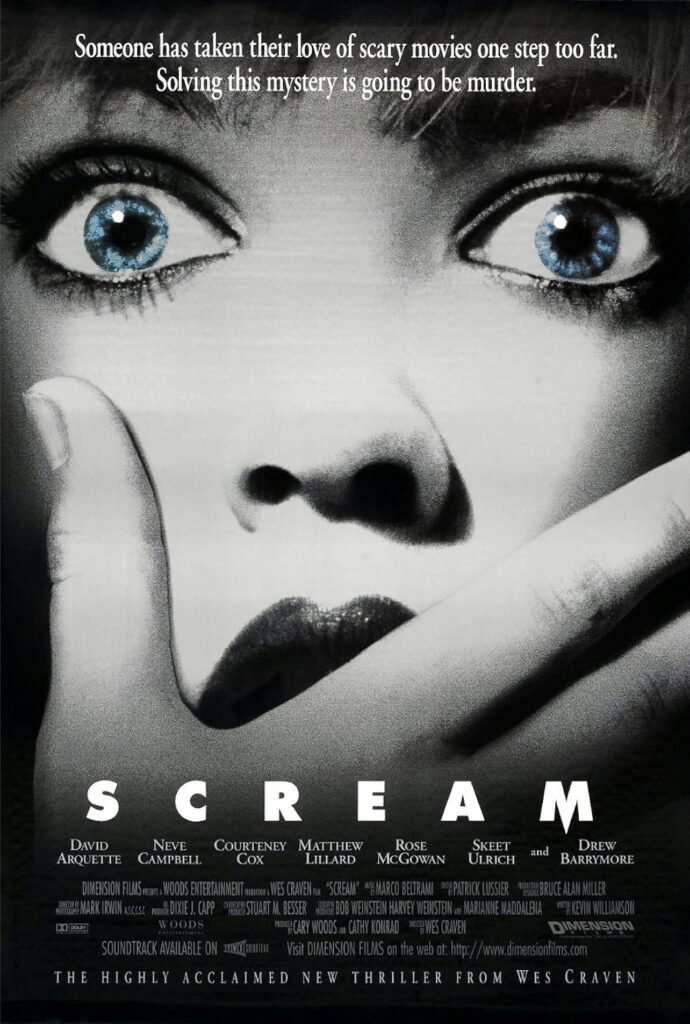
Introduction: Why Scream Changed Everything
When Scream hit theaters on December 20, 1996, no one expected it to resurrect horror itself. Directed by Wes Craven, written by Kevin Williamson, and starring Neve Campbell, Scream didn’t just scare audiences—it rewrote the rules. Combining slasher suspense, self-aware humor, and shocking twists, Scream became a cultural lightning bolt that revived the genre and introduced the world to Ghostface.
This comprehensive guide explores everything that makes Scream a modern horror masterpiece—from its shocking opening scene and Ghostface origin story to its lasting Scream film legacy and influence on cinema today.
Quick Facts: Scream at a Glance
| Aspect | Details |
|---|---|
| Director | Wes Craven |
| Writer | Kevin Williamson |
| Release Date | December 20, 1996 |
| Runtime | 111 minutes |
| Budget / Gross | $14–15 million / $173 million worldwide |
| Genre | Meta-Slasher, Horror, Mystery |
| Studio | Dimension Films (Miramax) |
| Cinematography | Mark Irwin, Peter Deming |
| Music | Marco Beltrami |
| CreepyCinema Scare Rating | 8.5/10 |
Plot Summary: A Small Town’s Deadly Secret
Set in the fictional town of Woodsboro, California, Scream follows high school student Sidney Prescott (Neve Campbell) as she becomes the target of a masked killer known as Ghostface. For those seeking Scream 1996 explained, the terror begins with one of cinema’s most unforgettable opening sequences: teenager Casey Becker (Drew Barrymore) receives a mysterious phone call that evolves from playful horror movie trivia into a deadly game of survival, ending with her brutal murder.
As the body count rises, Sidney and her circle of friends—including her best friend Tatum Riley (Rose McGowan), horror movie enthusiast Randy Meeks (Jamie Kennedy), her boyfriend Billy Loomis (Skeet Ulrich), and his friend Stu Macher (Matthew Lillard)—find themselves trapped in what Randy describes as a real-life horror movie. Meanwhile, ambitious tabloid reporter Gale Weathers (Courteney Cox) and well-meaning Deputy Dewey Riley (David Arquette) investigate the killings.
The film brilliantly balances its slasher elements with a murder-mystery whodunit structure, leading to a shocking Scream movie ending twist: both Billy and Stu are the killers, working together to frame Sidney’s father and avenge Billy’s mother, who abandoned him after an affair with Sidney’s mother. This double-killer revelation—two killers instead of one—became a franchise hallmark and influenced countless horror films that followed.
Cast and Characters: Meet the Woodsboro Survivors (and Victims)
Sidney Prescott (Neve Campbell)
Sidney represents a pivotal Sidney Prescott final girl analysis for horror cinema. Still grieving her mother’s murder a year earlier, Sidney must confront both physical danger and psychological trauma. Unlike traditional final girls who stumble through survival by luck or virtue, Sidney actively fights back with intelligence, skepticism, and agency. Campbell’s performance grounds the film’s meta-humor with genuine emotional depth, creating a protagonist who feels real rather than archetypal—a young woman dealing with grief, relationship uncertainty, and the horrifying realization that those closest to her cannot be trusted.
Gale Weathers (Courteney Cox)
Playing brilliantly against her Friends sitcom persona, Cox portrays Gale as a ruthlessly ambitious reporter who wrote a controversial book about Sidney’s mother’s murder. Initially antagonistic, Gale evolves into a crucial ally, proving that even the most cynical character can be heroic when it counts.
Deputy Dewey Riley (David Arquette)
As Tatum’s well-meaning but slightly bumbling older brother, Dewey provides both comic relief and genuine heart. His sweet flirtation with Gale became one of the franchise’s most beloved elements—and led to a real-life romance between Arquette and Cox during filming.
The Supporting Cast
Tatum Riley (Rose McGowan): Sidney’s sassy, loyal best friend who delivers some of the film’s best one-liners before meeting her demise in the infamous garage door scene.
Billy Loomis (Skeet Ulrich): Sidney’s intense, brooding boyfriend whose ultimate reveal as one of the killers shocked audiences worldwide.
Stu Macher (Matthew Lillard): The goofy, seemingly harmless friend whose transformation into a gleeful psychopath remains one of horror’s most memorable villain turns.
Randy Meeks (Jamie Kennedy): The horror movie expert whose knowledge of genre “rules” provides both comic relief and meta-commentary throughout the film.
Casey Becker (Drew Barrymore): Though only appearing in the opening sequence, Barrymore’s character set the tone by proving that no one—not even the biggest star—was safe.
Ghostface: The Voice Behind the Mask
Roger L. Jackson provided the chilling voice of Ghostface, never appearing on set to keep the actors genuinely unsettled during filming. His taunting, menacing delivery of lines like “Do you like scary movies?” became instantly iconic.
Behind the Scenes: The Making of a Horror Classic
Development: From Rejected Script to Bidding War
Kevin Williamson wrote the original screenplay (titled “Scary Movie”) in just three days, inspired by a real-life experience while house-sitting. After watching a news program about the Gainesville Ripper serial killer and hearing suspicious noises, Williamson called a friend in a panic—and that very night began writing what would become Scream’s legendary opening scene.
Williamson’s script drew heavily from classic horror films he loved—particularly John Carpenter’s Halloween (1978), Fred Walton’s When a Stranger Calls (1979), and Sean S. Cunningham’s Friday the 13th (1980). This Wes Craven Scream behind the scenes development process created a bridge between horror’s golden age and its postmodern revival, with Williamson deliberately deconstructing the very films that inspired him.
The script sparked an immediate bidding war in Hollywood, ultimately won by Dimension Films (Miramax’s genre division). However, securing a director proved challenging. Wes Craven initially turned down the project, exhausted by horror after disappointing experiences with “Vampire in Brooklyn” and other films. He wanted to escape what he called “the horror ghetto.”
Other directors considered included Robert Rodriguez, Danny Boyle, Sam Raimi, George Romero, and even Quentin Tarantino. What finally convinced Craven to sign on? Drew Barrymore’s enthusiasm for playing the opening-scene victim rather than the lead—a casting twist inspired by Janet Leigh’s shocking early death in “Psycho.”
Casting: Finding the Perfect Scream Queen
With Barrymore taking the cameo role, the production needed a new lead. Neve Campbell, then starring in TV’s “Party of Five,” delivered such a compelling audition that the filmmakers “front-loaded” her in the audition reel. No other actress came close.
The supporting cast came together with a mix of up-and-comers and familiar faces:
- Courteney Cox actively pursued the role of Gale Weathers, eager to play against type
- David Arquette was originally considered for Billy but lobbied to play lovable Dewey instead
- Skeet Ulrich researched real-life killers like Leopold and Loeb to prepare for Billy
- Matthew Lillard improvised many of Stu’s wildly comic moments, including the famous “You hit me with the phone, dick!” line
Interestingly, Reese Witherspoon, Brittany Murphy, and Vince Vaughn were all considered for various roles before the final cast was assembled.
Filming: 21 Nights of Horror in Northern California
Principal photography took place over eight weeks in mid-1996, primarily around Santa Rosa, California in Sonoma County. However, last-minute drama struck when the local school board withdrew permission to film at Santa Rosa High School after reading the script’s violent content. Craven had to scramble, relocating scenes to the Sonoma Community Center and rewriting sequences on the fly.
In a delicious act of revenge, Craven added “NO THANKS whatsoever to the Santa Rosa City School District Governing Board” to the film’s end credits.
Other key locations included:
- A secluded farmhouse estate in Tomales, CA (Stu’s party house)
- Various neighborhoods in Glen Ellen and Healdsburg, CA
The climactic party sequence—dubbed “Scene 118” by the crew—proved especially grueling. This 42-minute sequence required 21 consecutive night shoots, earning the joking title “The longest night in horror history.” The cast wore the same blood-soaked costumes night after night for continuity, with Neve Campbell recalling how her outfit became so stiff with dried corn-syrup blood that wardrobe could only dampen it between takes.
Creative Techniques That Elevated the Terror
The Ghostface Voice: Rather than dubbing dialogue in post-production, Roger L. Jackson made live phone calls to the actors during filming, hiding just out of sight. This technique kept the cast genuinely unsettled—they truly felt someone unknown was watching and taunting them. Jackson even improvised chilling lines like “Have you ever felt a knife cut through human flesh and scrape the bone beneath?” which weren’t in the original script.
Drew Barrymore’s Tears: To help Barrymore cry authentically during the opening scene, Craven whispered disturbing stories about animal cruelty between takes. Drew later said simply hearing Craven say “I’m lighting the lighter…” would instantly bring her to tears.
Maintaining Secrecy: The production distributed dummy scripts with different endings to cast and crew to protect the killer reveal. Actors only received final pages when absolutely necessary.
Production Challenges & Censorship
The MPAA Battle: Nine Submissions for an R Rating
Scream initially earned an NC-17 rating for graphic violence. Wes Craven had to submit the film nine times, making numerous small edits, to finally secure an R rating—a grueling process that tested the limits of creative expression in mainstream horror.
Ironically, beyond gore and disembowelments, the MPAA took particular issue with Billy’s line: “Movies don’t create psychos; movies make psychos more creative.” This meta-comment on media influence—the very thesis of Williamson’s script—was considered too provocative and “problematic” by the ratings board. The line spoke an uncomfortable truth about the relationship between art and violence, making censors nervous about its cultural impact.
Craven stood his ground and kept the line in the final cut, defending the film’s right to commentary on the very debates surrounding horror cinema. Editor Patrick Lussier noted the MPAA never frames objections as outright censorship, just as “areas of concern,” but it was clear that self-referential statement struck a nerve with those who preferred horror to remain safely escapist rather than culturally critical.
School Board Drama
Another major challenge arose when Santa Rosa High School’s board withdrew filming permission at the last minute after reading the script’s violent content. This forced Craven to scramble, relocating scenes to the Sonoma Community Center and rewriting sequences on the fly. In a delicious act of revenge, Craven added “NO THANKS whatsoever to the Santa Rosa City School District Governing Board” to the film’s end credits—a pointed jab that remains in every version of the film.
The Ghostface Mask: An Accidental Icon
The Ghostface origin story is one of Hollywood’s happiest accidents. The now-iconic mask wasn’t designed for the film—it was an existing Halloween mask (Fun World’s “Genie” or “Fantastic Faces” design) that producer Marianne Maddalena discovered hanging in a house during location scouting. The design, reminiscent of Edvard Munch’s “The Scream” painting and with an otherworldly, distorted quality, was perfect for the film’s needs.
Because neither the production nor Williamson owned the design, Dimension had to license it from Fun World, which then trademarked it as “Ghostface” in 1996. This business arrangement turned out to be fortuitous for everyone—Fun World gained a cultural icon, and Scream got an instantly recognizable villain that felt both fresh and somehow archetypal.
The costume’s robe was originally going to be white but was changed to black to appear more ominous on camera and avoid any resemblance to Ku Klux Klan robes. This simple color change helped create one of horror’s most enduring visual designs—a flowing black robe paired with that stark white screaming face, making Ghostface instantly visible in dark scenes while maintaining an theatrical, almost operatic quality.
The Title Change Controversy
Very late in production, the Weinstein brothers insisted on changing the title from “Scary Movie” to “Scream,” inspired by the Michael and Janet Jackson song. This decision was initially unpopular with Williamson and the crew, and even triggered a brief legal scare when Sony Pictures claimed it infringed on their film “Screamer” (1995). The lawsuit was quickly settled, and in hindsight, most agreed “Scream” was the perfect title. The rejected “Scary Movie” title later became famous as the 2000 parody film that spoofed Scream.
Box Office Success: The Horror Hit Nobody Expected
Produced on a modest $14-15 million budget, Scream was released during an unconventional time—December 20, 1996, right in the Christmas holiday season typically reserved for family films and prestige dramas. The gamble initially seemed questionable: Scream debuted at #4 with only $6.3 million on 1,413 screens, overshadowed by “Beavis and Butt-head Do America” and “Jerry Maguire.”
Industry analysts predicted the film would quickly fade. But something remarkable happened: powered by explosive word-of-mouth, Scream’s grosses actually increased in its second weekend to approximately $9 million—a rare 50%+ gain. The momentum continued building throughout early 1997.
By the end of its theatrical run, Scream had grossed $103 million domestically and approximately $173 million worldwide—more than 11 times its production budget. This made Scream the highest-grossing slasher film of all time, a title it held for over two decades until 2018’s Halloween reboot finally surpassed it. For the 1990s, Scream became one of the top-performing horror films of the decade and proved that clever, quality horror could dominate mainstream entertainment.
The film remained in theaters for months, still pulling in over $1 million per weekend as late as Memorial Day 1997—an extraordinarily long run that proved horror’s creative renaissance had arrived.
Marketing: The Clever Campaign That Fooled Everyone
Dimension Films deliberately bait-and-switched audiences by featuring Drew Barrymore prominently in posters and trailers, billing her as a lead despite her brief appearance. This marketing trick—championed by Barrymore herself—made her shocking early death all the more effective.
The poster’s tagline captured the film’s mystery: “Someone has taken their love of scary movies one step too far… Solving this mystery is going to be murder.”
An unintended but telling outcome of Scream’s popularity: Caller ID usage reportedly tripled in America after the film’s release. The image of a killer taunting victims over anonymous phone calls was so potent that viewers rushed to adopt caller identification technology—demonstrating how deeply Scream penetrated the public consciousness.
Industry Impact: How Scream Saved Dimension Films
Scream’s runaway success essentially rescued Dimension Films, the Weinstein brothers’ genre division at Miramax. The film’s massive profitability—earning over 11 times its budget—gave Dimension the financial confidence and industry clout to greenlight and fund a wave of late-’90s genre hits.
Following Scream’s triumph, Dimension bankrolled:
- Halloween H20 (1998): The successful Jamie Lee Curtis comeback
- The Faculty (1998): Another Kevin Williamson script
- Mimic (1997): Guillermo del Toro’s early creature feature
- From Dusk Till Dawn series and other genre projects
This business impact extended beyond Dimension—Scream’s box office proved to major studios that intelligently crafted horror could be both critically respected and commercially dominant, opening doors for higher-budget horror productions throughout the late ’90s and early 2000s. The film didn’t just revive a genre; it revived an entire business model for genre filmmaking.
Critical Reception: From Mixed Reviews to Horror Classic
Initial Reviews (1996-1997)
Scream opened to generally positive reviews, with critics surprised by its fresh take on horror. Roger Ebert gave it 3 out of 4 stars, noting that “Scream is not about the plot. It is about itself. In other words, it is about characters who know they are in a plot.” He appreciated the meta-deconstruction while cautioning that the ironic humor might defuse horror for some viewers.
The Washington Post’s Richard Harrington praised how the film “deftly mixes irony, self-reference and wry social commentary with chills and blood spills,” admitting the whodunit twist caught him by surprise.
However, not all critics embraced Scream’s unique tone. The New York Times’ Janet Maslin argued that Craven “wants things both ways, capitalizing on lurid material while undermining it with mocking humor.” Some questioned whether mixing self-parody with brutal violence was appropriate or effective.
Despite these reservations, Scream holds an approximate 78-80% approval rating on Rotten Tomatoes, remarkably strong for a horror film in that era. The script, performances (particularly Campbell and Barrymore), and fresh approach won widespread praise.
Evolving Legacy
In the decades since release, Scream’s reputation has only grown. What seemed novel in 1996 is now recognized as revolutionary. The film appears on numerous “best of” lists:
- Entertainment Weekly’s “New Classics” (#60)
- Bravo’s 100 Scariest Movie Moments (#13 for the opening sequence)
- Empire magazine’s 500 Greatest Movies of All Time
Film scholars now credit Scream with single-handedly reviving the slasher genre and making horror “cool” again for late ’90s youth audiences. The once-controversial elements (meta-humor, violence) are now standard in horror, and the film is taught in film courses as a prime example of postmodernism in popular cinema.
Today, Scream maintains a “Fresh” 79% rating on Rotten Tomatoes and is beloved by fans across generations. On its 25th anniversary in 2021, numerous retrospectives praised how Scream “redefined the entire horror genre for a new generation” and how its commentary on media and violence remains relevant in the internet age.
Awards and Honors: Recognition for a Genre Game-Changer
Scream received recognition from both mainstream and genre award bodies—rare for horror films in the 1990s:
1997 MTV Movie Awards:
- Winner: Best Movie (beating several big-budget Hollywood films)
- Nominated: Best Female Performance (Neve Campbell)
- Nominated: Best Kiss (Courteney Cox and David Arquette)
23rd Annual Saturn Awards (1997):
- Winner: Best Horror Film
- Winner: Best Actress (Neve Campbell)
- Winner: Best Writing (Kevin Williamson)
Other Honors:
- Grand Prize at the Gérardmer Film Festival (Wes Craven)
- Blockbuster Entertainment Award for Favorite Actress, Horror (Neve Campbell)
- Fangoria Chainsaw Awards: Best Supporting Actress (Drew Barrymore)
- International Film Music Critics: Breakthrough Composer (Marco Beltrami)
The MTV Movie Awards victory was particularly significant—for a slasher film to be celebrated as “Best Movie” by mainstream audiences (MTV viewers) was almost unheard of, underlining Scream’s crossover appeal and cultural impact.
In subsequent years, Scream has received retrospective honors, including induction into the Horror Hall of Fame by Fangoria magazine in 2020.
Themes and Style: Meta-Horror That Changed the Game
The Birth of Meta-Horror
Scream is often hailed as “meta-horror”—a film that is simultaneously a straight slasher story and a commentary on slasher stories. Kevin Williamson’s screenplay is packed with self-referential humor, genre in-jokes, and characters who consciously discuss horror clichés even as they unwittingly participate in them.
This approach was groundbreaking in 1996. As one analysis notes, Scream “revamped the dying [slasher] genre by pastiching its formulaic structure.” The film takes well-worn tropes (mysterious killer, high body count, teens in peril, the “final girl”) and calls attention to them—yet still delivers them effectively.
The Rules of Horror
One of Scream’s most famous moments occurs when Randy lays out the “rules” for surviving a horror film at the party:
- No sex (virgins are the survivors)
- No drinking or drugs (sins get punished)
- Never say “I’ll be right back” (because you won’t be)
This meta-monologue is both humorous and foreboding, as the partygoers proceed to break all the rules. Scream uses self-aware dialogue to satirize the very formula it’s following. Sidney even comments on how horror heroines are “big-breasted girls who can’t act” running up stairs instead of out the door—then later finds herself chased up the stairs by Ghostface.
Deconstructing Horror Tropes
Scream systematically deconstructs several conventions:
- The killer’s identity: Not a supernatural entity but literally one of the friends, adding paranoia to every interaction
- The Final Girl: Sidney starts as a virgin (fitting the trope) but subverts it by losing her virginity to Billy and still surviving
- Absent parents: Woven into Sidney’s backstory and given real weight as core motivation for the killers
- Self-awareness: Characters explicitly reference Halloween, Friday the 13th, and other slashers, positioning themselves as horror-literate
Social Commentary: Media, Violence, and Society
Beyond genre tropes, Scream offers sharp commentary on media sensationalism. Gale Weathers represents exploitative journalism—writing a book on Sidney’s tragedy and chasing ambulances for stories. Students react to classmates’ deaths with morbid thrill, some even wearing Ghostface masks to school as pranks.
The film addresses the “violence in media” debate head-on. Billy’s controversial line—”Movies don’t create psychos; movies make psychos more creative!”—is Williamson inserting commentary on how society blames horror films for real violence. In Scream, the killers partially imitate movies but are motivated by personal trauma, not cinema itself.
Visual Style and Direction
Wes Craven directs with slick, modern visual style that differed from grittier ’80s slashers. The camera is fluid, employing clever point-of-view shots (inside closets, through windows, from the killer’s perspective). The editing is tight during chase scenes but knows when to slow down and build suspense—the opening scene is a masterclass in pacing.
Craven uses Dutch angles and shadowy lighting to establish unease, as seen when the camera slowly pushes in off-kilter during Casey’s phone call as the conversation turns threatening. The violence, while graphic, has a slightly exaggerated quality that underscores the dark comedy.
The Score: Marco Beltrami’s Breakthrough
Composer Marco Beltrami created the eerie original score in his first major film assignment. Remarkably, Beltrami had never seen a horror movie before scoring Scream—Craven specifically wanted a fresh musical perspective. The result was an avant-garde mix of suspenseful orchestral themes, including the haunting “Sidney’s Lament” motif with its ethereal female vocals.
Beltrami’s Scream score launched his career as a sought-after genre composer, and he returned for Scream 2, 3, and 4.
Cultural Impact: How Scream Changed Horror Forever
Reviving the Slasher Genre
The impact of Scream on horror cinema cannot be overstated. After its success, studios rushed to produce teen horror films, leading to a wave of Scream-influenced slashers:
- I Know What You Did Last Summer (1997, also written by Kevin Williamson)
- Urban Legend (1998)
- Halloween H20 (1998)
- Cherry Falls (2000)
- Valentine (2001)
Even established franchises adjusted their approach. Halloween H20 brought back Jamie Lee Curtis with polished style and meta-humor explicitly because Scream demonstrated audience appetite for such horror.
Ghostface: A New Horror Icon
Prior to Scream, the slasher icon pantheon was locked with ’70s/’80s characters (Freddy, Jason, Michael Myers, Leatherface). Scream gave the world a new icon for the ’90s—Ghostface, with his flowing black robe and white screaming mask.
The Ghostface mask became one of the most popular Halloween costumes from 1997 onward, a perennial staple at costume shops. The voice, the look, and catchphrases like “Do you like scary movies?” became instantly recognizable worldwide. Unlike Freddy or Jason, “Ghostface” is a mantle various characters assume, yet the design remains iconic.
Influence on Filmmakers and Future Horror
Scream’s influence extends to:
- The Cabin in the Woods (2012): Direct meta-horror descendant
- Behind the Mask: The Rise of Leslie Vernon (2006): Deconstruction of slasher tropes
- Happy Death Day series: Horror-comedy balance
- Buffy the Vampire Slayer (premiered 1997): Strong heroine with meta quips
Kevin Williamson’s style of witty teen dialogue plus horror references became a blueprint, influencing not just horror but teen entertainment throughout the late ’90s and early 2000s.
Parodies and References
Scream’s cultural footprint is evident in how heavily it was parodied:
- Scary Movie (2000): Direct parody using Scream’s original working title
- Saturday Night Live sketches
- South Park episodes
- MTV Movie Awards (1997): Mike Myers parodied the opening scene
Lines like “What’s your favorite scary movie?” became nationwide catchphrases. The film launched “a thousand film-school discussions on meta-textualism,” as Entertainment Weekly noted.
Long-Term Legacy
Scream paved the way for:
- Horror’s embrace of self-awareness and meta-commentary
- The horror-comedy boom of the 2000s
- “Elevated horror” that mixes intelligence with scares
- TV horror (MTV’s Scream series, Slasher, etc.)
- Marketing tricks (big stars with early deaths)
The film influenced how audiences engage with horror—after Scream, horror fans became far more comfortable with open self-referentiality.
Legacy in Horror Studies: Academic Recognition
Scream’s impact extends beyond popular culture into serious academic discourse about horror cinema. The film has become a cornerstone text in horror film studies, frequently analyzed in scholarly works examining postmodern cinema, genre evolution, and cultural anxiety.
Essential Academic Context
Film scholars regularly cite Scream in foundational horror theory texts:
Carol J. Clover’s “Men, Women, and Chain Saws: Gender in the Modern Horror Film” (revised editions): While Clover’s original work predates Scream, later discussions of the “Final Girl” trope frequently use Sidney Prescott as a evolved example—a character who is both aware of the trope she embodies and actively subverts it.
Mark Jancovich’s Essays on Postmodern Horror: Jancovich and other scholars have examined how Scream represents a turning point where horror cinema became explicitly self-reflexive, marking a shift from modern to postmodern horror aesthetics.
Academic Journals: Scream appears regularly in film studies journals discussing:
- Intertextuality and self-referential cinema
- The relationship between media violence and real violence
- Generational shifts in horror consumption
- The economics of genre revival
- Gender politics in slasher films
Scream in the Classroom
The film is now standard curriculum in university film studies courses worldwide, taught as:
- A prime example of meta-cinema and postmodernism in popular entertainment
- A case study in genre deconstruction and reconstruction
- An exploration of audience expectations and how filmmakers can simultaneously meet and subvert them
- A text for discussing media literacy and cultural commentary within entertainment
Students analyze Randy’s “rules” monologue as a moment where the film breaks the fourth wall without technically breaking it—the characters acknowledge genre conventions while remaining unaware they’re in a movie themselves, creating a sophisticated narrative layer.
This academic legitimacy is rare for slasher films. Where Friday the 13th or Nightmare on Elm Street might be studied primarily as cultural phenomena, Scream is analyzed for its narrative technique, thematic complexity, and philosophical implications about the nature of storytelling itself. For a film that began as a spec script written in three days, this intellectual legacy represents one of its most surprising achievements.
The Scream Franchise: Sequels and Evolution
Scream 2 (1997)
Released less than a year after the original, Scream 2 follows Sidney at college as copycat murders begin. The film doubles down on meta-commentary by discussing horror sequels while attempting to be one. It opens with “Stab” (a movie-within-a-movie based on Woodsboro murders) and features a memorable crowded-theater massacre.
Scream 2 shocked audiences by killing Randy, proving even beloved characters weren’t safe. Many critics argued it matched or surpassed the original in tension and cleverness.
Scream 3 (2000)
Set in Hollywood on the set of Stab 3, Scream 3 takes meta to extreme levels. Sidney walks through set recreations of her home, creating surreal commentary on trauma and storytelling. Due to Columbine concerns, the studio requested reduced graphic violence, resulting in a lighter, campier tone.
Scream 3 broke tradition by featuring only one killer (script changes and simplification led to abandoning the two-killer format). It delves into Sidney’s mother’s Hollywood past, commenting on “third part of trilogy” tropes. Often viewed as the weakest entry, it still provides closure to Sidney’s original arc.
Scream 4 (2011)
After a decade break, Wes Craven and Kevin Williamson returned for Scream 4, which functions as both sequel and soft reboot. Set on the 15th anniversary of the original massacre, it satirizes the remake/reboot trend that dominated 2000s horror.
The opening features brilliant fake-out Stab movie scenes-within-scenes. The killer’s motive—recreating original Scream killings for social media fame—offers fresh commentary. Scream 4 has more graphic violence, reflecting horror’s evolution by 2011, and was appreciated as a return to the spirit of the first two films.
Scream (2022) [Scream 5]
After Craven’s death in 2015, new directors (Matt Bettinelli-Olpin and Tyler Gillett) revived the franchise with a “requel”—part reboot, part sequel. Sidney, Gale, and Dewey return in supporting roles while focus shifts to new protagonist Sam Carpenter.
Scream 2022 explicitly critiques toxic fandom and “requels,” with killers being hardcore Stab fans disappointed in recent entries. It lovingly recreates beats from 1996 (updated Casey Becker opening with smart home technology) and brings back Stu’s house for the climax. The film successfully bridges old and new, passing the torch to a new final girl.
Scream VI (2023)
The latest installment took a bold step by moving to New York City, departing from Woodsboro’s suburban setting. Sidney Prescott doesn’t appear (Neve Campbell’s pay dispute), marking the first film without her.
Scream VI comments on franchise longevity and escalation, incorporating true-crime fandom and online conspiracy theories (including a Ghostface shrine). It kills a legacy character (Dewey) to demonstrate “anyone can die” stakes. The NYC setting (including a subway Halloween sequence) provides fresh visuals while maintaining Scream’s core mystery formula.
Series Connections
Each Scream sequel adds layers of commentary:
- Scream (1996): Established the rules
- Scream 2: Examined sequels
- Scream 3: Lampooned trilogies and Hollywood
- Scream 4: Tackled remakes/reboots
- Scream (2022): Dissected requel culture and fandom
- Scream VI: Explored franchise fatigue and escalation
What connects them: the continuous narrative (at least through 5), recurring characters, and the idea that Ghostface could be anyone—the whodunit structure persists. Differences lie in tone, setting, and thematic focus, but Scream (1996) remains the most groundbreaking, setting a template the franchise continues to riff on brilliantly.
Iconic Scenes and Unforgettable Quotes
The Opening Scene: “What’s Your Favorite Scary Movie?”
Often ranked among horror’s most effective sequences, the opening follows Casey Becker (Drew Barrymore) home alone, making popcorn when she receives a flirtatious phone call. The banter about horror movies quickly turns sinister as the caller reveals he’s watching her.
The tension escalates unbearably until Casey is attacked and brutally murdered just as her parents arrive home, finding her corpse hanging from a tree. This scene’s audacity—killing the apparent star in the first 12 minutes—stunned audiences and set Scream’s ruthless tone.
Behind the scenes, Barrymore’s genuine tears came from Craven’s unorthodox method: whispering disturbing animal cruelty stories between takes. Her terrified performance, combined with the scene’s suspenseful pacing and Ghostface’s chilling dialogue, created an instant horror classic.
Randy’s “Rules” Monologue
At the party climax, horror buff Randy explains the rules for surviving a horror movie:
“There are certain rules that one must abide by in order to successfully survive a horror movie. Number one: you can never have sex. Sex equals death, okay? Number two: you can never drink or do drugs. And number three: never, ever, ever under any circumstances say ‘I’ll be right back.’ Because you won’t be back.”
This scene crystallizes Scream’s meta-thesis. The interplay with Halloween playing on TV—where Randy yells “Jamie, behind you!” to Jamie Lee Curtis while Ghostface stalks behind him—creates brilliant layers of irony.
The Garage Door Kill
Tatum’s death remains one of Scream’s most creative and shocking kills. Heading to the garage for beer during the party, she encounters Ghostface. Thinking it’s a prank, she jokes: “Oh, you want to play psycho killer? Can I be the helpless victim?”
When Ghostface attacks, Tatum fights back fiercely, pelting him with beer bottles. But attempting escape through the pet door, she’s trapped as Ghostface raises the automatic garage door, crushing her at the top. The mix of Tatum’s sass, fierce resistance, and sudden gruesome death exemplifies Scream’s tonal balance.
The Kitchen Showdown
The climactic reveal—Billy and Stu as the killers—takes place in Stu’s kitchen. Billy, appearing dead, suddenly resurrects: “We all go a little mad sometimes” (quoting Psycho). The double-killer revelation shocked audiences.
As they monologue, iconic exchanges occur:
Sidney: “Why are you doing this?”
Billy: “It’s scarier when there’s no motive!”
After stabbing each other to fake being victims, Stu whines: “My mom and dad are gonna be so mad at me!” This childlike complaint amid carnage encapsulates Scream’s dark humor.
When Billy hits Stu with the phone, Stu’s improvised “You hit me with the phone, dick!” became a cult favorite—left in because of its authenticity.
Sidney ultimately gains the upper hand, donning the Ghostface mask to unnerve Billy before fighting back. When Billy attempts a final scare, Sidney shoots him: “Not in my movie.”
Memorable Quotes
Ghostface’s Taunts:
- “Do you like scary movies?”
- “What’s your favorite scary movie?”
- “I’m gonna gut you like a fish!”
- “Hello, Sidney.”
Meta Commentary:
- “Movies don’t create psychos, movies make psychos more creative!” (Billy)
- “This is like a horror movie. It is a horror movie!” (Randy)
- “They ALWAYS come back.” (Randy’s warning before Billy’s last jump scare)
Dark Humor:
- “My mom and dad are gonna be so mad at me!” (Stu, while dying)
- “You hit me with the phone, dick!” (Stu to Billy)
- “It’s all a movie. It’s all one great big movie. Only you can pick your genre.” (Billy)
These scenes and quotes have become part of horror’s cultural lexicon, referenced, parodied, and celebrated for nearly three decades.
Merchandising and Fan Culture
The Ghostface Phenomenon
The most ubiquitous piece of Scream merchandise is the Ghostface mask and costume. Sales skyrocketed after release—what was once a $2 novelty item became a must-have Halloween costume. Every October since 1996, the Ghostface mask appears everywhere, arguably one of the top-selling Halloween costumes of the past 25+ years.
Fun World officially renamed the mask “Ghostface” and continues producing it with numerous variations (glow-in-the-dark, zombie versions), though the classic look remains most popular.
Collectibles and Memorabilia
- Action Figures: McFarlane Toys released detailed Ghostface figures (1999) with phone accessories and voice boxes
- Prop Replicas: Replica knives and voice changers for hardcore fans
- Home Video: Original VHS released with three collectible covers (Barrymore, Campbell, Cox) and special editions included phone cards—a playful nod to the film’s motif
- Special Editions: DVDs and Blu-rays feature documentaries like “Still Screaming” and “Scream: The Inside Story”
Fan Community
Scream fandom has thrived for decades:
- Early Days: Fans debated killer identities on message boards and created dedicated websites (HelloSidney.com, Scream-Thrillogy)
- Modern Era: Social media and Reddit communities share memes, cosplay, and host “Scream-a-thon” viewing parties each Halloween
- Location Tourism: Fans visit filming locations, including Stu’s house in Tomales, CA, where official fan parties have been held
- Convention Presence: Regular cast reunions at horror conventions (Monster Mania Con, etc.) draw enthusiastic crowds across generations
The “Stab” Meta-Universe
The franchise’s internal movie series “Stab” has inspired fans to create fake posters, fan fiction, and fan-made short films pretending to be Stab entries—meta upon meta, with fans playing in Scream’s self-created sandbox.
Gaming and Modern Media
Ghostface was added to the horror video game Dead by Daylight (2019), allowing gamers to play as a Ghostface-like killer—demonstrating the character’s enduring appeal across media platforms.
The franchise wisely embraces its fanbase, including easter eggs in recent sequels that reference fan theories and online discussions, making devotees feel part of the story.
Scream Today: Relevance and Lasting Legacy
A Modern Horror Benchmark
Nearly three decades after release, Scream remains a benchmark for the horror genre. As the film turned 25 in 2021, retrospectives celebrated how revolutionary it truly was. It commonly appears on “greatest horror films of all time” lists alongside The Exorcist and Halloween.
Scream is credited with pulling the slasher film out of a creative slump and making horror “cool” again for late ’90s youth. In essence, Scream did for ’90s horror what Halloween did for ’70s horror—it revitalized and redefined it for a new generation.
Academic Recognition
Scream is now studied in film courses as prime example of postmodern cinema. Its use of intertextuality, self-referential script, and genre commentary make it rich for analysis. Scholars have examined its portrayal of violence, meta-narrative on audience expectations, and even queer subtext in Billy and Stu’s partnership (which Kevin Williamson later acknowledged as an interesting interpretation).
Few slasher films can claim this level of academic interest.
Influence on Modern Filmmakers
Many contemporary horror directors cite Scream as pivotal inspiration. You can see homages in:
- The Cabin in the Woods (2012): Arguably wouldn’t exist without Scream’s meta-horror template
- Jordan Peele’s Work: Get Out’s balance of horror and social commentary shares Scream’s ethos
- The “Requel” Trend: Halloween (2018), Candyman (2021), and others owe debt to Scream’s approach
Sidney Prescott’s Impact
Sidney is often mentioned among the best “Final Girls” in horror. She broke molds by being self-aware and actively fighting back—no damsel in distress. Sidney’s legacy influences later heroines like Laurie Strode in Halloween (2018), who has a character arc more about empowerment and trauma processing than perpetual victimhood.
Themes That Aged Well
Aside from dated technology (landline phones, VHS tapes), Scream’s storytelling holds up remarkably well. Its themes—satirizing horror conventions, commenting on media—are arguably more relevant in the internet age with true-crime obsession and media saturation. The cultural conversation about violence and media that Scream engaged with continues today.
Franchise Vitality
The success of Scream (2022) and Scream VI (2023)—both critical and commercial hits—proves the franchise’s enduring relevance. New audiences discover the original through these sequels. Scream (1996) doesn’t feel dated to younger viewers; the dialogue and pace remain modern.
Continued Recognition
- 84% “Fresh” rating on Rotten Tomatoes maintained
- Frequently listed in “Top 100 Horror Films”
- Ghostface included in Entertainment Weekly’s best villains list
- 2020 induction into Fangoria’s Horror Hall of Fame
- Referenced constantly in modern media (Stranger Things, countless social media memes)
The “Pre-Scream” vs. “Post-Scream” Divide
Horror fans sometimes divide eras into pre-Scream and post-Scream. The post-Scream era normalized self-awareness in horror. Today’s audiences almost expect meta-commentary—a direct result of Scream’s innovation.
Why Scream Endures
Scream proved horror can be commercially successful and smart simultaneously. This helped horror gain mainstream respect and paved the way for the 2010s “elevated horror” movement. From Scream, you can draw lines to The Cabin in the Woods, It Follows, and even A24’s horror output—all showing that audiences appreciate horror with something to say.
Conclusion: The Film That Saved Horror
Scream (1996) stands as a genre-defining masterpiece that accomplished what few films can: it simultaneously honored and deconstructed its genre, delivering genuine scares while commenting on the nature of fear itself. Wes Craven’s direction and Kevin Williamson’s brilliant screenplay created something that was both of its moment and timeless.
From its shocking opening scene to its knife-edge balance of terror and humor, Scream reminded audiences why they fell in love with horror while introducing a new generation to the thrill of the slasher film. It gave us Ghostface, a horror icon for the ages, and Sidney Prescott, a final girl who fought back with intelligence and agency.
The film’s influence radiates through modern horror—every meta-commentary, every self-aware thriller, every horror film that dares to be smart and scary owes a debt to Scream. Its box office trajectory from modest opener to cultural phenomenon proved that quality horror could dominate mainstream entertainment.
Whether you’re experiencing Scream for the first time or revisiting it for the dozenth, the film delivers. The suspense remains taut, the humor lands, and that opening scene still terrifies. Twenty-eight years later, when that phone rings and Ghostface asks “What’s your favorite scary movie?”—the answer, for millions of horror fans, remains the same: Scream.
Do you like scary movies? If the answer is yes, Scream (1996) is essential viewing—the film that redefined horror for modern audiences and continues to influence the genre today.
For more deep dives into classic horror films, stay tuned to our comprehensive film guides and horror retrospectives.