The arrival of synchronized sound transformed horror. Suddenly the creak of a floorboard, the low moan of wind through a ruined castle, and the hiss of a vampire could accompany the images. The effect was electrifying. But the real revolution was subtler than simply adding noise to pictures. Sound gave filmmakers a new instrument for engineering dread: the strategic use of silence.
Consider Dracula (1931). Its musical content is famously sparse, largely limited to “Swan Lake” over the titles and a few concert-hall cues. To modern ears it can feel incomplete, almost accidental. It was neither. Audiences in 1931 were fresh from an era of live musical accompaniment to silent films, and they didn’t necessarily experience the dead stretches of Dracula as a deficit. They experienced them as atmosphere. The creak, the wind, the measured voice, the pause between lines: these weren’t incidental. They were the mechanism. Early horror didn’t just add sound to film. It learned to weaponize the space between sounds.
The Factory Behind the Myths
Universal’s monster cycle didn’t emerge from pure artistic inspiration. It emerged from industrial necessity, and that context matters if you want to understand why it worked.
Carl Laemmle Jr. took creative control of Universal Pictures in 1929 at the age of twenty-one, inheriting a studio caught between the financial pressure of the Depression and the immense cost of converting theaters to sound. His pivot toward horror was strategic: the genre could be produced efficiently using existing sets, it leaned on atmosphere rather than spectacle, and literary source material lent the studio a credibility it needed to compete with the Big Five. Universal acquired the rights to Bram Stoker’s Dracula for $40,000, a figure that reads as either a bargain or a gamble depending on which side of opening weekend you were standing on. The film earned roughly $700,000. The monster movie became Universal’s signature product almost overnight.
The stage-to-screen pipeline was foundational to how these myths were built. Dracula drew directly from a 1927 Broadway production, which is where Lugosi had already defined the role before a camera was ever pointed at him. Frankenstein traced its adaptation chain through Mary Shelley to Peggy Webling’s stage play before arriving at the screen. Universal’s early monsters were hybrids: part literature, part theatre blocking, part emerging sound-film grammar. They carried the weight of existing cultural forms into a new medium, and that weight made them feel inevitable.
The studio also produced a Spanish-language version of Dracula simultaneously with the English version, a common early-sound practice before dubbing became dominant. Shot on the same sets using the same script, often at night after the English crew had wrapped, the Spanish Drácula is less a footnote than a window into how Universal understood its international reach even in 1931. The monster business was always a global one.
1931: Two Pillars
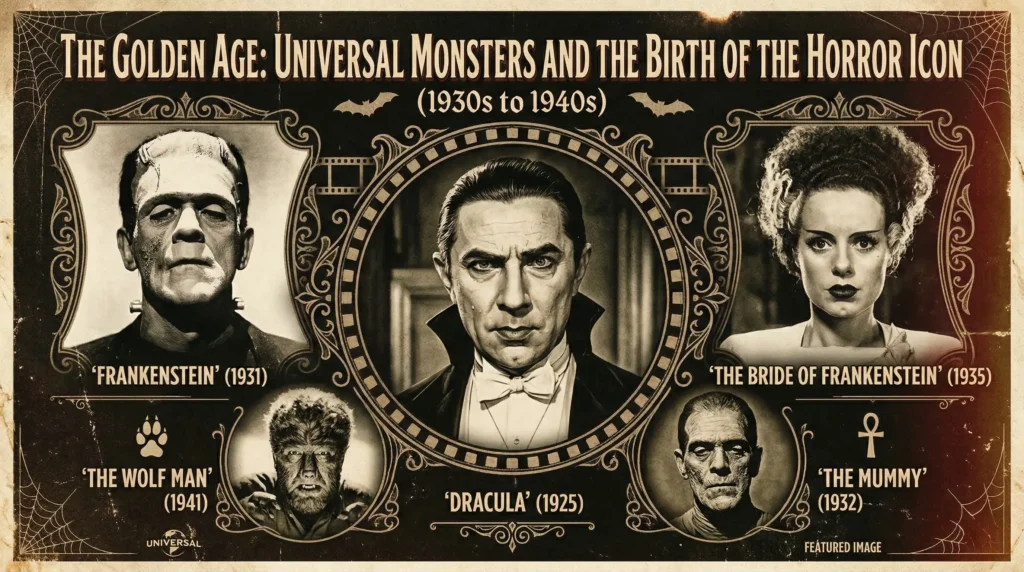
Dracula opened on February 14, 1931, and Frankenstein followed on November 21 of that year. Together they established the dual mythology that Universal would spend the next fifteen years expanding, diluting, and eventually parodying.
Lugosi’s Dracula was sophisticated and seductive, an aristocratic predator from a dying world. His stiff bow and rococo accent projected the “louche decadence of a Continental libertine,” a quality that both fascinated and unsettled Depression-era audiences already primed to distrust foreign influence. But there was something more precise happening in that performance. Lugosi’s voice was a transnational cultural artifact in itself: his Hungarian accent constructed Dracula’s foreignness as a specific kind of threat, the old world arriving uninvited in the new one. The film asked Depression-era audiences to accept medieval superstition on-screen, and its creators understood that an outside force intruding on ordinary life carried a subconscious charge for a public that already felt helpless against destructive forces it couldn’t see or name.
Frankenstein cut the other direction entirely. Boris Karloff, cast after Lugosi famously declined the non-speaking role, used expressive facial movements and a stiff, lumbering gait to convey a creature in pain. This was not a villain. It was a being that never asked to exist and was punished by society for the crime of being different. Audiences identified with that. In 1931, a lot of people understood what it felt like to be rendered powerless and rejected by a system that had no place for them.
The makeup that made Karloff into the Monster was the work of Jack Pierce, and it deserves its own accounting. Pierce’s application process could take many hours, consuming significant chunks of the shooting day and contributing real physical strain to Karloff’s performance. The flat head, the neck bolts, the sunken eyes: these weren’t costume elements. They were a design language that became so thoroughly absorbed into the culture that the image exists independently now, recognized by people who have never seen the film. Pierce’s artistry was inseparable from how the studio scheduled, lit, and shot its monsters. The icon was always, at root, a production problem that got solved with extraordinary craft.
The film also ran into censorship immediately. A line in which Dr. Frankenstein exclaims “Now I know what it is like to be God!” was removed before release as blasphemy. The cut is useful evidence for something the films understood intuitively: “scientific overreach” was legible in 1931 as moral transgression, not just narrative consequence.
What the Monsters Meant
The Universal monster cycle was doing something more than providing Depression-era escapism, though it was doing that too. These films were working through genuine cultural anxieties, and the craft choices reinforced the themes whether the filmmakers intended them to or not.
Frankenstein operated within the era’s debates about the ethics of science, drawing on Romantic-era conflicts between materialism (life as mechanical function, explicable and replicable) and vitalism (life requiring a spark that science cannot manufacture). Dr. Frankenstein treats the human body as raw material. The film treats that impulse as catastrophe. The electrical spectacle of the creation scene, built around Kenneth Strickfaden’s high-voltage machines, was not only narrative: it was a pre-CGI special effects ritual that cinema has returned to compulsively ever since, precisely because it captures something true about the terror of creation without responsibility.
The Invisible Man (1933) made the ethics argument even more starkly. When Dr. Griffin, freed from the gaze of society, abandons all social accountability, the film is dramatizing interwar anxieties about authoritarianism with a specificity that registers as almost prescient. The Library of Congress quotes Griffin’s own confession: “I meddled in things that man must leave alone.” That line is doing a lot of work in a short space.
The Mummy (1932) operated differently, as a “Machine Age” story about modern science compartmentalizing and demystifying the past, turning the modernist urge toward cataloguing and containing history into horror via literal and figurative confinements: tombs, cases, boxes, rooms. The monster wasn’t a supernatural threat so much as a symbol of everything the modern world had decided it could understand, only to discover it could not.
The Wolf Man (1941) arrived late in the cycle but delivered the final great mythological statement. Larry Talbot, cursed by a werewolf bite and destroyed by forces beyond his control, was Greek tragedy in Universal horror clothing. The film’s werewolf lore, including the wolfsbane poem and the silver bullet, became so thoroughly embedded in popular mythology that audiences treat it as ancient tradition. It was written in 1941 by screenwriter Curt Siodmak, a German Jewish refugee who had fled the Nazis. The themes of being marked for destruction by one’s own nature, of being something that society cannot accommodate, arrived from a very specific historical experience.
The Peak: Bride of Frankenstein
James Whale’s Bride of Frankenstein (1935) is where the Universal cycle reaches its artistic summit, and it does so by refusing to play it straight.
Whale, given complete creative freedom by Laemmle Jr., infused the film with Gothic horror, dark humor, and romantic tragedy operating simultaneously. The Bride herself, with her iconic lightning-bolted hair and bandaged gown, is on-screen for perhaps three minutes and became one of the most recognizable images in cinema history. Her immediate, wordless rejection of the Monster spoke to manufactured domesticity and arranged obligation in terms the censors somehow missed entirely.
Franz Waxman’s original score for Bride represented a technical and artistic leap that the Universal cycle hadn’t previously attempted. Where Dracula weaponized silence and Frankenstein used music sparingly, Waxman created a full through-composed score built on leitmotifs, with distinct recurring themes for the Monster, for Dr. Pretorius, and for the Bride. He used “flutter-tonguing” brass and pulsating timpani to mimic a faulty heartbeat during the creation sequence. Waxman’s work earned him a Universal contract, and pieces of the score were recycled in later Universal productions, which tells you something about how the studio understood what he had built: not just a score, but a sonic repertoire for the entire monster brand.
The contrast with Dracula four years earlier is worth dwelling on. Universal was deliberately building a grammar of sound-based horror, using silence and presence as complementary tools depending on what the film required.
The Karloff-Lugosi Years
The mid-1930s produced a series of films pairing Boris Karloff and Bela Lugosi, two icons marketed together precisely because their styles were so different. Karloff’s gaunt, melancholy reserve against Lugosi’s flamboyant, self-absorbed menace. They were called the “Garbo and Dietrich” of the horror genre, which is either marketing genius or the most accurate description of what was actually happening on-screen, depending on how much credit you want to give the Universal publicity department.
The Black Cat (1934) pitted them against each other in a tale of Satanism and revenge. The Raven (1935) gave Lugosi a Poe obsession and turned Karloff into a reluctant accomplice. The Invisible Ray (1936) flipped the expected dynamic entirely, casting Lugosi as a sympathetic supporting character while Karloff descended into paranoia. The pairing allowed for consistent subversion of villainy, keeping audiences off-balance about which of the two represented the genuine threat in any given film.
Karloff’s ability to convey humanity beneath the monstrous facade gave him the longer career trajectory. Lugosi struggled with Hollywood’s perception of his language skills, a tendency toward theatrical excess that producers didn’t always know how to use, and a drift toward lesser B-grade productions that accelerated his decline even as Karloff’s reputation continued to grow. The divergence of their careers in the late 1930s is a small tragedy inside the larger story of the cycle.
The Hiatus and the Return
Something important happened in 1936 that film histories often get wrong. Universal pulled back from horror production almost completely, and popular accounts blamed a supposed British ban on horror films. The evidence doesn’t support that narrative. What actually drove the two-year abandonment of the genre was pressure from the Production Code Administration, which had been campaigning against horror content with increasing effectiveness. The Laemmle family also lost control of the studio to its creditors in 1936 after overspending, which didn’t help.
The comeback was triggered by a 1938 double-bill reissue of Dracula and Frankenstein, which demonstrated that demand for the monsters hadn’t disappeared. Universal fast-tracked Son of Frankenstein (1939), and the sequel engine re-engaged. The studio had learned something useful: the monsters were recombinable properties. Individual character depth mattered less in the second phase than the combinatorial logic of the “monster rally,” where multiple icons shared a single narrative.
House of Frankenstein (1944) and House of Dracula (1945) were commercially successful precisely because they treated their monsters as brand assets rather than characters. The emotional depth that had made the early films resonate was largely absent. What the rally films delivered instead was the pleasure of recognition, which is a lesser thing, but a durable one.
The War and the Dissolution
The onset of World War II made supernatural vampires and werewolves feel inadequate as vessels for fear, and the genre sensed it. The reality of mass death, of extermination camps, of the atomic bomb: these were horrors that no monster could scale to meet. The Universal stable didn’t disappear so much as become inadequate to the moment.
Abbott and Costello Meet Frankenstein (1948) is usually treated as the moment the monsters died. That’s slightly too neat. What it actually marked was the completion of a process already underway: the monsters had become familiar enough to be funny, which is what happens to fears that a culture has finished processing. Comedy is how you bury what used to scare you.
The Pivot: Domestic Horror and Psychological Terror
The more interesting story of 1940s horror is not the decline of the Universal cycle but what replaced it. The locus of fear relocated: from Gothic European castles to American homes, from external supernatural threats to internalized psychological ones.
Alfred Hitchcock’s Shadow of a Doubt (1943) literalized this relocation by placing a psychopathic killer inside a cheery California suburb, filming substantial portions of the production in Santa Rosa. Uncle Charlie, the Merry Widow Killer, looks like a neighbor. He looks like a loved one. He looks, in the film’s most unsettling sequences, like he might not be wrong about some of the things he says. The monster is no longer an easily identifiable “Other” from a foreign land. He’s sitting at the dinner table and passing the salt.
Gaslight (1944) took the domestic threat even further inward, depicting a husband systematically manipulating his wife into doubting her own sanity. The film gave English a new word. “Gaslighting,” traced directly to Patrick Hamilton’s 1938 play and its film adaptations, entered the psychological vocabulary as a description of manipulation designed to make a victim distrust their own perceptions. That the term is still in active use today, applied to everything from abusive relationships to political rhetoric, measures the depth of the nerve the film struck. Horror had moved inside the mind.
Val Lewton’s unit at RKO Pictures represented a parallel evolution. Working with modest budgets that prevented elaborate monster effects, Lewton and directors like Jacques Tourneur developed a cinema of implication and negative space. Cat People (1942) eschewed on-screen transformations entirely, using shadows, sound, and narrative ambiguity to generate dread. The “Lewton Bus,” a jump scare built around a sudden harmless sound rather than a genuine threat, established the “false scare” as a formal technique. More importantly, Lewton proved that the most effective horror existed in the viewer’s imagination rather than on the screen. Universal had built icons you could see. Lewton built the space around them.
The contrast defines the decade’s transformation cleanly. Universal’s Golden Age constructed visible, definable monsters and gave them mythological weight. The 1940s pivot internalized the threat, finding horror in the domestic sphere, in the unreliable narrator, in the gap between what is shown and what is implied. The beast within, which The Wolf Man had externalized through physical transformation, became the madness within in the films of Lewton and Hitchcock.
What It Left Behind
The technical infrastructure of the Golden Age established industry standards that persisted long after the monsters themselves faded. Jack Pierce’s makeup artistry set the template for creature design. Jack Foley’s work at Universal on synchronized sound effects created a discipline and a vocabulary that every horror film made since has drawn on. John P. Fulton’s invisibility effects for The Invisible Man, achieved through black velvet keying and laboratory work, prefigured the matte systems that would dominate effects work for decades. Waxman’s leitmotif scoring gave horror a musical grammar that Bernard Herrmann and John Carpenter and dozens of others extended into new territory.
But the more durable legacy is thematic. Universal’s monsters were effective because they were always about something beyond their scares. The tragic outcast. The scientist who didn’t stop to ask whether he should. The outsider punished for being different. The forces that destroy you before you understand what they are. These weren’t Depression-era anxieties in period costumes. They were permanent anxieties in period costumes, which is why the genre has never stopped reaching for them.
The Golden Age proved that horror was a serious medium for exploring the human condition. Every horror film made since has been working with that proof of concept, often without acknowledging it, which is the sincerest form of influence there is.