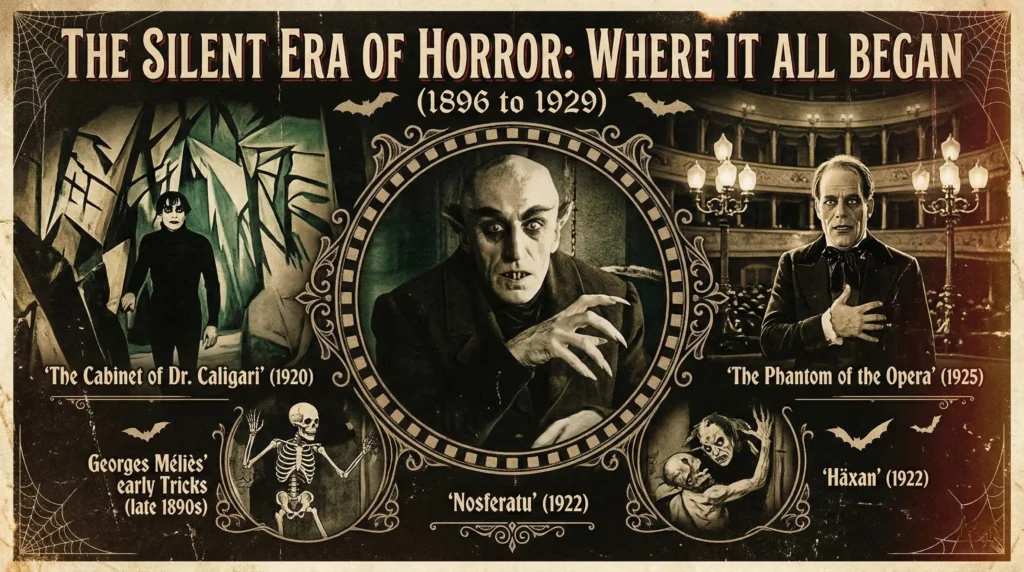
Horror did not wait long to find the movies. Just one year after the Lumière brothers introduced projected film to the world, a French stage magician named Georges Méliès pointed a camera at a painted castle set and conjured the devil himself. That film, Le Manoir du Diable (1896), is now universally recognized as the first horror movie ever made, and the fact that it came so quickly says something important: the urge to frighten an audience is as old as storytelling itself. Cinema just gave that urge a terrifying new set of tools.
The thirty-three years between Méliès’s haunted castle and the close of the silent era were not a primitive warm-up for the “real” horror movies that came later. They were a period of genuine artistic invention, technical experimentation, and cultural reckoning. The foundations of the genre, its shadows, its monsters, its psychological depth, were poured in silence.
Georges Méliès and the Magic of Early Terror
Méliès came to filmmaking as a professional illusionist and theater owner, and he approached the camera the way a magician approaches a new trick: what can this thing do that nothing else can? His answer arrived by accident. While filming at the Place de l’Opéra in the autumn of 1896, his camera jammed mid-shot. When he processed the footage, he discovered that the subjects in the frame appeared to instantaneously transform, a horse-drawn bus becoming a hearse in a single cut. He called this the stop-trick, and he immediately put it to work.
In Le Manoir du Diable, Méliès used the stop-trick to make a giant bat transform into Mephistopheles, and then to populate the screen with skeletal apparitions and vanishing demons. The film runs only about three minutes, but it introduced motifs that the horror genre would never abandon: the Gothic castle with hidden rooms, the supernatural creature capable of transformation, and the use of religious iconography to repel evil. The film’s climax, where the hero drives off the devil with a large crucifix, prefigures the vampire subgenre by decades.
What made Méliès genuinely revolutionary was his understanding that cinema’s greatest power was not replication but distortion. While others were filming trains arriving at stations, he was filming hell. His later work deepened the craft: Le Chaudron Infernal (1903) used painstaking hand-tinting, where technicians painted individual frames to produce green demons and orange fireballs, adding a visceral pop to his macabre visions that black-and-white photography could never achieve. Méliès established what film theorists would later call the “theater of attractions,” a cinema where the spectacle of the impossible was the entire point. Everything else in horror cinema grew from that idea.
The Grand Guignol and the Roots of Physical Horror
While Méliès was perfecting supernatural fantasy, a different kind of horror was thriving in a converted chapel in Paris’s Pigalle district. The Théâtre du Grand-Guignol, founded in 1897, was the most influential theatrical institution the horror genre has ever had, and almost nobody outside of film scholarship talks about it enough.
Under director Max Maurey, the Grand Guignol developed a performance philosophy built around maximum physiological impact. Maurey reportedly measured a production’s success not by ticket sales but by the number of patrons who fainted or vomited in their seats. The effects that produced those reactions were technically sophisticated: retractable knives that squirted stage blood, artificial blood formulated in nine distinct shades of coagulation, and meticulously rehearsed simulations of eye-gougings and dismemberment. The theater pioneered what Maurey called the “hot and cold shower” technique, alternating short, gruesome dramas with light comedies to keep audiences in a constant state of emotional whiplash.
The Grand Guignol’s most lasting contribution to horror was thematic rather than technical. Its plays focused relentlessly on the “evil doctor” and the “mad scientist,” exploiting contemporary anxieties about rapid advances in medicine and psychology. Productions like A Crime in the Mad House and The Laboratory of Hallucinations suggested that science, unchecked by morality, was as monstrous as any supernatural creature. That idea moved horror away from external demons and toward the internal horrors of the human mind and the physical vulnerability of the body. When Edison Studios adapted Frankenstein in 1910, and when German Expressionism later populated its films with tyrannical psychiatrists and uncontrollable surgeons, the Grand Guignol’s influence was unmistakable.
The theater also gave horror cinema one of its foundational archetypes. Paula Maxa, known to Parisian audiences as “the most assassinated woman in the world,” reportedly died over 10,000 times on stage in various gruesome ways across her career. She established the physical and emotional vocabulary of the horror victim, the language of the body under threat, that silent film would adopt and refine.
Literary Horror and the First Feature Films (1910 to 1919)
As cinema matured from short “attractions” into structured narrative features during the 1910s, horror found its most reliable source material in the Gothic literary tradition. Mary Shelley, Robert Louis Stevenson, Bram Stoker, and Edgar Allan Poe had already done the work of building compelling monsters and terrifying situations. Early filmmakers borrowed those frameworks and focused their energy on the challenge of translating literary dread into a purely visual medium.
The Edison Studios production of Frankenstein (1910), directed by J. Searle Dawley, was the first significant American horror feature and a landmark in adaptation. The production deliberately softened Shelley’s biological horror, positioning the creature less as a scientific abomination and more as a projection of Victor Frankenstein’s “evil mind,” a psychological double rather than a physical monstrosity. The creation scene, where the monster coalesces from flames and ash, used reverse photography of a burning dummy to create an image that was genuinely uncanny even by modern standards. The film was considered lost for decades, and its rediscovery in Wisconsin in the 1970s from a single surviving nitrate print is itself a small miracle of preservation.
Italy contributed what is arguably the first true horror epic with L’Inferno (1911), a 72-minute adaptation of Dante’s Divine Comedy that used massive sets and hundreds of extras to depict the layers of hell with relentless visual literalism. The film included decapitated figures carrying their own heads, bodies twisted into grotesque configurations, and the first instance of full-frontal male nudity in American theatrical exhibition. Its status as an adaptation of canonical classical literature gave it a kind of cultural protection that allowed it to bypass the moralistic censorship that constrained more popular genre fare. L’Inferno proved that horror was capable of prestige, and that cinematic spectacle could serve the highest ambitions of classical storytelling.
Throughout the decade, studios worked through the Gothic canon systematically: multiple versions of Dr. Jekyll and Mr. Hyde, adaptations of Poe’s asylum stories, and early attempts at Notre-Dame de Paris. Each production added to the growing grammar of horror filmmaking, working out how to externalize internal states, how to make a human body register as monstrous, and how to build dread across the duration of a feature-length narrative.
German Expressionism: Horror as Post-War Wound
Nothing in the silent era changed horror cinema more profoundly than the catastrophe of World War I. Specifically, what it did to Germany. By 1919, the country had lost two million soldiers, endured national humiliation, and was descending into the political and economic chaos of the Weimar Republic. The artists and filmmakers who emerged from that wreckage were not interested in creating entertainment. They were trying to make visible something that had no adequate language: collective psychological trauma on a civilizational scale.
German Expressionism answered that challenge by rejecting naturalism entirely. If the world had revealed itself to be a distorted, irrational, and terrifying place, then film should look like that. Sets were built at impossible angles and painted with shadows that did not correspond to any light source. Camera angles were oblique, canted, deliberately disorienting. Lighting was stripped down to brutal contrasts of black and white, with the mid-tones that give the face its humanity largely eliminated. The style was not ornamental. It was diagnostic.
Robert Wiene’s The Cabinet of Dr. Caligari (1920) is the defining work of the movement. The film’s writers, Hans Janowitz and Carl Mayer, were pacifists who drew from their personal distrust of military authority to craft a story about a hypnotist who compels an innocent somnambulist to commit murders on his behalf. The visual designers, Hermann Warm, Walter Reimann, and Walter Röhrig, painted shadows and highlights directly onto the sets, creating an environment where the physical world itself appeared to be lying. Contemporary critics coined the term “Caligarisme” for this approach, recognizing it as something genuinely new: a cinema where the architecture of the frame was an argument about the architecture of power.
F.W. Murnau took a different approach in Nosferatu: A Symphony of Horror (1922). Where Wiene built distortion in the studio, Murnau found it in the real world. He shot on location in actual castles, forests, and port towns, but used light and framing to make them feel alien and diseased. Max Schreck’s Count Orlok was a radical reimagining of the vampire, stripping away every trace of aristocratic romanticism to reveal something closer to a plague rat walking upright: long-nailed, hunch-shouldered, with a face like a skull that had grown skin. Orlok did not seduce; he crept. The film’s unauthorized adaptation of Stoker’s Dracula resulted in a lawsuit from Stoker’s widow that nearly led to the destruction of every existing print. The fact that it survived is either luck or fate, depending on your temperament.
The Expressionist movement also explored what might be called the horror of the body without agency. Paul Wegener’s The Golem: How He Came into the World (1920) drew from Jewish folklore to depict a clay figure animated by mysticism and then turned to destructive ends by the authorities who created it. Robert Wiene’s The Hands of Orlac (1924) starred Conrad Veidt as a pianist who receives the hands of a murderer in a transplant, and who becomes convinced, with mounting horror, that his new limbs possess a murderous will of their own. In both films, the monster is not an external threat so much as a loss of control over one’s own body, a fear that resonated with devastating precision for veterans who had returned from the trenches with shattered nervous systems and bodies that no longer felt like their own.
Lon Chaney: The Man of a Thousand Faces
American horror during this period was, to a degree that is difficult to overstate, the story of one man. Lon Chaney, born Leonidas Frank Chaney in 1883 to Deaf parents, developed an extraordinary facility for physical expression and pantomime out of necessity, learning to communicate entirely through his body from childhood. That foundation gave him a capacity for transformation that no one in cinema has matched before or since.
Chaney had no formal makeup department. He invented his own techniques, devised his own prosthetics, and subjected his body to genuinely painful procedures in the service of a role. For The Penalty (1920), in which he played a legless criminal, he wore a harness that bound his legs behind him and walked on his knees across hard floors. For The Hunchback of Notre Dame (1923), he wore a rubber hump that weighed fifty pounds, along with wax and prosthetics applied to distort his facial structure to match Victor Hugo’s descriptions. For The Phantom of the Opera (1925), his “living skull” effect was achieved by painting his eye sockets black, inserting wires that pulled his nose upward, and wearing jagged false teeth that deformed the shape of his mouth. Contemporary accounts report that the unmasking scene in Phantom caused audiences to scream and faint, making it one of the earliest documented instances of a genuine jump scare producing a mass physical reaction in a theater.
What elevated Chaney beyond mere technical virtuosity was his insistence on treating his characters with empathy. He was drawn consistently to the marginalized and the physically “othered,” and he found in those figures not grotesque spectacle but tragic humanity. His collaboration with director Tod Browning at MGM produced some of the most unsettling work of the era, including The Unknown (1927), in which Chaney played an armless knife-thrower in a circus whose elaborate concealment of his true identity leads to an act of permanent self-destruction. The film’s logic, driven by obsession, desire, and the grotesque lengths a person will go to in order to be loved, is genuinely disturbing in ways that have nothing to do with conventional horror mechanics.
Chaney’s expertise was eventually considered so authoritative that he wrote the entry on “Makeup” for the 1929 Encyclopedia Britannica. His influence on the actors who followed him was direct and documented; Boris Karloff, who would define the Universal Monster era of the 1930s, was among those Chaney personally mentored. Chaney died in 1930, shortly after completing his only talking picture, and the loss to the genre was incalculable.
Scandinavia, Folk Horror, and the Horror Documentary
While Hollywood was building stars and Germany was processing trauma, Scandinavian filmmakers were doing something that had never been attempted: using the horror genre as a vehicle for scholarly investigation.
Benjamin Christensen’s Häxan: Witchcraft Through the Ages (1922) remains one of the most genuinely strange and remarkable films of the silent era. Produced by Svensk Filmindustri with a budget of nearly two million Swedish kronor, making it the most expensive Scandinavian silent production ever made, Häxan combined a “magic-lantern lecture” format using historical woodcuts and illustrations with vividly realized dramatizations of witches’ sabbaths, demonic visitations, and Inquisition torture. Christensen himself appeared in the film as a tongue-waggling Satan, giving the production a transgressive, anarchic energy that resulted in it being banned or heavily censored in several countries including the United States.
The film’s thesis was genuinely provocative for its time: the women burned as witches during the Inquisition were not practitioners of the occult but victims of mental illness, and modern psychiatry represented an enlightened replacement for religious persecution. Viewed today, that conclusion lands with a chilling irony that Christensen could not have anticipated, given the history of psychiatric abuse that followed. Häxan essentially invented the horror documentary and pointed toward the “essay film” form that would become increasingly important in avant-garde cinema.
Victor Sjöström’s The Phantom Carriage (1921) worked in a different register, using sophisticated multiple-exposure photography to create a ghost story about a man who learns that the last soul to die on New Year’s Eve is cursed to drive Death’s carriage for an entire year. The film’s spectral imagery, with its ghostly horse-drawn carriage moving through luminous Swedish landscapes, was technically years ahead of anything being produced elsewhere. Ingmar Bergman has cited it as one of the formative influences on his entire body of work.
Japan and the Avant-Garde Asylum
In Japan, the silent era developed along a fundamentally different track. The cultural institution of the benshi, professional narrators who stood beside the screen providing live dialogue and commentary, freed Japanese filmmakers from the constraint of legible storytelling through intertitles alone. The result was a cinema of extraordinary visual experimentation.
Teinosuke Kinugasa’s A Page of Madness (1926), produced by the avant-garde Shinkankakuha movement, took that freedom to its logical extreme. The film, set in a rural mental asylum and following a janitor who has taken the job to be near his institutionalized wife, contains no intertitles at all. Its narrative is communicated entirely through double, triple, and quadruple exposures, aggressive fast cutting, and camera movements designed to reproduce the subjective experience of psychosis rather than describe it from the outside. The cinematography was handled by Kōhei Sugiyama, with a young Eiji Tsuburaya, later the creator of Godzilla, working as his assistant.
The film was lost for forty-five years until Kinugasa discovered a print stored in a rice barrel in his storehouse in 1971. Its influence on the J-horror movement that would terrify Western audiences in the 1990s and 2000s is substantial, particularly in its use of long, tangled black hair as a visual marker of supernatural menace, a motif derived from traditional kaidan ghost stories and Kabuki theater that A Page of Madness transferred directly into the film medium.
The Alchemy of Orthochromatic Film
The distinctive visual quality of silent horror was not entirely an artistic choice. Much of it was chemistry.
Until the early 1930s, film was shot on orthochromatic stock, which was sensitive only to the ultraviolet, blue, and green portions of the light spectrum. Yellow, orange, and red tones were rendered as near-black, which meant that blood, fire, and human lips all photographed as dark or completely black shapes. Blue eyes often appeared blank and spooky on screen, registering as pale or almost absent under the harsh studio arc lights of the era. Human skin photographed with a rough, heavily textured quality that emphasized every line and asymmetry of the face, making even relatively young actors look ancient and strange.
Makeup artists adapted to these constraints in counterintuitive ways. Actors commonly wore blue-toned greasepaint as a base to prevent their natural skin tones from registering as dirty or diseased under orthochromatic film. Max Factor’s development of “Flexible Greasepaint” in 1914 was a turning point, allowing more expressive performances under the demanding conditions of silent-era production. The transition to panchromatic film in the mid-1920s, which was sensitive to the full visible spectrum, opened up the atmospheric, more subtly graduated lighting seen in late silent masterpieces like The Cat and the Canary (1927) and The Man Who Laughs (1928).
Color was present in silent horror long before Technicolor. Tinting involved immersing a length of film in a dye bath to create an overall wash: blue for night scenes, red for fire and violence, green for ghostly or uncanny sequences. Toning was a chemical process that replaced the silver compounds in the darker areas of the frame with colored metallic compounds, leaving the lighter areas clear, effectively coloring the shadows while preserving the highlights. These processes were often layered, giving silent horror films a symbolic color grammar that guided audience emotion without dialogue: when the image turned blue-green, something supernatural was about to happen.
The Tragedy of Lost Films
The silent era cannot be discussed honestly without confronting the scale of what has been destroyed. Estimates suggest that up to eighty percent of all American silent films no longer exist in any form. The reasons are multiple and overlapping, but the primary culprit is nitrate film stock, the dominant recording medium until the early 1950s. Nitrate is chemically unstable and highly flammable. Stored improperly, it decomposes over time into a sticky or powdery mass that can spontaneously combust. Stored properly in controlled conditions, it has a reasonably long lifespan. Very little of it was stored properly.
Catastrophic archive fires destroyed enormous portions of the surviving record: the 1937 Fox vault fire, the 1967 MGM fire. But a significant number of films were not lost accidentally. Before television and home video created a commercial afterlife for old movies, studios viewed their silent-era back catalogs as having essentially no ongoing value. Prints were sold to scrap dealers or recycled for their silver content. Some were deliberately destroyed for financial purposes. Charlie Chaplin burned his own production A Woman of the Sea (1926) for a tax write-off.
The most famous loss in horror history is Lon Chaney’s London After Midnight (1927), the last known print of which perished in the 1967 MGM fire. What survives today is a reconstruction assembled from production stills and script pages, a shadow of a film haunting the archive where the film itself should be. Of Theda Bara’s forty films, only three and a half survive. The early horror catalog, the lost Dracula adaptations, the experimental shorts, the regional productions that never made it into major archives, represents a void that grows larger the more you look into it.
This is not merely a historical inconvenience. It means that our understanding of where horror came from is built on a fragmentary record, and that the full picture of what these early filmmakers invented may be irretrievable. The genre’s origins are, appropriately, partially lost in darkness.
The Foundation That Never Stopped Mattering
The silent era of horror established every major element that the genre would spend the following century elaborating. The stop-trick became special effects. The painted sets of Caligari became the production design philosophy of every horror film that has ever used architecture to externalize psychology. Chaney’s physical transformations became the makeup and prosthetics tradition that runs from Boris Karloff through Rick Baker to the present day. The Grand Guignol’s obsession with the evil scientist became every mad doctor film ever made. The kaidan traditions that fed A Page of Madness eventually produced Ring, Ju-On, and the J-horror movement that redefined the genre for a new generation.
These were not primitive films made by people who were trying to do what we do now but lacked the tools. They were sophisticated, formally ambitious works made by artists who understood exactly what they were doing and pushed their medium as far as it would go. The fact that most of them no longer exist makes the ones that survive feel almost unbearably precious.
The shadow that Murnau cast over a harbor in 1922 is still falling. The painted nightmares of Wiene’s jagged sets are still haunting us. Horror did not begin in silence and move toward something louder and more articulate. It began in silence because silence, it turned out, was exactly the right language for what the genre needed to say.