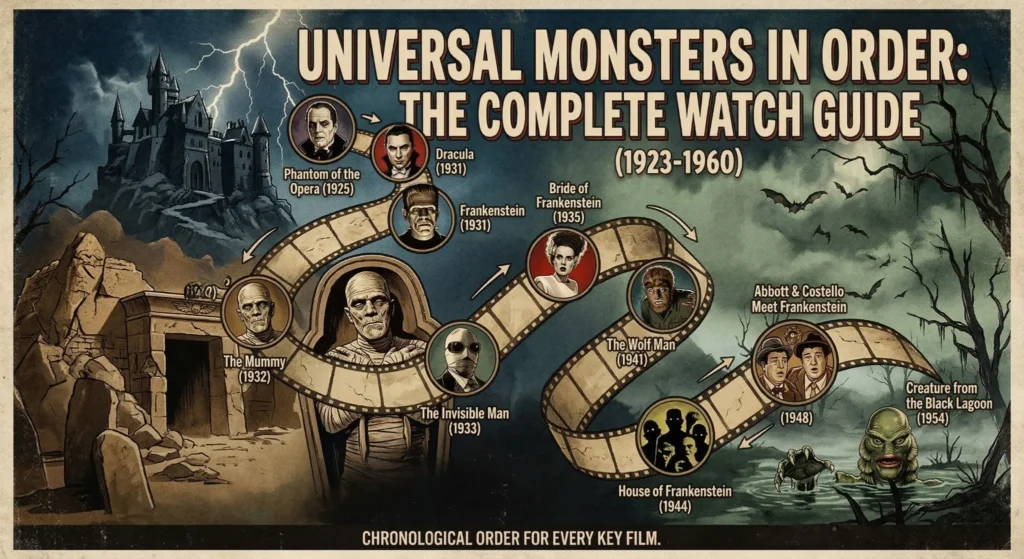
Before CGI. Before torture porn. Before the reboot cycle that has been strip-mining horror for twenty years and leaving nothing behind. There were thirty films made by Universal between 1923 and 1956, and they invented practically everything you think you know about monsters.
Not invented in the way a press release means invented. Invented in the way that a thing gets made for the first time and the world is different after it. Boris Karloff walked out of James Whale’s laboratory in 1931 with bolts in his neck and Jack Pierce’s makeup and something in his eyes that looked genuinely lost, and every monster that came after him has been trying to find that again.
This guide exists to help you find your way through Universal Monsters movies in order, from the 1931 originals through the final Gill-Man entry in 1956. Some of these films are essential. Some are interesting. Some are what happens when a studio is filling a release schedule and knows the audience will show up anyway. We will tell you which is which and we will not be polite about it.
Bela Lugosi descended a staircase in a castle in Transylvania that same year and became something that did not exist before him: the vampire as seduction, as inevitability, as a man who has all the time in the world because he has forever. The staircase. The cape. Those eyes.
Universal Monsters movies in order can be approached three ways: strict release date, narrative continuity within each monster’s own series, or a curated path that prioritizes quality and context. All three are here. Use whichever one matches where you are.
How to Watch Universal Monster Movies: A Quick Orientation
The first thing to understand is that Universal was not building a franchise in the way anyone today would use that word. Nobody sat in a room in 1931 with a whiteboard and mapped out twenty years of monster crossovers. They made Dracula. It made money. They made Frankenstein. More money. They kept going, and somewhere in the middle of it all they stumbled into something that had never existed before: a shared universe of horror characters that audiences came to know and love and mourn.
The Frankenstein series has the strongest internal continuity. From the original in 1931 through to 1945, there is a genuine through-line: the Monster passes from actor to actor, each film picks up something from the one before it, and the whole arc has a shape that rewards watching in order. It is not tight continuity. Characters die and come back without explanation. The Monster has been played by four different actors across the series and nobody thought to explain the transitions. But the emotional throughline is real, and if you follow it, you feel something at the end that you did not expect from a franchise about a man made out of body parts.
The Wolf Man films with Lon Chaney Jr. build on each other emotionally more than narratively. Larry Talbot is one of horror cinema’s genuinely tragic figures, a man who does not want what he has become and cannot escape it, and Chaney carries that weight across five films. By the end you have watched a man be destroyed by something he never asked for and you feel it.
The Dracula films are more self-contained. Each one works without the others. The Mummy and Invisible Man series have enough variation between entries that you can pick based on interest. And the Creature from the Black Lagoon trilogy is best watched as a unit, even though the quality drops hard after the first film and never quite recovers.
One more thing, and this matters: these films are short. Dracula is 75 minutes. Frankenstein is 71. Bride of Frankenstein is 75. You can watch the entire Golden Age of Universal horror in a single long afternoon, and at some point in your life, you should.
The Recommended Watch Order for First-Time Viewers
This is not a completist list. This is the curated path, the twelve films that reward new viewers most and establish everything you need to understand the full cycle. Approximately fifteen hours. The complete education.
- Dracula (1931) — Start here. Lugosi, Browning, the foundational text.
- Frankenstein (1931) — Same night if you can manage it. Karloff, Whale, Pierce’s creation.
- The Mummy (1932) — Karloff again in a completely different register. Karl Freund’s direction is extraordinary.
- The Invisible Man (1933) — Whale’s dark comedy. Claude Rains gives one of cinema’s great invisible performances.
- Bride of Frankenstein (1935) — The peak. Whale at full creative power. Not optional.
- Son of Frankenstein (1939) — Karloff’s farewell to the Monster. Lugosi as Ygor. Surprisingly great.
- The Wolf Man (1941) — Lon Chaney Jr. defining a monster. The emotional center of the Silver Age.
- The Ghost of Frankenstein (1942) — Bridge film. Chaney takes the Monster. Lugosi’s Ygor returns.
- Frankenstein Meets the Wolf Man (1943) — The first crossover. Required context for what follows.
- House of Frankenstein (1944) — Peak monster mash. Karloff plays the scientist now, not the Monster.
- House of Dracula (1945) — Direct sequel to House of Frankenstein. The crossover era winds down.
- Abbott and Costello Meet Frankenstein (1948) — The glorious, affectionate ending. Lugosi as Dracula one last time.
After these twelve, you have the full shape of the Universal Monsters franchise. Everything else is additions for the completist, the genre historian, or the devoted fan who has seen the twelve and wants more.
Complete Chronological Release Order
Every film in the core Universal horror cycle in release order, with runtime and a plain assessment. Essential means it belongs in any serious viewing. Optional means it rewards the curious. Skip means the studio was running out the clock.
| Year | Title | RT | Assessment | Verdict |
|---|---|---|---|---|
| 1923 | The Hunchback of Notre Dame | 93m | Lon Chaney’s first great Universal grotesque. Quasimodo, the bell-ringer of Notre Dame, in love with a woman who cannot love him back. Silent, but the emotional language translates completely and the physicality Chaney brings is something that cannot be faked or replicated with effects. | Optional |
| 1925 | The Phantom of the Opera | 93m | Chaney beneath the Paris Opera House. The unmasking scene burned itself into film history the night it screened and has never entirely cooled down. Public domain and freely available. The last great Chaney Universal horror. | Optional |
| 1931 | Dracula | 75m | Bela Lugosi becomes the Count. Browning stages it like a dream: static, hypnotic, completely under Lugosi’s spell. The film that started everything. Seventy-five minutes of a man making the camera believe he has lived forever. | Essential |
| 1931 | Frankenstein | 71m | Whale and Karloff together for the first time. Pierce’s Monster as tragedy before terror. One of the most important horror films ever made and it is not close. You feel the loneliness of the creature before you feel the fear, which is exactly right. | Essential |
| 1932 | The Mummy | 73m | Karloff as the resurrected Egyptian priest Imhotep. Karl Freund’s photography is extraordinary and the atmosphere overwhelms the plotting, which is absolutely a feature and not a flaw. A film about time as weight. | Essential |
| 1933 | The Invisible Man | 71m | Claude Rains’s voice acting tour de force. Whale’s dark wit makes a science fiction premise feel genuinely menacing. The effects hold up because they were built on craft rather than technology. | Essential |
| 1935 | Bride of Frankenstein | 75m | The best film in the series. Whale with full creative control. Elsa Lanchester as both Mary Shelley and the Bride. Dark and funny and genuinely moving in a way that nothing this studio ever made quite matched again. The Monster wants companionship and gets contempt, and somehow Whale makes you laugh and grieve at the same time. | Essential |
| 1935 | Werewolf of London | 75m | Universal’s first werewolf film, pre-Wolf Man, different mythology entirely. Henry Hull plays a botanist cursed in Tibet. Worth seeing as historical context for how the studio’s werewolf mythology evolved before Curt Siodmak rewrote the rules in 1941. | Optional |
| 1936 | Dracula’s Daughter | 71m | Gloria Holden as a vampire who hates what she is. Underrated, psychologically interesting, with striking proto-feminist and queer subtext that Universal would never have acknowledged and that the film absolutely contains anyway. | Optional |
| 1939 | Son of Frankenstein | 99m | Karloff’s final Monster. Basil Rathbone as the Monster’s son. Lugosi as Ygor, who is the film’s true engine and one of the great supporting performances in the series. Longer than it needs to be and better than it has any right to be. | Essential |
| 1940 | The Invisible Man Returns | 81m | Vincent Price in an early career role as a man wrongly accused who uses the invisibility formula to clear his name. More thriller than horror. Worth it for Price, who was finding his way toward something even then. | Optional |
| 1940 | The Mummy’s Hand | 67m | Introduces Kharis, the shuffling Mummy who replaces Karloff’s Imhotep for the rest of the series. Lower budget, mostly setup. The Mummy you want is Karloff. What follows is a different, lesser creature wearing the same bandages. | Skip |
| 1941 | The Wolf Man | 70m | Lon Chaney Jr. as Larry Talbot, cursed to become a wolf. Curt Siodmak’s screenplay invents most of what audiences believe is ancient werewolf mythology: the silver bullet, the pentagram, the full moon. None of it is ancient. Siodmak made it up and it stuck. Essential and legitimately great. | Essential |
| 1942 | The Ghost of Frankenstein | 67m | Chaney takes over as the Monster. Lugosi’s Ygor returns with a new scheme. The series is clearly declining in ambition but Lugosi holds it together almost by force of personality. Essential for continuity into the crossover films. | Essential |
| 1942 | The Mummy’s Tomb | 61m | Kharis comes to America. A continuation of The Mummy’s Hand with a fraction of the budget and none of the energy. Completists only. | Skip |
| 1942 | Invisible Agent | 81m | Wartime propaganda dressed as an Invisible Man sequel. The invisibility is a MacGuffin for a spy plot. Skip unless you have a specific interest in 1940s wartime pictures. | Skip |
| 1943 | Frankenstein Meets the Wolf Man | 74m | The franchise’s first crossover. Ilona Massey replaces Elsa Lanchester; Lugosi plays the Monster while Chaney plays Talbot. The seams show and the concept delivers. Something genuinely new happened here: two monsters, one film, a shared world clicking into place. | Essential |
| 1943 | Son of Dracula | 80m | Lon Chaney Jr. as Count Alucard. Yes, Alucard. Robert Siodmak directs with real atmosphere. Chaney is wrong for the role in ways that are interesting to watch, and the film works anyway, which is either a testament to the direction or to how much Chaney brought even when miscast. | Optional |
| 1943 | Phantom of the Opera | 92m | Lush Technicolor remake with Claude Rains and a focus on the opera more than the horror. Gorgeous to look at, not very frightening. Won Academy Awards for cinematography and art direction. Universal made it beautiful and forgot to make it scary. | Optional |
| 1944 | House of Frankenstein | 71m | Karloff as a mad scientist, not the Monster. The Monster, Wolf Man, and Dracula all present. Boris Karloff sharing a film with Boris Karloff’s most famous creation, playing a different character. The monster mash at its peak and there is something genuinely fun about watching the studio lean into exactly what it had become. | Essential |
| 1944 | The Mummy’s Ghost | 61m | More Kharis, this time in Massachusetts. The Mummy films after the original Karloff entry are a case study in diminishing returns made on a tightening budget with a shuffling monster who cannot run and cannot speak and generates no real dread. | Skip |
| 1944 | The Mummy’s Curse | 62m | The final Kharis entry, filmed back to back with The Mummy’s Ghost and slightly worse. | Skip |
| 1944 | The Invisible Man’s Revenge | 78m | Disconnected from the previous Invisible Man continuity and notably mean-spirited in a way that feels less like horror and more like the studio was angry at someone. | Skip |
| 1945 | House of Dracula | 67m | Follows House of Frankenstein directly. A doctor attempts to cure both Dracula and the Wolf Man simultaneously, which sounds like a premise and is mostly a delivery mechanism for getting all the monsters in the same building again. Essential for continuity as the crossover era closes. | Essential |
| 1948 | Abbott and Costello Meet Frankenstein | 83m | Lugosi as Dracula for the second and final time. Chaney as the Wolf Man. The comedy and horror balance better than they have any right to. A genuine classic on its own terms, not just as a joke about the end of an era, though it is that too. | Essential |
| 1951 | Abbott and Costello Meet the Invisible Man | 82m | A boxer wrongly accused of murder uses the invisibility formula to clear his name. Better than it sounds. The comedy is sharp and the premise fits the formula well. | Optional |
| 1954 | Creature from the Black Lagoon | 79m | Jack Arnold and the Gill-Man in his natural habitat, shot with underwater photography that is still extraordinary seventy years later. The last great Universal Monster movie. Everything about how the creature moves through water is right in a way that cost a lot of thought and care to achieve. | Essential |
| 1955 | Revenge of the Creature | 82m | The Gill-Man captured and brought to Florida for study. A step down from the original. Clint Eastwood’s film debut is here, uncredited, which is the most interesting fact about the movie. | Optional |
| 1955 | Abbott and Costello Meet the Mummy | 79m | The team’s last monster movie. Kharis in Egypt. Affectionately made and thin. A farewell to something. | Optional |
| 1956 | The Creature Walks Among Us | 78m | The Gill-Man surgically altered to breathe air. The series ends by dismantling its own creature, which is either a metaphor or what happens when you run out of ideas and still need to fill a release slot. Melancholy in the way franchise endings often are. | Optional |
Monster-Specific Watch Orders
If you only want to follow one monster through the full Universal cycle, these are the dedicated paths. Pick your monster. Start at the beginning. See where it goes.
The Dracula Films
- Dracula (1931) — The source. Lugosi at his most commanding.
- Dracula’s Daughter (1936) — Picks up immediately after the original. Gloria Holden, not Lugosi. A different angle on the same darkness.
- Son of Dracula (1943) — Lon Chaney Jr. as Count Alucard. Loose continuity with the original and worth watching for the atmosphere Siodmak creates.
- House of Frankenstein (1944) — John Carradine as Dracula in a brief but pivotal appearance.
- House of Dracula (1945) — Carradine again. The conclusive Dracula entry before the comedy era.
- Abbott and Costello Meet Frankenstein (1948) — Lugosi’s return to the role after seventeen years. The emotional ending of the Dracula cycle, which is not something anyone planned and is more affecting for it.
The Frankenstein Films
- Frankenstein (1931) — Karloff and Whale. The beginning of the thing.
- Bride of Frankenstein (1935) — The peak. Watch it immediately after the original if you can.
- Son of Frankenstein (1939) — Karloff’s farewell. Lugosi as Ygor, which is the performance of the film.
- The Ghost of Frankenstein (1942) — Chaney as the Monster. The continuity bridge.
- Frankenstein Meets the Wolf Man (1943) — The crossover. Lugosi as the Monster this time.
- House of Frankenstein (1944) — Monster mash. Karloff as the scientist.
- House of Dracula (1945) — Conclusion of the Monster’s arc across the crossover era.
- Abbott and Costello Meet Frankenstein (1948) — The comedic coda. Glenn Strange as the Monster. Lugosi as Dracula. The end of something.
The Wolf Man Films
- The Wolf Man (1941) — The introduction of Larry Talbot. The mythology starts here and nowhere else.
- Frankenstein Meets the Wolf Man (1943) — Talbot searches for a cure and finds Frankenstein’s notes instead.
- House of Frankenstein (1944) — Talbot continues his cursed journey through the crossover era.
- House of Dracula (1945) — A doctor finally attempts to cure Talbot’s lycanthropy.
- Abbott and Costello Meet Frankenstein (1948) — Chaney’s final Wolf Man appearance. A fitting farewell to a character he carried for seven years.
The Mummy Films
A word of warning before you commit to this one. The Mummy series is two completely different things sharing a name. The first film, Karloff, 1932, is legitimate horror cinema. What follows it in 1940 is a different creature entirely: Kharis, the shuffling, bandaged mummy who became Universal’s budget monster for the next four years. Watch the 1932 film as the essential it is. Everything after it is diminishing returns.
- The Mummy (1932) — Karloff as Imhotep. The original and the only truly great one in the series.
- The Mummy’s Hand (1940) — Introduces Kharis. A reboot more than a sequel.
- The Mummy’s Tomb (1942) — Kharis comes to America.
- The Mummy’s Ghost (1944) — Kharis in Massachusetts.
- The Mummy’s Curse (1944) — The Kharis cycle concludes.
- Abbott and Costello Meet the Mummy (1955) — The comedic epilogue.
The Creature from the Black Lagoon Films
Watch these as a unit. The drop in quality from the first film to the second is significant and the drop from the second to the third is worse. But watching the Gill-Man’s arc to its conclusion is worth it. The creature starts in his natural habitat, gets captured and studied, gets surgically altered to breathe air, and ends the series trapped between two worlds, belonging to neither. That is a tragic arc, even if the films delivering it are not equal to the first.
- Creature from the Black Lagoon (1954) — Essential. The Gill-Man at his peak and Jack Arnold at his best.
- Revenge of the Creature (1955) — The Gill-Man captured. Diminished but worth one watch.
- The Creature Walks Among Us (1956) — The final chapter. Bleak and stranger than its reputation suggests.
The Crossover Films Explained
Here is what nobody gives Universal credit for: they invented the shared universe. Not as a concept people articulated at the time, and not with any grand plan behind it, but as a fact of what they built. Marvel gets credit for something Universal did seven decades earlier with a fraction of the budget and none of the planning, which is a better story than what Marvel tells about itself.
Frankenstein Meets the Wolf Man in 1943 is the key document. Director Roy William Neill took characters from two separate film series and put them in the same physical space, implying that all the Universal monster films existed in a single shared world. The logic is shaky at best. The Frankenstein films are set in some vague nineteenth century Central European country. The Wolf Man is explicitly set in the early 1940s. Universal’s answer to this continuity problem was to simply not address it and trust that audiences would not care. Audiences did not care, which says something about what people actually want from their monster movies.
What the crossover films understood is that audiences had developed genuine feeling for these characters. Dracula and the Frankenstein Monster and the Wolf Man were not interchangeable horror units. They were specific creatures with specific histories that horror audiences had been following for over a decade. Putting them together was not just a stunt. It was a reunion.
To get full value from the crossover era, you need at minimum The Wolf Man (1941) and The Ghost of Frankenstein (1942) before you watch Frankenstein Meets the Wolf Man. For House of Frankenstein and House of Dracula, add Son of Dracula and Frankenstein Meets the Wolf Man to your preparation. The films are built on the assumption that you know these characters already, and they reward that knowledge.
Abbott and Costello Meet Frankenstein (1948) is the culmination and the conscious ending. All three principal monsters appear together in a comedy, with Bela Lugosi returning to the Dracula role for the first time since 1931. The studio had finally acknowledged what the franchise had become: beloved entertainment rather than genuine horror. They made that acknowledgment into a film, and the film is funny, and Lugosi is Dracula in it one last time, and if you have followed the whole series there is something in that final appearance that hits you somewhere unexpected. Nobody planned it that way. It happened anyway.
Films to Skip vs. Films Worth Your Time
The honest accounting, for anyone who wants maximum quality for minimum time invested.
The Essential Eight: Start Here
- Dracula (1931): Lugosi. The foundational text. The beginning of everything.
- Frankenstein (1931): Karloff and Whale. The defining Monster.
- Bride of Frankenstein (1935): The peak of the entire cycle. The best Universal Monsters film made.
- The Invisible Man (1933): Whale’s dark comedy and Claude Rains making you believe in a man who isn’t there.
- The Wolf Man (1941): Chaney’s defining work and Siodmak’s invented mythology.
- Abbott and Costello Meet Frankenstein (1948): The perfect coda. Lugosi’s farewell.
- Creature from the Black Lagoon (1954): The last great Universal Monster movie.
- Son of Frankenstein (1939): Lugosi as Ygor, one of the great supporting performances in the series.
Add These for the Full Narrative Arc
- The Mummy (1932): Karloff’s atmospheric showcase. The film that proved he wasn’t just Frankenstein.
- The Ghost of Frankenstein (1942): Essential bridge from Son of Frankenstein into the crossover era.
- Frankenstein Meets the Wolf Man (1943): The first crossover. Required context.
- House of Frankenstein (1944): Peak monster mash. The crossover era at its most confident.
- House of Dracula (1945): The conclusive entry before the comedy era closes things out.
Skip Unless You Are a Completist
The Mummy’s Hand and its three sequels need to be talked about honestly. After Karloff’s 1932 original, Universal replaced Imhotep with Kharis, a shuffling, silent mummy who could not run and could not speak and generated no real dread. They then made four Kharis films in four years on budgets that shrank with each entry, as if the studio was actively daring audiences to lose interest. The Mummy’s Hand (1940) is the best of them and it is still a significant drop from the 1932 original. The Mummy’s Tomb (1942), The Mummy’s Ghost (1944), and The Mummy’s Curse (1944) are what happens when a studio runs a monster into the ground until there is nothing left.
Skip also: Invisible Agent (1942), which is wartime propaganda dressed as an Invisible Man movie. The Invisible Man’s Revenge (1944), which is severed from the series’ continuity and not very good. Son of Dracula (1943) is optional at best: Chaney was wrong for the role and interesting to watch being wrong, but it is not essential. The two late 1944 Mummy entries were filmed back to back and are nearly interchangeable in their mediocrity.
Where to Stream Every Universal Monster Movie Right Now
Streaming availability changes constantly. These listings reflect known availability as of early 2026. Always verify at JustWatch.com for current status in your region before you settle in.
Peacock (Best Single Platform)
Peacock is Universal’s own streaming platform and carries the largest single-platform collection of Universal Classic Monsters films. Frankenstein, Bride of Frankenstein, The Invisible Man, The Wolf Man, Son of Frankenstein, The Ghost of Frankenstein, Frankenstein Meets the Wolf Man, House of Frankenstein, House of Dracula, Abbott and Costello Meet Frankenstein, and the Mummy’s Hand through Mummy’s Curse are all available or have been recently. Dracula (1931) and Creature from the Black Lagoon availability varies so check current status before you go looking.
Tubi (Free, Ad-Supported)
Tubi has historically carried Creature from the Black Lagoon and rotating selections of classic Universal horror. The 1925 Phantom of the Opera and other older titles show up here regularly. Free entry point, worth checking.
YouTube (Free)
Universal has made select classic Monster films available on their Fear: The Home of Horror YouTube channel at various points. The 1923 Hunchback of Notre Dame and 1925 Phantom of the Opera are public domain and available from multiple sources on YouTube in varying restoration quality. The Internet Archive at archive.org is a reliable free source for public domain titles.
Physical Media
The Universal Classic Monsters: Complete 30-Film Collection is available on Blu-ray from major retailers and remains the definitive option. Individual films have received standalone 4K Ultra HD releases. Dracula, Frankenstein, Bride of Frankenstein, The Invisible Man, and Creature from the Black Lagoon have all received or been announced for 4K treatment. For the serious fan, the physical collection is the right answer. You want these films in the best version available. They have earned that.